
Label dispensing problems occur when a pressure-sensitive label does not separate from its release liner in a controlled way or does not transfer correctly to the product. The visible symptom may be a lifted label, a liner break, a missed container, a skewed placement, or a label that falls off later. Those symptoms do not necessarily have the same cause.
A pressure-sensitive construction combines facestock, adhesive, and release liner. Its dispensing behavior also depends on die-cut quality, label geometry, winding, storage, web tension, peel geometry, line speed, applicator timing, static, and the condition and presentation of the container. Troubleshooting therefore needs to identify where the failure starts before assigning it to the material or machine.
Machine access, threading, cleaning, jogging, and reduced-speed observation must follow the applicator manufacturer’s manual and the site’s safety procedures. Do not reach into a moving web or bypass guarding to improve the view of a fault.
Identify where the failure starts
Dispensing is the stage at which the liner changes direction around a peel edge and the label continues toward the container or transfer device. It should be distinguished from placement—the positioning of the dispensed label—and adhesion, which develops after the adhesive contacts the container.
Classify the symptom by its first observable location:
| Fault location | Typical observations | Starting questions |
|---|---|---|
| Unwind or web feed | Telescoped roll, edge damage, wandering web, loose layers, splice disturbance | Is the roll wound and mounted as specified? Is the damage limited to one roll or roll position? |
| Before the peel edge | Labels lift early, adhesive contacts machine parts, liner breaks, labels remain attached to matrix remnants | Is there edge ooze, die-cut damage, excessive curl, or unstable tension? |
| At the peel edge | Label follows the liner, separation varies, label stop position changes | Are web path, peel-edge condition, label geometry, tension, and speed within the machine’s documented setup? |
| Transfer to container | Label dispenses but misses, rotates, folds, or clings to a component | Are timing, sensors, container presentation, air assistance, tamp or wipe action, and static behavior repeatable? |
| After contact | Edge lift, sliding, wrinkling, flagging, or complete detachment | Is this an adhesion or container-contact problem rather than a dispensing failure? |
As a first response, stop the line under the approved procedure and preserve the affected roll rather than rewinding, cutting, or discarding all evidence. Record the machine settings, line speed, time, container, roll identity, and environmental conditions. Photograph the roll and web path without changing the setup. Observation at reduced speed should occur only where the machine documentation and site procedure permit it.
Check the roll, web path, and release behavior
Start with conditions that can be seen without dismantling the applicator. Look for telescoping, crushed or nicked edges, loose winding, offset layers, contamination, unusual curl, damaged cores, irregular splices, and missing labels. Confirm winding direction, web width, core size, maximum roll diameter, label pitch, and orientation against the order and applicator specification.
A roll may look acceptable while still having uneven tension through its width or diameter. Conversely, a visually imperfect roll is not proof of the root cause. Compare the location of the fault with the roll circumference and repeat length. A problem that recurs at a fixed interval may suggest a converting or roll defect; a fault that changes with acceleration, speed, or roll diameter may point toward web control. These are investigation clues, not conclusive diagnoses.
Trace the liner through the specified web path and verify that unwind, guides, peel edge, and take-up arrangement match the machine documentation. Changes made during a previous job can remain hidden in a setup. Record tension or brake settings as displayed, but do not apply a universal target: suitable tension depends on the liner, web width, roll construction, machine, speed, and path.
Release is also a property of the complete laminate under particular conditions. The adhesive must release from the liner at the peel edge, but remain with the facestock. That interaction can change with speed, peel geometry, temperature, storage history, and material conditioning. A generic description such as “paper label” or “permanent adhesive” is not enough to establish expected release behavior.
Check the exact laminate datasheet and supplier instructions for storage, conditioning, shelf life, and intended dispensing conditions. If rolls were moved from a substantially different storage environment, document how long they were conditioned before use rather than assuming they had reached the production-room temperature.
Separate facestock, adhesive, liner, and label-shape effects
Each part of the pressure-sensitive construction affects the mechanics of dispensing.
Facestock: Stiffer facestocks tend to resist following the liner around a sharp change in direction, while thin or flexible materials may conform more readily to the liner path. That does not make stiffness universally better. A stiff construction may be unsuitable for a tightly curved container, and a flexible film can dispense successfully when the liner, geometry, and applicator are designed for it.
Adhesive: Adhesive chemistry and coat construction affect release and edge behavior. Soft or disturbed adhesive may appear at label edges and contaminate the web path, but visible residue should be verified rather than automatically described as adhesive ooze. Temperature, winding pressure, storage, die-cutting, and the laminate construction can interact to produce similar evidence.
Release liner: The liner carries the labels through printing, converting, rewinding, storage, and application. Its strength, caliper, dimensional stability, release coating, and surface condition influence web handling and separation. Paper and film liners can both perform effectively when properly specified. Neither category is inherently suitable for every machine or label geometry.
Label geometry: Small labels, narrow labels, acute leading points, irregular shapes, and labels oriented differently on the web can present distinct separation behavior. Corner radius, label length in the machine direction, gap, pitch, number across, and matrix pattern should all be recorded. A shape that runs reliably in one orientation may not behave identically after rotation.
When comparing constructions, change one documented variable at a time where an approved trial is practical. A roll with a different adhesive may also have a different liner or facestock, making an uncontrolled comparison difficult to interpret.
Inspect die-cutting, matrix removal, and rewinding
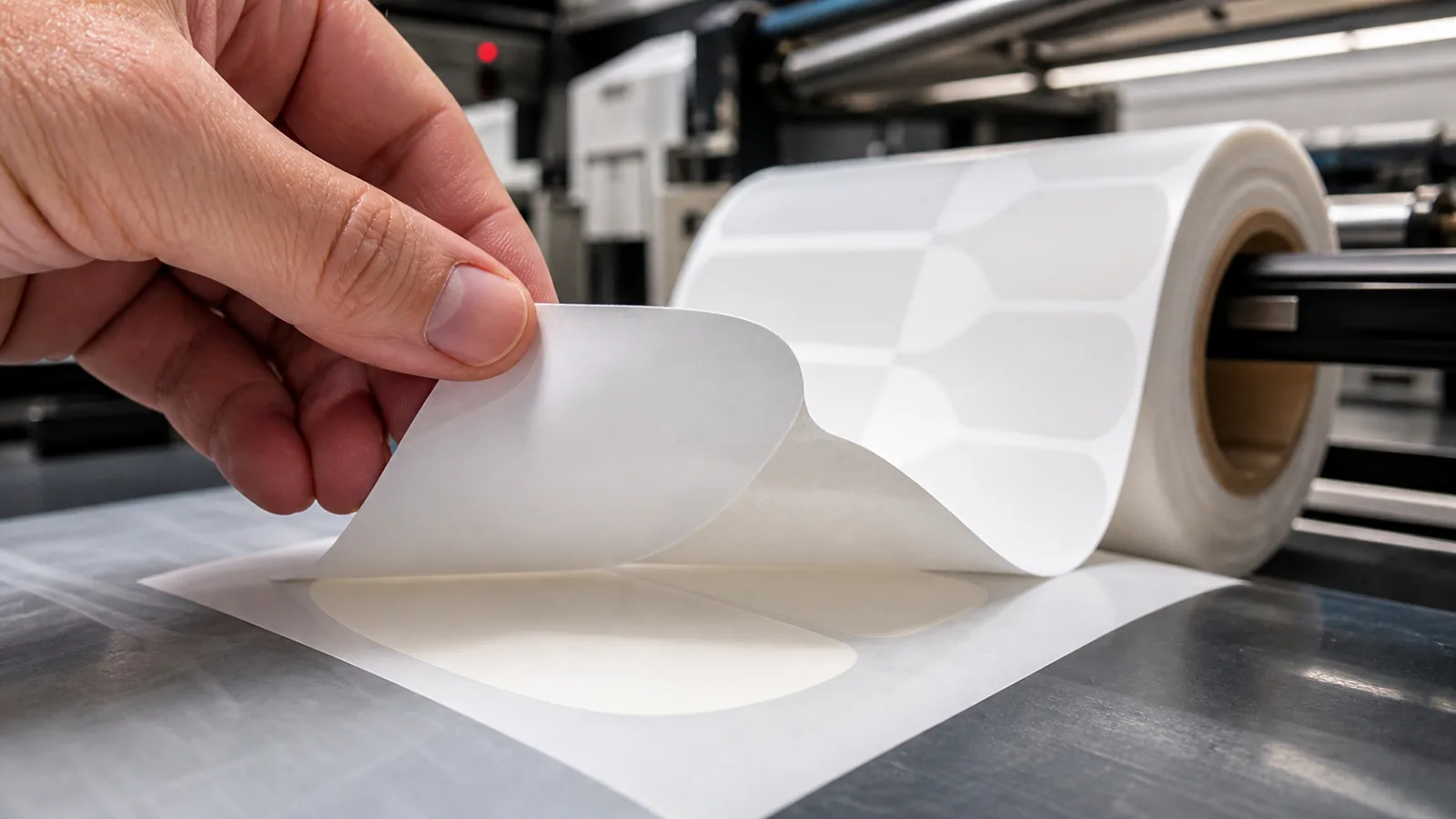
In conventional pressure-sensitive converting, the die is intended to cut through the facestock and adhesive without cutting into or through the release liner. The surrounding matrix is then removed, leaving individual labels on the liner. This construction sequence is described in Labels & Labeling’s explanation of label application.
Several converting defects can appear later as applicator faults:
- An incomplete cut can leave a label connected to the matrix or an adjacent label.
- Excessive die strike can score or weaken the liner, encouraging breaks when the web is tensioned around rollers or the peel edge.
- Edge nicks can initiate tearing.
- Matrix remnants can interfere with sensors, guides, or separation.
- Missing labels can disrupt registration or trigger machine faults.
- Excessive or uneven rewind tension can distort the roll or place sustained pressure on adhesive edges.
- Poor slitting or handling can damage the liner edge, where a tear may then propagate across the web.
The converter should inspect affected labels, unaffected labels from the same roll, exposed liner, and retained production samples under suitable magnification or another approved inspection method. Record where damage appears relative to the die line and repeat length. Converter records can add the die identity, press, station, laminate lot, production date, matrix-stripping conditions, rewind setup, and inspection results.
A scored liner does not prove that die-cutting alone caused a break. Applicator tension, edge damage, web misalignment, or a splice may contribute. Likewise, a web break near the peel edge is not by itself evidence of excessive machine tension.
Verify applicator settings, static, and transfer conditions
Once obvious roll and converting defects have been checked, compare the applicator setup with the manufacturer’s instructions and a documented successful run. Relevant variables may include:
- web tracking and liner take-up;
- unwind brake or tension control;
- peel-edge condition, position, and approved geometry;
- sensor type, calibration, and label-stop position;
- dispense speed and timing;
- container detection and spacing;
- tamp, blow, wipe, or air-assist timing where fitted;
- contamination on approved web-contact or transfer components; and
- changeover parts selected for the label and container.
Do not clean, reposition, or adjust these parts using a generic troubleshooting instruction. Use the exact machine manual, approved cleaning materials, lockout or access procedure, and permitted operating range.
Static can alter the path of a light or flexible label, cause it to cling to a liner or machine component, or disturb transfer. It should not become the default explanation for every intermittent problem. Useful evidence includes repeatable attraction, repulsion, or clinging at a specific point, or a measurement made with a suitable instrument under an approved procedure. Record temperature and relative humidity with the instrument and time if those measurements are used in the investigation.
If a fault disappears at lower speed, the result shows only that the system behaved differently under that setup. The changed release rate, web dynamics, timing, vibration, and static conditions remain possible contributors.
Distinguish dispensing from placement and adhesion
A label that leaves the liner correctly can still be applied badly. Before changing the laminate, observe whether the label reaches the intended position and makes sufficient, uniform contact.
Check container spacing, orientation, movement, and support. Record the container material, surface finish, curvature, seams, recessed or embossed areas, condensation, dust, oil, release agents, and other contamination. Also record the temperatures of the label, container, adhesive environment, and room when relevant. Fill temperature and rapid container dimensional changes may affect the result after application.
Wrinkles or ridges may arise from skewed transfer, mismatched surface geometry, excessive or uneven application pressure, label stiffness, container movement, or trapped air. Edge lift may reflect poor initial contact, a difficult curve, contamination, an unsuitable adhesive construction, or stress in the facestock. The symptom alone does not identify which variable is responsible.
Consult the exact adhesive supplier’s technical data for application-temperature limits, service conditions, recommended substrates, storage, and stated exclusions. Terms such as permanent, removable, freezer, or high-tack are adhesive categories, not proof of suitability, safety, food contact, migration compliance, or regulatory acceptance for a particular package.
Document the fault before escalation
A supplier or equipment manufacturer can investigate more effectively when both receive a controlled record rather than a description such as “the labels will not run.” Preserve at least one affected roll and, where possible, a known-performing comparison roll.
Include:
- Photos or video showing where the fault first becomes visible.
- Roll label, order number, batch or lot, and position within the shipment.
- Exact facestock, adhesive, and liner codes—not only generic material names.
- Label dimensions, corner radii, web orientation, gap, pitch, and number across.
- Winding direction, core size, roll diameter, web width, and splice locations.
- Storage and conditioning history, including dates and observed conditions.
- Converter job details and available die-cut, inspection, and rewind records.
- Applicator make and model, web path, setup sheet, settings, speed, fault codes, and maintenance status.
- Container identity, surface condition, fill condition, and presentation method.
- Failure frequency and whether it follows time, roll diameter, speed, repeat length, or a particular lane.
- Results from a known-performing roll under the same approved setup.
- Any change made immediately before the problem appeared.
The broader label application troubleshooting guidance from Labels & Labeling similarly separates customer-use, material, converting, handling, and applicator variables. That separation is important because several causes can create the same visible symptom.
Direct construction and converting questions to the label supplier or converter. Direct threading, controls, timing, sensor, and machine-component questions to the applicator manufacturer. When the boundary is unclear, provide both parties with the same roll identity, samples, images, setup record, and comparison results.
Frequently asked questions
Why do labels lift before reaching the peel edge?
Possible causes include excessive curl, disturbed or exposed adhesive, unsuitable release behavior under the operating conditions, roll pressure, die-cut or matrix defects, edge damage, web-path contact, or unstable tension. Record exactly where lifting begins and whether it repeats at a fixed position before changing settings.
How can you tell whether a liner break came from die-cut damage or applicator tension?
Inspect the broken area and comparable unused sections for liner scoring, edge nicks, or a repeating die pattern. Then compare machine settings and break location with a successful run. Scoring supports a converting hypothesis; a break associated with tracking, acceleration, or take-up behavior supports a machine-side hypothesis. Either may still require the other condition to produce the failure.
Can static cause label dispensing problems?
Yes, static can affect handling and transfer, particularly with light or flexible materials. Diagnose it from repeatable behavior or suitable measurements, not appearance alone. Changing humidity or adding static-control equipment without confirming the cause can conceal another web, material, or timing fault.
What should be sent to the label supplier?
Send affected and comparison samples, roll and lot identification, the exact laminate construction, label drawing, winding details, storage history, machine and container information, settings, speed, environmental observations, and time-stamped images showing where the problem begins.
The most reliable selection rule is to classify the fault by location, preserve the original evidence, and compare one controlled variable at a time. Do not approve a material or machine change until the construction, roll specification, applicator setup, container, and operating conditions are documented together.