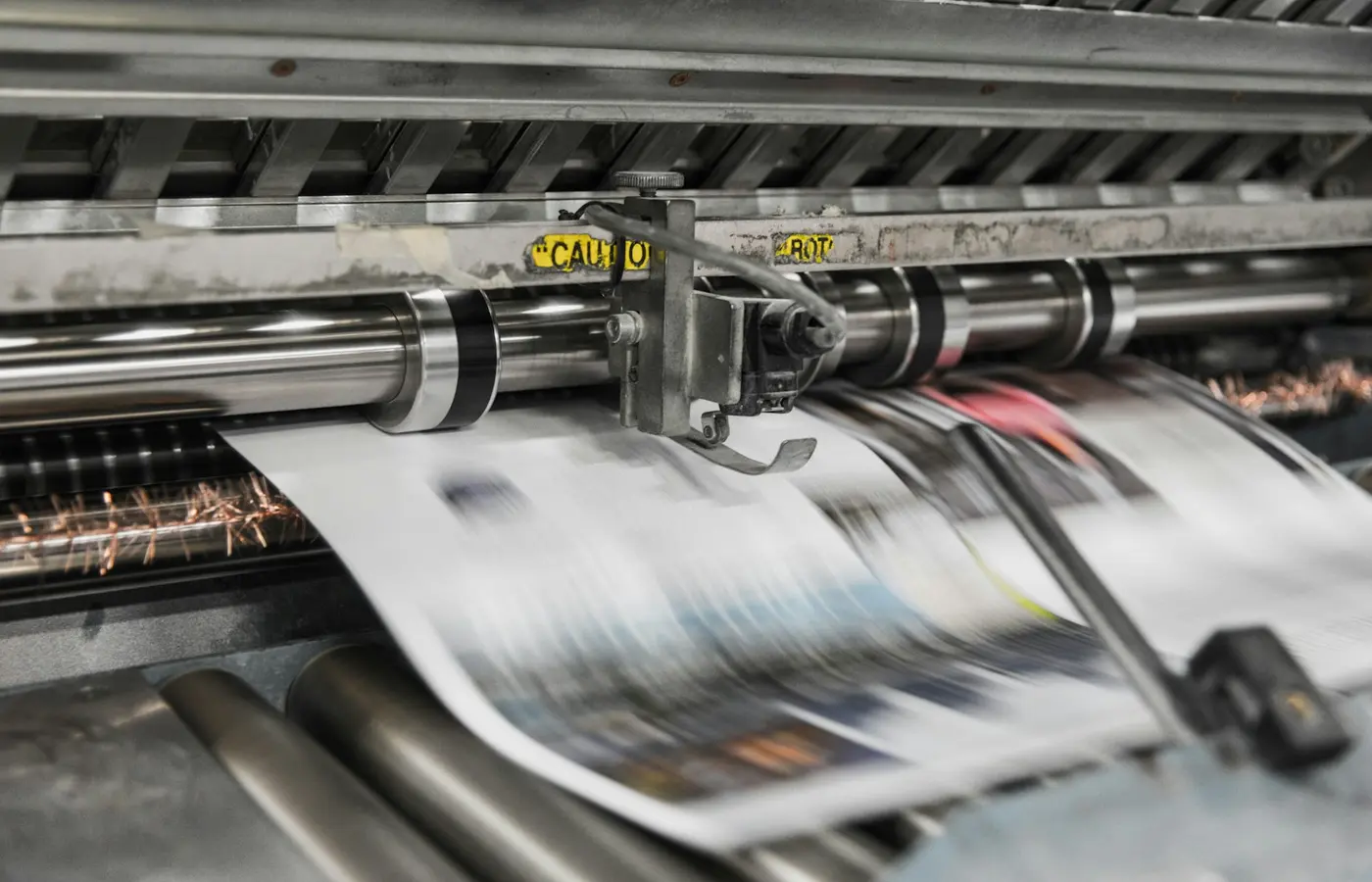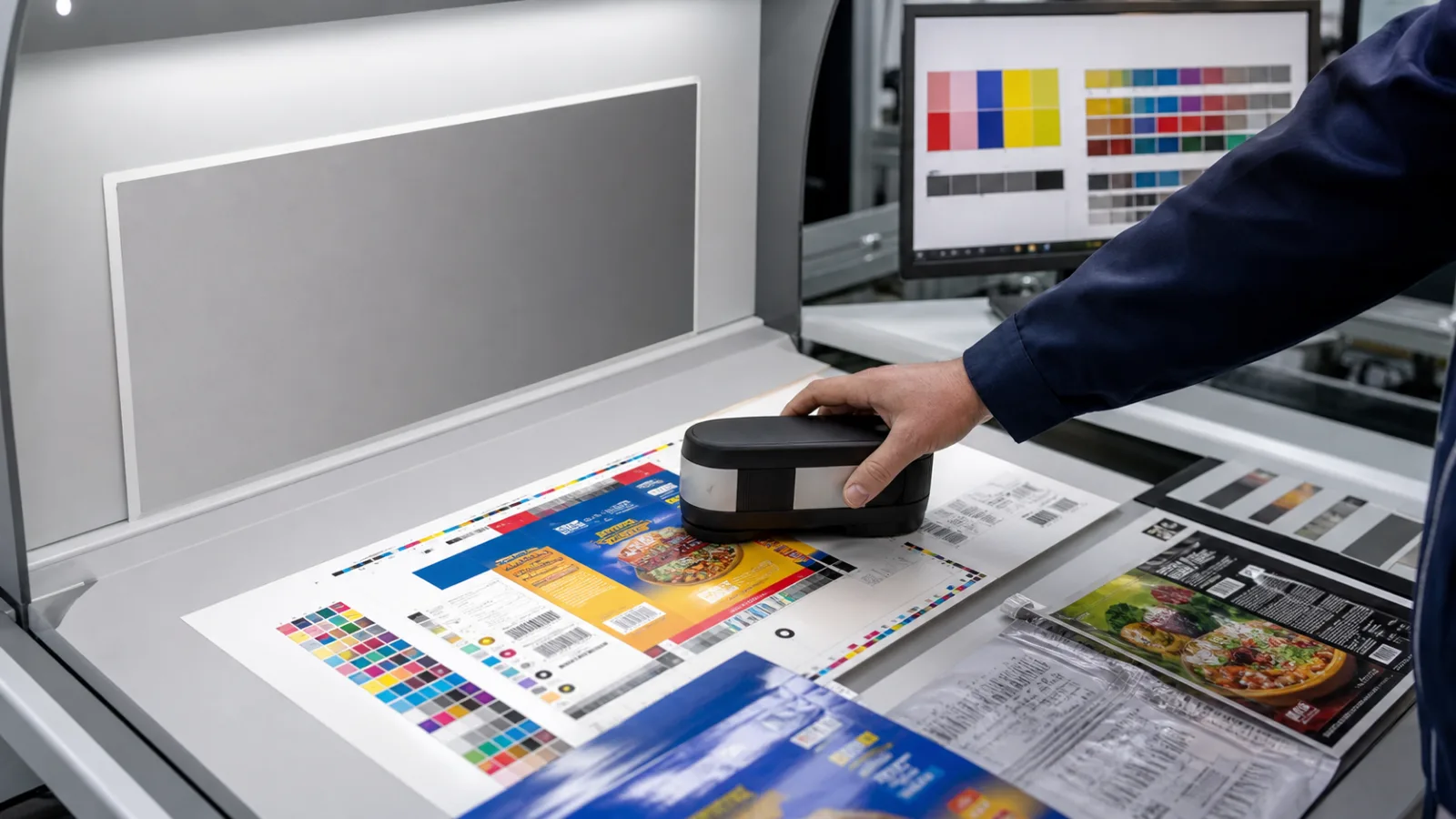

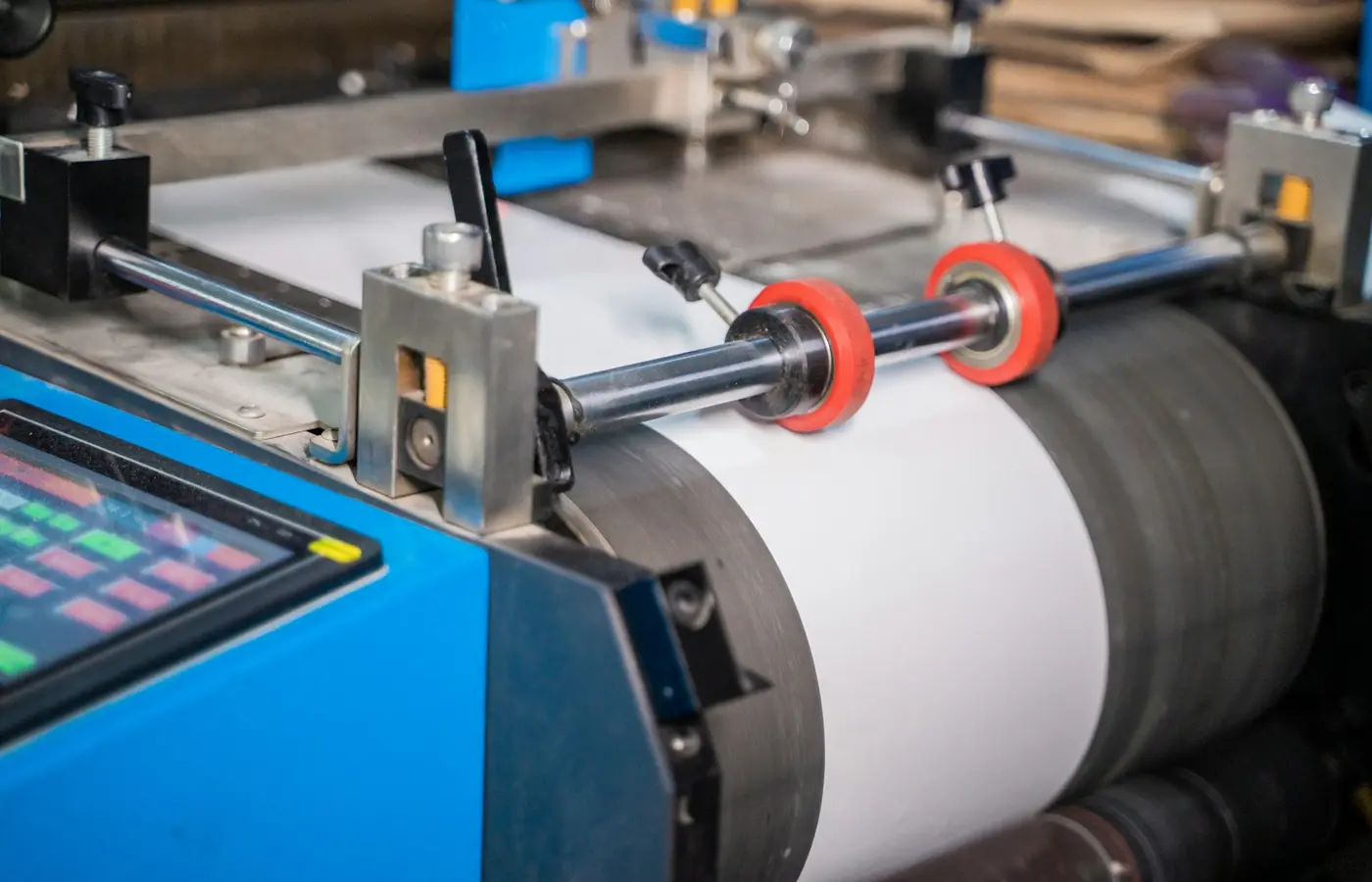
A release liner is not simply the disposable backing behind a pressure-sensitive label. It is the carrier web that supports the construction through printing, die-cutting, matrix stripping, rewinding and automatic application. Its substrate, caliper, stiffness, silicone release coating and dimensional behaviour can all affect whether labels convert cleanly and dispense consistently.
For that reason, a label release liner specification should describe a complete pressure-sensitive construction, not just request a paper or film liner by name. The suitable liner depends on the face stock, adhesive, label geometry, converter, press configuration, roll format and applicator. A construction that runs reliably on one die station or peel plate may require further qualification on another.
Pressure-sensitive label construction is commonly described as a face stock, adhesive, release coating and liner. The liner and release coating form the web; the face stock and adhesive become the applied label. That distinction matters because the liner must remain intact and controllable until the label separates at the dispensing point.
Define the liner’s job in the complete construction
The liner provides physical support during manufacture and use. A silicone release coating on the liner surface resists the pressure-sensitive adhesive sufficiently for the label to be removed when needed. Labeling Systems’ guide to pressure-sensitive labeling describes the liner as the roll web and the release coat as the layer that permits the adhesive and face stock to peel away.
That apparently simple function has several production consequences:
- The liner must carry the web through printing, coating or laminating operations where applicable.
- It must provide enough support for die-cutting the label without unacceptable liner damage.
- It must remain stable while the waste matrix is pulled away from the die-cut labels.
- It must wind, slit and unwind within the converter’s handling limits.
- It must travel through the applicator’s web path, peel plate and waste rewind system without excessive stretching, breaking, wandering or release variation.
The release liner is therefore not specified independently from the adhesive. A silicone coating that gives acceptable separation with one adhesive may not give the same release behaviour with another. Similarly, a liner that supports a large rectangular label may not provide the same converting margin for a small, sharply angled or closely spaced label.
A useful starting point is to identify the construction by named face stock, adhesive family and liner grade. If a laminate supplier offers a prequalified construction, obtain its current technical documentation and confirm the stated intended converting and application scope. Do not assume that a broadly described “standard liner” is interchangeable with another liner of similar basis weight or nominal thickness.
Specify substrate, caliper and web behaviour
Release liners are commonly paper-based or film-based, but those material families are too broad to be a complete specification. Within each family, grade, coating, caliper, tensile behaviour, surface condition and moisture response can differ materially.
The relevant question is not whether paper or film is universally better. It is whether a particular liner grade supports the proposed web and process under the required conditions.
Channeled Resources notes that properties including roughness, flexibility and thermal capacity influence liner performance in coating, converting and application. In practical terms, those properties may affect how a web tracks, how it responds to tension, how it supports die pressure and how it behaves around rollers or a peel plate.
| Specification area | Why it matters | What to define or verify |
|---|---|---|
| Liner substrate and grade | Establishes the actual carrier construction rather than a generic material family. | Named supplier grade, coating side or sides, and any approved equivalent process. |
| Caliper or thickness | Affects roll build, die support, web path fit and some dispensing settings. | Nominal value, tolerance, test method and conditioning requirements. |
| Basis weight, where applicable | Can help identify and control paper liner grade, but does not replace caliper or mechanical data. | Units, nominal value, tolerance and method. |
| Tensile and elongation behaviour | Can influence tension response, web break risk and registration stability. | Machine-direction and cross-direction data, test method and relevant conditions. |
| Moisture or dimensional response | Can matter for paper-based webs exposed to changing production or storage environments. | Supplier method, conditioning conditions and acceptable variation where relevant. |
| Surface quality | May affect silicone coat uniformity, web contact and converting consistency. | Grade definition, inspection criteria and defect limits agreed with the supplier. |
Caliper should not be requested as an isolated number. A nominal thickness without a tolerance, measurement method and conditioning condition may not be sufficient for a converter to assess die settings, roll geometry or process capability. The same applies to tensile data: a value is meaningful only when the direction, specimen preparation and test method are known.
Film liners may be selected where their particular dimensional or mechanical characteristics suit the application. Paper liners may be selected where their handling, converting characteristics, availability or cost structure suit the construction. Neither statement predicts performance for a specific job. Confirm the candidate grade with the converter, especially where there are narrow webs, high line speeds, small labels, demanding matrix removal or sensitive dispensing equipment.
Match release behaviour to the adhesive and peel system
Release behaviour is an interaction between the silicone release system and the adhesive. It should not be treated as a generic property of “the liner.” The practical requirement is controlled separation: the label must remain secure during printing, die-cutting, rewinding and transport, then release cleanly and consistently at application.
The silicone coating provides this release function, but silicone chemistry and coating systems vary. A stated release-force value is useful only when accompanied by its test context. At minimum, ask for:
- the exact adhesive and release system tested;
- the release-force test method;
- peel angle and speed;
- dwell time before testing;
- test temperature and conditioning environment;
- whether the result is an initial, aged or accelerated-aged measurement;
- the nominal result, variation and acceptance basis.
Without those details, two numerical release values may not be comparable. A peel test at one angle or speed does not necessarily describe behaviour at the applicator’s peel plate, which may use a different web path, speed, tension and label departure angle.
The applicator also matters. Obtain the equipment documentation for approved web routing, peel-plate configuration, label-size range, operating speed and tension controls. The liner affects feeding, tracking and peeling; Quadrel’s explanation of pressure-sensitive labels usefully identifies these as machine-level consequences of liner selection. That is a functional reminder, not a substitute for qualification on the actual machine.
For a label that must dispense at multiple locations, identify every applicator model, speed range, product geometry and operating environment before approving the construction. A successful trial on one line does not establish performance on another line with different rollers, sensors, peel geometry or tension control.
Account for die-cutting, matrix stripping and rewinding
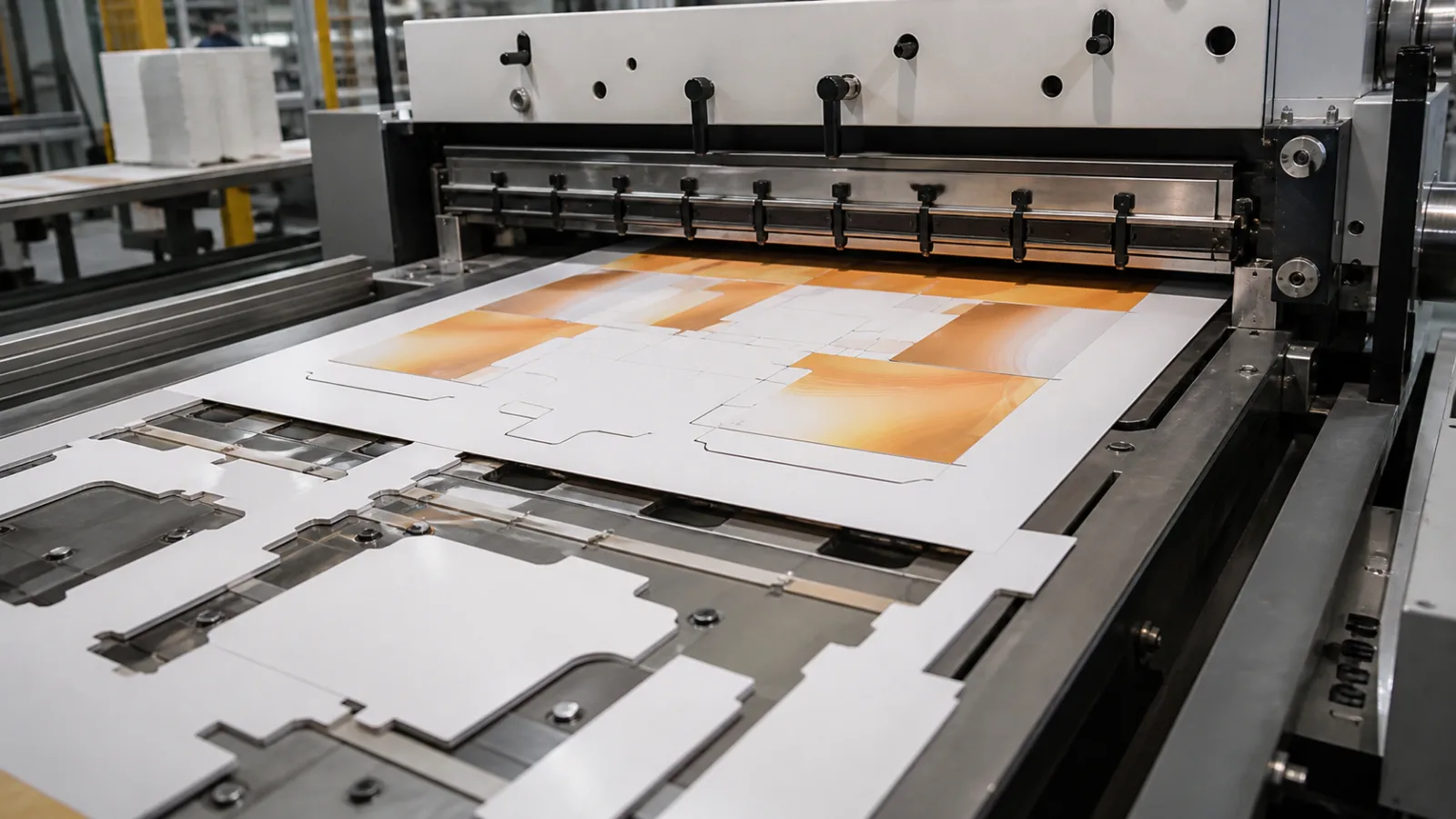
During pressure-sensitive label converting, the die should cut the face stock and adhesive to the intended shape while leaving the liner sufficiently intact to carry the labels. The process also includes slitting and matrix stripping, as described in the Labels & Labeling overview.
Liner selection affects the operating window, but it does not determine it alone. Die-cut quality depends on the combined effect of liner support, face stock, adhesive, die condition, anvil or cylinder condition, die strike, press speed and web tension. Excessive penetration can score, weaken or cut the liner. Insufficient penetration can leave incomplete cuts, which may cause labels to lift with the matrix or fail to dispense cleanly.
Matrix stripping is particularly dependent on interaction. The waste matrix must separate from the labels and travel through the removal path without breaking. Relevant variables include:
- label shape, corner radii and small internal features;
- label pitch and waste-matrix width;
- face stock stiffness and extensibility;
- adhesive flow or stringing behaviour under the production conditions;
- die sharpness, die strike and cut quality;
- stripping angle, web path and press speed;
- machine-direction tension before and after the stripping point;
- liner integrity and support beneath the labels.
Do not diagnose a matrix break as a liner failure without examining these variables. Start by retaining samples of the unconverted laminate, the die-cut web and the failure section. Record the job settings, die identity, press speed, tension settings, ambient conditions and roll position. That record makes it possible to distinguish a repeatable construction issue from a worn die, setup change or local roll defect.
Rewinding is another control point. Check whether the converted roll is telescoping, wrinkling, showing uneven edge profile or developing label lift near the roll ends. These observations can indicate a tension, alignment, slit-quality or construction interaction. They should be investigated before the rolls reach a high-speed application line.
Write a release liner specification that can be quoted and checked
A purchase specification should allow a supplier, converter and buyer to identify the same construction and verify whether delivered material meets the agreed requirements. Avoid terms such as “easy release,” “high strength” or “stable liner” unless they are converted into named properties, methods and limits.
Include the following fields in a converter brief or material specification:
- Complete construction identification: face stock, adhesive, release coat and liner supplier grade or laminate code.
- Liner construction: substrate type, grade, silicone-coated side, any back treatment and nominal caliper or basis weight where applicable.
- Dimensional and mechanical properties: required caliper tolerance, tensile or elongation data where relevant, and the test methods and conditioning conditions.
- Release requirement: the nominated adhesive-release combination, test method, peel angle, speed, dwell, conditioning and acceptance range.
- Converting configuration: press type, die method, web width, slit widths, label shape, pitch, matrix-removal path and intended production-speed range.
- Roll format: roll direction, core diameter, maximum outside diameter, web width, splice policy, winding requirements and edge-profile expectations.
- Application conditions: applicator make or model where known, peel-plate arrangement, speed range, container or package geometry, application position and downstream inspection needs.
- Storage and handling conditions: expected temperature and humidity exposure, roll-age limits where applicable, and any requirements for conditioning before conversion or application.
- Quality documentation: required certificate of analysis, lot identification, test reports, retained samples and procedure for approving substitutions.
- Change control: whether a change in liner grade, silicone system, adhesive, caliper tolerance or manufacturing site requires notification and requalification.
The purpose is not to prescribe unnecessary numbers. It is to make sure the number of variables matches the risk of the application. A simple hand-applied label may need fewer controls than a small, high-speed label with tight placement tolerances and a difficult waste matrix.
Qualify the construction in converting and dispensing trials
Qualification should proceed through controlled stages. Results apply to the tested material, machine, settings and conditions; they should not be expanded into a blanket claim for all equipment or applications.
- Review construction data. Confirm the current datasheets for the exact laminate or component grades. Compare material properties, roll dimensions and release-test conditions with the converter and applicator requirements.
- Run a representative converting trial. Use the intended face stock, adhesive and liner combination wherever possible. Record press, die, anvil, speed, tension, web width and ambient conditions.
- Inspect the converted rolls. Check die-cut completeness, liner score or damage, matrix removal, label lift, web wrinkles, slit edges, winding quality, splice performance and roll geometry.
- Dispense on the intended equipment. Trial the specified speed range, package shape, peel-plate arrangement and label position. Observe tracking, label separation, placement, missed labels, skew and waste rewind behaviour.
- Document acceptance and limits. Keep material lot details, roll age, settings, inspection criteria, defects observed and any approved adjustment window. Define what change requires a new trial.
If inconsistent dispensing occurs, first isolate whether the issue is release, web transport or product handling. Inspect the label edge at the peel plate, liner tracking, tension settings, liner damage from conversion, roll winding and package presentation. If matrix breaks occur, inspect the waste path, die-cut quality, label geometry and tension profile before changing liner grade.
The right release liner is the one that gives the required converting margin and dispensing consistency for a named pressure-sensitive construction under defined conditions. Specify the liner grade and release system alongside the adhesive, then confirm the result on the intended converter and applicator rather than relying on the material family alone.
Frequently asked questions
What information should a label buyer provide when specifying a release liner?
Provide the full label construction, label drawing, application method, applicator details, speed range, package geometry, roll format and storage conditions. Also provide converting requirements such as press type, die method, matrix-removal challenges, slit widths and roll direction. Ask the supplier or converter to identify the test methods behind any quoted caliper, tensile, moisture or release data.
How does release force affect label dispensing?
Release force describes the resistance encountered as the label separates from the liner under a defined test. If the release system is poorly matched to the adhesive and applicator, labels may separate inconsistently or place poorly. However, the useful value depends on the adhesive, silicone system, test angle, speed, dwell, temperature and conditioning. It should be evaluated alongside an applicator trial.
Can the same pressure-sensitive label construction run on different applicators?
It may, but this should be confirmed rather than assumed. Applicators can differ in web path, roller layout, peel-plate geometry, sensors, tension control, operating speed and package handling. Qualify the construction on each materially different application setup, particularly where label size, placement accuracy or line speed is demanding.
What should be checked if labels dispense inconsistently or the matrix breaks?
For dispensing, check roll winding, web tracking, liner damage, peel-plate condition, tension settings, label geometry and package presentation. For matrix breaks, inspect die-cut penetration, die condition, waste width, stripping angle, press speed, tension profile, adhesive behaviour and liner support. Retain failed samples and production settings so the cause can be investigated as a system interaction.