
A 10 gsm difference between 70 gsm and 80 gsm paper can matter in a digital-print workflow, but it does not predict the result on its own. Basis weight describes mass per unit area. It does not define caliper, stiffness, opacity, grain direction, moisture content, surface treatment, cut quality, or compatibility with a particular press and finisher.
For an operator or production buyer, the practical question is not simply whether 70 gsm or 80 gsm is “better.” It is whether the exact paper grade will feed, print duplex, remain acceptably flat, carry the required image, and finish reliably on the installed machine configuration. That requires checking the press manufacturer’s supported-media requirements and running a job-representative qualification trial.
What the 70 gsm vs 80 gsm comparison does—and does not—show
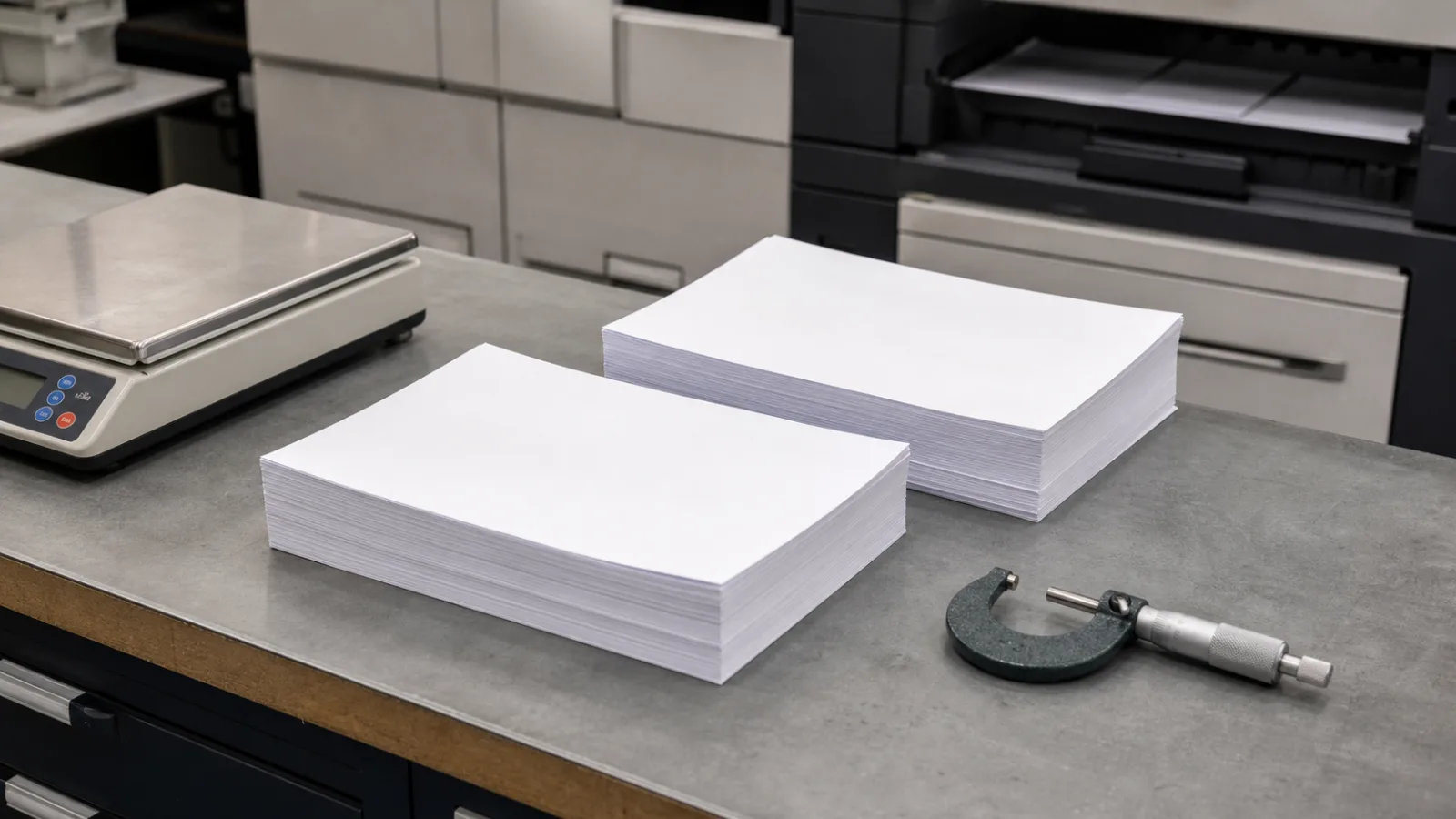
At the same sheet size, an 80 gsm sheet has more mass than a 70 gsm sheet. A ream will therefore weigh more, and the paper may have a different stack height, feel, opacity, and resistance to handling. Those differences can affect logistics and may affect machine behaviour.
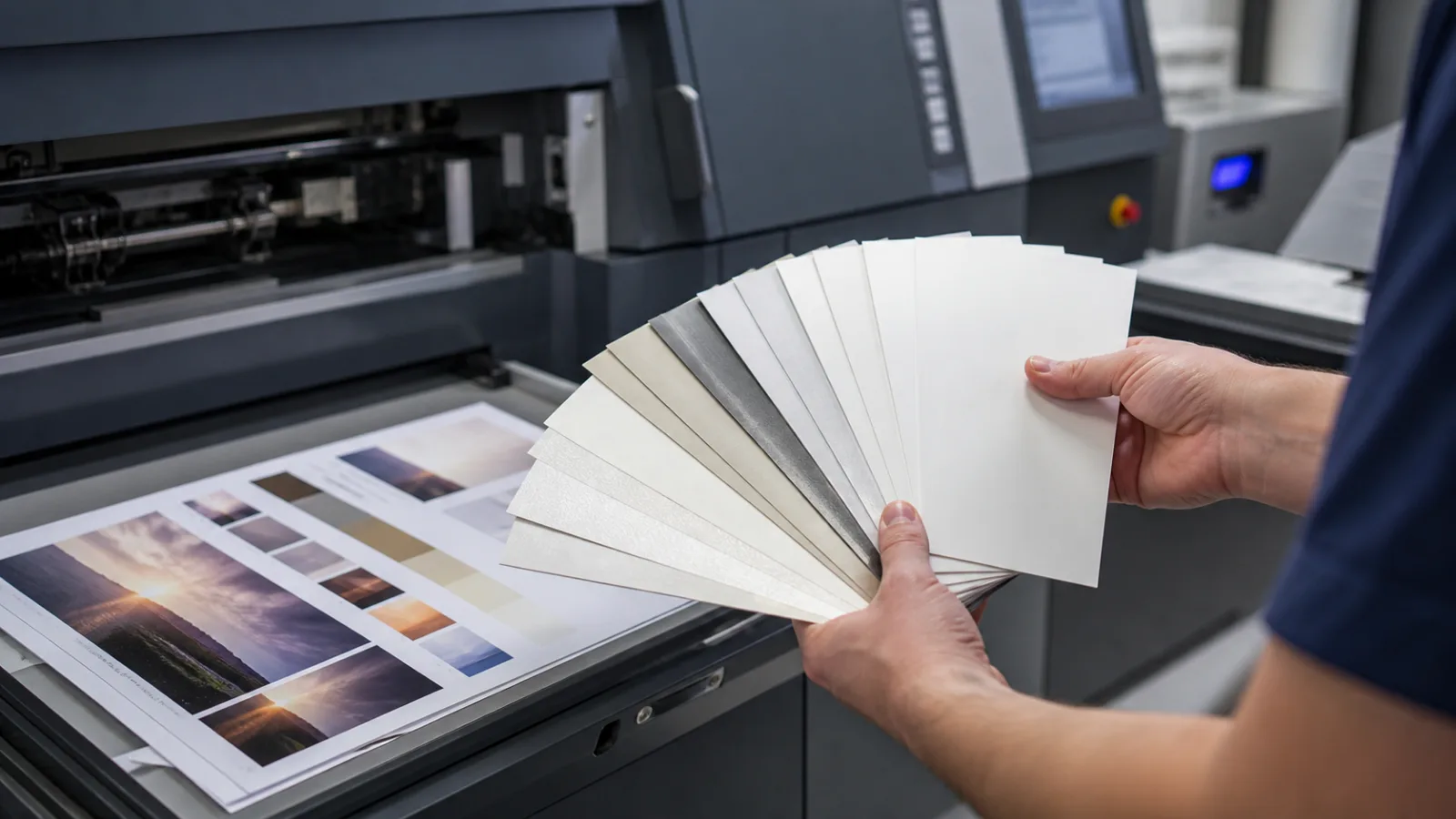
They are not fixed consequences of the nominal weight. Two papers with the same gsm can differ materially because of fibre furnish, bulk, calendering, formation, filler level, coating or surface sizing, and moisture condition. A bulky 70 gsm grade can be thicker than a densely calendered 80 gsm grade. Likewise, an 80 gsm sheet is not automatically stiffer, more opaque, smoother, or more stable through a press path.
Read the technical datasheet for the specific grade and format under consideration. Useful values include:
- basis weight and tolerance;
- caliper, often stated in micrometres or microns;
- opacity and brightness where show-through or colour appearance matters;
- smoothness or surface specification;
- grain direction options;
- moisture specification or storage guidance;
- intended print technologies and any stated limitations;
- available sheet sizes and packing configuration.
A paper developed for production inkjet should not be assumed suitable for dry-toner electrophotographic presses, and the reverse is also true. For example, the Steinbeis Digital InkJet ISO technical datasheet describes a named 70 gsm and 80 gsm product range for high-speed inkjet applications. That is useful evidence for the stated product scope, not proof of performance on every digital press or finishing line.
Check the press media range before treating either weight as approved
A press media range is a starting constraint. If a tray, duplex unit, or finisher does not support a particular basis-weight range, neither a 70 gsm nor an 80 gsm grade outside that range should be treated as an approved production substrate. If both weights fall inside the published range, that confirms only that the nominal weight is potentially usable.
The actual approval decision may also depend on:
- press model, software version, and installed paper-path modules;
- feeder or tray type;
- sheet size and feed orientation;
- coated, uncoated, preprinted, textured, or treated surface classification;
- simplex versus automatic duplex operation;
- output device, such as a stacker, booklet maker, or inserter;
- available media-profile settings;
- paper supplier, grade, and sometimes listed product code.
Manufacturer-recommended media documents can show how specific a qualification may need to be. The Xerox Versant 80/180/280 Europe Paper and Specialty Media Guide is specific to named Versant models, documented media, and its publication context. Its observations should not be transferred to a different Xerox model, another manufacturer’s press, or an unlisted paper.
Use the current operator documentation for the installed press, including the relevant feeder and finisher manuals. Confirm the supported range by tray, rather than relying on a general machine headline specification. A bypass tray may accept stock that a high-capacity feeder, duplex path, or booklet module cannot process under the same conditions.
Feeding and transport depend on the sheet and the stack
Feeding faults are often described as a weight problem because they occur after a stock change. In practice, the fault may result from the interaction of paper construction, storage condition, tray setup, and separation hardware.
A 70 gsm grade can run cleanly while an 80 gsm grade double-feeds, or an 80 gsm grade can run cleanly while a 70 gsm grade misfeeds. Possible contributing factors include sheet curl, static charge, rough or dusty cut edges, uneven stack formation, moisture imbalance, grain direction, and the friction characteristics of the sheet surface.
Higher basis weight can change the force needed to bend a sheet through a transport path, but stiffness is not determined by gsm alone. Caliper and fibre structure matter. A nominally heavier grade can also create a taller stack for a given tray fill if it is bulkier, changing tray capacity and pickup conditions.
A practical feeding trial
Qualify each candidate paper as a distinct stock, not as a generic 70 gsm or 80 gsm category.
- Record the supplier, grade name, sheet size, grain direction, lot or batch identifier, and pack-opening date.
- Check that the paper has been stored and conditioned according to the supplier’s guidance. Avoid comparing a newly opened cold pack with stock that has equilibrated in the pressroom.
- Load the intended tray at a realistic production fill level. Set guides accurately and select the closest approved media profile.
- Apply documented tray settings, including air assist, tray heater, feed orientation, and paper-type selection where the machine provides them.
- Run a representative quantity in the planned print mode, not only a few blank sheets.
- Record misfeeds, multi-feeds, skew, edge damage, jams, transport marks, and output-stack behaviour.
- Repeat after changing only one controlled variable, such as stock grade or feed orientation.
This sequence does not establish a universal result. It provides a traceable basis for deciding whether the particular paper, machine, and job setup are acceptable.
Duplexing, curl, and registration need a job-specific trial
Automatic duplexing places additional demands on a sheet. The paper must survive the first imaging and fixing or drying stage, travel through a reversing route, and return for side-two imaging without excessive distortion, curl, marking, or loss of registration.
Front-to-back registration and curl are related only indirectly. Registration concerns the position of the image on side two relative to side one. Curl concerns the sheet’s shape after printing, fixing, drying, cooling, or moisture exchange. A sheet can register well but curl enough to disrupt stacking or finishing. It can also remain reasonably flat while showing unacceptable front-to-back image movement.
The 70 gsm versus 80 gsm choice may influence response to heat, moisture, and path stress, but it does not determine it. Important variables include:
- side-one and side-two image coverage;
- imbalance between heavy solids on one side and light content on the other;
- fuser temperature or inkjet drying energy;
- paper moisture condition before printing;
- side-to-side paper construction and grain direction;
- duplex-path geometry and speed;
- machine curl-correction and registration settings;
- time allowed for output to cool and equilibrate.
Use the press manufacturer’s approved adjustment process for registration and curl controls. Do not compensate for a poor stock choice by making undocumented machine changes that conflict with operating instructions.
For each stock, print a representative duplex form with realistic coverage. Measure registration using a defined target and method. Inspect sheets immediately at delivery and again after cooling or conditioning. Record curl direction, visible severity, stack flatness, toner or ink offset, and whether the sheets remain acceptable after the actual finishing delay.
Toner adhesion and inkjet drying are technology-and-grade questions
Digital printing includes different imaging mechanisms. Dry-toner electrophotographic presses use heat and pressure to fix toner. Production inkjet systems depend on interactions among ink chemistry, paper surface treatment, absorption, and drying capacity. A paper described broadly as suitable for digital printing may be engineered for only one of these routes.
In dry toner, acceptance may include image fixation, rub resistance, gloss uniformity, contamination control, and avoidance of offset or marking. Paper surface, moisture, fusing conditions, coverage, and the selected media profile can all affect the result. A heavier sheet is not automatically more resistant to toner scuffing or more stable through the fuser.
In inkjet, surface treatment and absorbency influence dot spread, optical density, show-through, colour reproduction, drying behaviour, and the risk of ink transfer in the output stack. The Domtar InkJet Digital Product Guide states that its named products are intended for specified digital and inkjet uses within original equipment manufacturer limitations. That framing is important: press compatibility and the exact product construction remain part of the decision.
Ask the paper supplier which technology the grade is intended for: dry toner, liquid toner, desktop inkjet, production inkjet, or more than one system. Then compare that statement with the press manufacturer’s current approved-media guidance. Where image durability, rub resistance, drying, or offset is critical, agree an acceptance method before production rather than relying on visual judgement alone.
Folding and finishing: qualify the printed sheet, not the unprinted gsm label
Finishing exposes problems that may not be visible at press delivery. Folding can reveal excessive curl, grain-related resistance, toner cracking, ink transfer, registration movement, or distortion at the fold. Trimming can reveal poor stack stability or edge damage. Booklet making, punching, binding, and inserting may have their own substrate and sheet-count limitations.
An 80 gsm paper may feel more substantial in a finished document, but it will not necessarily fold more cleanly than a 70 gsm alternative. The result depends on caliper, grain direction, fibre flexibility, image coverage at the fold, conditioning, fold geometry, and the capabilities of the folder or booklet maker.
Use the actual printed job for the finishing trial. Include the heaviest expected coverage, the intended fold pattern, and the final output device. Inspect for:
- fold cracking, whitening, or image disruption;
- toner delamination, scuffing, or ink set-off;
- trim accuracy and edge quality;
- booklet or binding alignment;
- sheet marking in the finisher;
- stack flatness and delivery consistency;
- sheet-count and bulk limits in downstream equipment.
Confirm the current supported-stock requirements for each finishing module, not only the press engine. A stock that prints successfully may still be unsuitable for automatic booklet making or high-volume insertion.
Pre-production selection checklist
Before selecting 70 gsm or 80 gsm for a recurring digital job, confirm the following:
- Is the exact grade listed or otherwise supported by the press manufacturer for the intended technology and configuration?
- Are caliper, grain direction, surface type, and moisture guidance known for the supplied format?
- Does the selected tray support the stock in simplex and automatic duplex modes?
- Has the paper been trialled at realistic coverage, speed, run length, and environmental condition?
- Are registration, curl, image durability, and stack behaviour measured or assessed against agreed criteria?
- Has the printed sheet passed the actual folding, trimming, binding, or booklet-making route?
- Are the approved media profile, tray setup, feed orientation, and finishing settings documented for repeat work?
Choose 70 gsm when the verified grade meets the job’s opacity, handling, print, and finishing requirements at the required run conditions. Choose 80 gsm when its documented construction and qualification result offer a needed benefit for the specific application. If neither grade has been qualified on the intended press path and finishing route, gsm alone is not enough information to make a production approval.