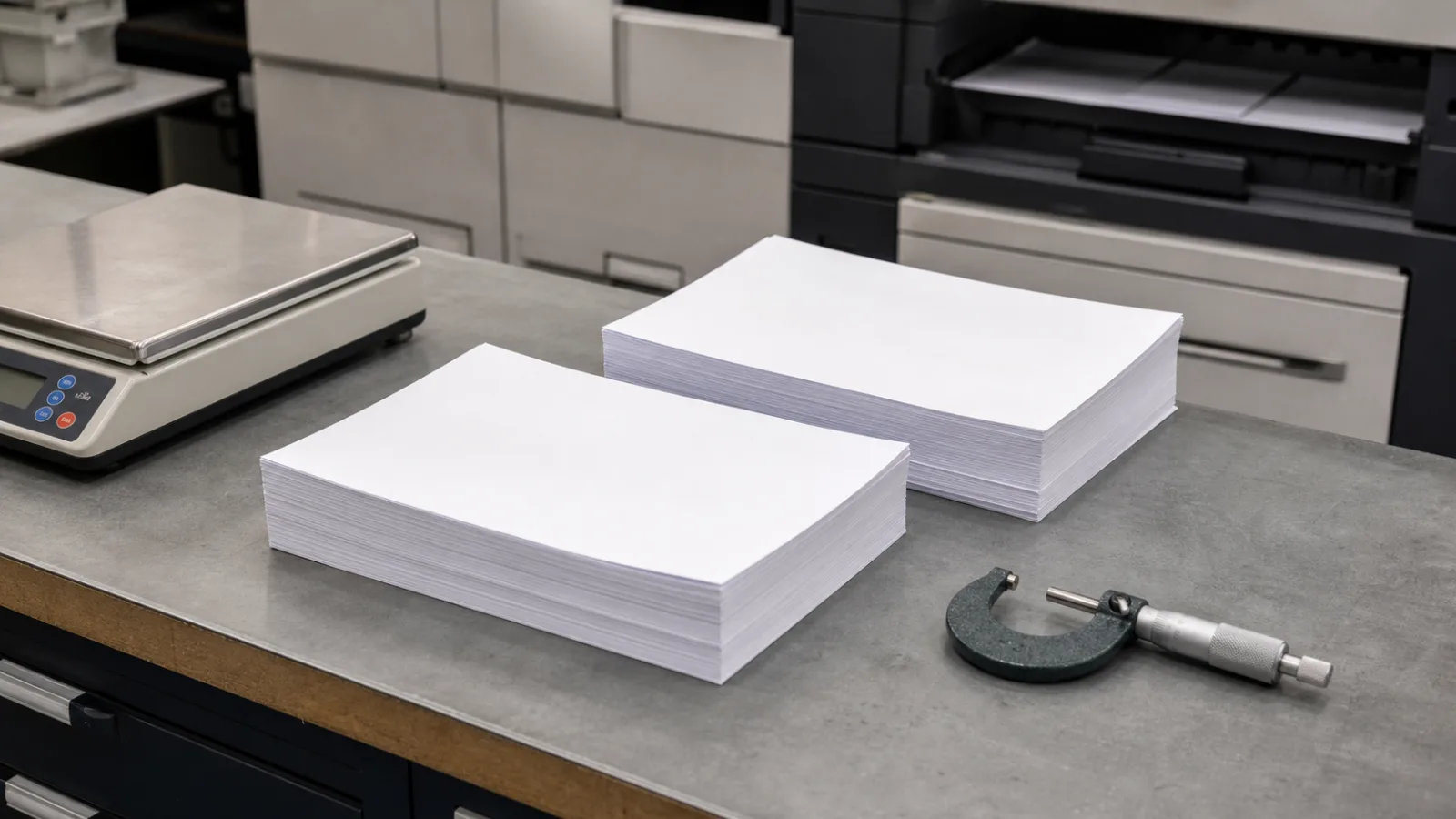

Paper opacity for printing is the sheet property that helps determine how effectively one side of a duplex sheet obscures printing on the other side. It should be specified as an optical property with a stated test method and acceptance basis, rather than inferred from grammage alone.
That distinction matters because a quoted opacity value does not, by itself, guarantee an acceptable double-sided printed result. Perceived show-through depends on the paper grade and construction, but also on the artwork, ink or toner coverage, print process, finishing route, lighting, and the way the finished piece is viewed. A paper that is suitable for a lightly printed book page may not be suitable for a duplex mailer with dense solids, reverse type, or high-contrast imagery.
Why opacity matters in duplex printing
Opacity describes the ability of a sheet to visually obscure material behind it. For paper, the relevant question is commonly whether printing on the reverse side remains distracting when the reader views the front side.
The scope of ISO 2471:2008 is specifically paper-backing opacity: the property governing the extent to which one sheet obscures printed matter on underlying sheets of similar paper. This makes it useful for considering many reading and printed-page applications, where sheets are stacked or turned during use.
However, opacity is not the same as every reverse-side printing defect described as “show-through” in everyday production language.
- Optical show-through is the visual influence of a reverse-side or underlying image seen through the sheet. Paper opacity is directly relevant to this effect.
- Ink strike-through can occur when part of a liquid ink system penetrates through the sheet structure. It may be affected by porosity, absorbency, ink vehicle, ink load, drying conditions, and coating or sizing.
- Print-through is used inconsistently. Some teams use it for visible reverse-side images; others use it for ink penetration. Define the term in the job specification rather than assuming every party means the same thing.
- Set-off is the unwanted transfer of wet or insufficiently dried ink from one printed surface to another. It is a handling and drying issue, not an opacity measurement.
A high-opacity paper may still show strike-through if the ink system and sheet absorbency are poorly matched. Conversely, a sheet with moderate opacity may be visually acceptable where coverage is low, image contrast is limited, and the finished item is viewed briefly under diffuse light. The approval question is therefore not simply, “Is this paper opaque?” It is, “Does this named paper provide acceptable reverse-side obscuring in this printed job?”
What an opacity value measures
Opacity is derived from reflectance measurements under defined conditions. In simplified terms, the instrument compares how the sheet reflects light when placed over different backing conditions. The relationship between those readings is expressed as a percentage.
That percentage has practical value only when the measurement basis is known. Do not compare values as if they were interchangeable if supplier documents use different methods, instrument geometries, illuminants, or backing arrangements.
ISO 2471:2008 describes a diffuse-reflectance method for determining paper-backing opacity. Its introduction also makes an important specification point: the method selected should relate to how the result will be interpreted in use. Paper-backing opacity is intended to represent how one sheet obscures printed matter on similar underlying sheets; it is not the same measure as white-backing opacity, historically called contrast ratio.
TAPPI T 425 om-21 also identifies more than one opacity approach, including 15/d geometry, illuminant A/2° conditions, an 89% reflectance backing, and paper-backing methods. The technical details matter because a result is inseparable from the procedure used to create it.
When requesting data from a mill, merchant, or converter, ask for:
- the exact named paper grade, finish, and grammage;
- the opacity result and unit, normally expressed as a percentage;
- the named test method and edition where available;
- whether the value is based on paper backing, a specified white backing, or another arrangement;
- the instrument geometry and illuminant if stated in the supplier documentation;
- whether the figure is a nominal product value, a production target, a lot result, or a certificate-of-analysis result.
A datasheet value is usually useful for grade selection. It may not be sufficient as a lot-by-lot acceptance limit unless the supplier has agreed a relevant tolerance, sampling plan, and reporting arrangement.
Why grammage is not a substitute for paper opacity
Grammage is mass per unit area, expressed in g/m². It is an essential paper specification field, but it does not measure opacity.
A heavier sheet will often be thicker than a lighter sheet within a similar product family, and greater thickness can contribute to increased light scattering and visual hiding. But this relationship is not reliable enough to use grammage as an opacity acceptance criterion across different grades.
As the TAPPI method summary notes, opacity can be influenced by thickness, filler type and amount, fibre bleaching, coating, and related construction variables. In production terms, two 100 g/m² sheets may differ in opacity because they differ in bulk, fibre furnish, filler loading, formation, surface treatment, or coating construction.
For example, a bulky uncoated grade and a denser smooth grade may have similar grammage but different thickness and internal light-scattering behaviour. A coated grade may also produce a different perceived result from an uncoated grade even where reported opacity figures appear close. The printed image, gloss, and viewing angle can alter what the reader notices.
This does not mean grammage is unimportant. It should be specified separately because it influences stiffness, postage or distribution weight, folding, caliper, runnability, and the tactile character of the finished item. But it should not stand in for a required opacity value.
A practical paper specification should therefore record grammage, thickness or bulk where relevant, and opacity as distinct properties. The same principle is reflected in this paper specification guidance: sheets with the same mass per area can differ in thickness and opacity, so each requirement needs its own target and measurement basis.
Shade, construction, and image conditions affect perceived show-through
An instrument result is an important control, but readers do not evaluate a duplex sheet with an opacity meter. They see a printed object under particular lighting conditions, often at a short distance and with the reverse image aligned in a specific way.
Several variables can change perceived show-through without creating a simple one-to-one change in the quoted opacity value.
Paper shade and optical appearance
Shade, brightness, whiteness, and fluorescent optical effects can influence the apparent contrast between the paper and reverse-side image. A brighter-looking sheet may make a faint reverse image more noticeable in some viewing conditions, while a warmer or less bright sheet may alter that perception. These are not universal outcomes; assess the actual candidate grades under the intended viewing conditions.
Specify the supplier’s shade designation rather than merely requesting “white.” If brightness, whiteness, or colour coordinates are important, identify the required test basis and tolerance rather than assuming different supplier labels describe equivalent paper.
Structure, bulk, formation, and surface treatment
Paper construction affects both the optical path through the sheet and its print response. Thickness and bulk may influence light scattering. Fibre composition, filler system, formation, sizing, coating, and surface treatment can also affect opacity, ink holdout, gloss, and image sharpness.
Formation deserves particular attention for demanding work. Local variations in basis weight or structure may become more visible in broad solids, fine reverse type, or images with large tonal areas. A nominal opacity figure represents a measurement result for the defined test method; it does not replace visual assessment of sheet uniformity and printed appearance.
Front and reverse image design
The job itself can be the largest driver of visible show-through. Risk generally increases when the front or reverse contains:
- dense black or dark-colour solids;
- large areas of high ink coverage;
- high-contrast reverse type behind a light front image;
- fine rules, small text, barcodes, or detailed line art in close registration;
- large unprinted areas on one side opposite heavy coverage on the other;
- strong tonal differences between the two sides.
Digital toner, inkjet ink, conventional offset ink, UV systems, and other print technologies can create different image density, gloss, penetration, and curing behaviours. The relevant requirement is not that one process is inherently better for opacity, but that the paper, imaging system, coverage limit, and finishing route have been evaluated together.
Fields to include in a duplex paper specification
A durable specification separates the material requirement from the visual acceptance requirement. Use the following fields as a starting structure.
| Specification field | What to record | Why it matters |
|---|---|---|
| Paper identification | Manufacturer, named grade, finish, shade, and sheet or reel format | Prevents substitution by a broadly similar but differently constructed grade. |
| Grammage | Target grammage and agreed tolerance where applicable | Controls mass-related performance but does not replace opacity. |
| Opacity | Target or minimum value, plus the test method | Makes the optical requirement measurable. |
| Test basis | Method designation, edition if known, backing basis, and stated measurement conditions | Avoids comparing unlike values as equivalent. |
| Thickness or bulk | Required value or range when stiffness, folding, or construction is relevant | Helps control the physical sheet structure separately from mass. |
| Print process | Offset, toner, inkjet, flexographic, or other process; press or device family if relevant | Links the material to the actual imaging route. |
| Image risk | Maximum expected coverage, dark solids, fine reverse text, and duplex registration sensitivity | Identifies where visual approval must be most demanding. |
| Finishing | Coating, varnish, lamination, folding, embossing, or other conversion steps | Finishing can change gloss, handling, appearance, and acceptable print response. |
| Lot control | Whether grade, mill, shade, lot, or certificate data must be retained | Supports repeatability and investigation if appearance changes. |
| Visual acceptance | Approved sample, lighting condition, viewing distance, observers, and reject or escalation rule | Converts an abstract paper value into a job-specific decision. |
If a supplier cannot provide every field on a standard datasheet, identify which information must be confirmed by a lot certificate, a retained sample, or a production trial. Do not add an unverified number to a purchasing specification simply because a comparable-looking figure appears in another supplier’s literature.
A practical approval check before production
For duplex work where show-through could affect readability, brand appearance, or customer acceptance, conduct a controlled job-specific approval check before the main run. This is not a substitute for material specification; it is the check that confirms the material specification works in the intended system.
- Select representative paper. Use the intended named grade, finish, grammage, and shade. Where lot variation is a concern, use stock from the planned production lot where practical.
- Prepare representative artwork. Include the highest-risk content: dense solids, dark images, fine text, light areas opposite heavy coverage, and critical registration relationships. A generic colour bar is not enough for this purpose.
- Print both sides using the intended route. Use the planned press or device, ink or toner set, screening or imaging settings, and normal production sequence. Record any substitutions or departures from the planned job.
- Apply normal post-print conditions. Allow the usual drying, curing, fusing, conditioning, coating, or finishing stage. Evaluating a sheet before the normal process is complete can produce a result that does not represent the delivered item.
- Inspect under agreed conditions. Define the lighting, viewing distance, orientation, and whether the sample is viewed singly, as part of a stack, or in the final folded form. A retail carton, book signature, direct-mail piece, and technical insert may each need a different assessment context.
- Compare with an agreed reference. This may be a signed proof, approved production sample, customer standard, or written acceptance description. Avoid approval language such as “minimal show-through” unless the parties share a clear visual reference.
- Record the decision. Retain the paper identification, lot where available, print conditions, coverage information, finishing conditions, assessment date, participants, and approved sample.
- Define escalation before production. If the result is unacceptable, decide whether the response is a paper change, a grammage or opacity change, revised artwork, reduced coverage, altered print settings, a different finishing route, or further trial work.
The most useful approval sample is one that represents the delivered product, not merely a paper test sheet. Instrumental opacity data can narrow the list of candidate grades and support a measurable procurement requirement. Visual duplex approval determines whether the chosen grade is acceptable for the actual image and use case.
Common specification failures
Several recurring shortcuts create avoidable disputes.
“Use 120 g/m² or heavier.” This may be a useful starting point based on past experience, but it is not an opacity specification. The same grammage can be supplied in grades with different optical and structural properties.
“Opacity must be at least X%.” A minimum may be appropriate only if its test method and acceptance basis are defined. Do not copy a threshold from an unrelated product category, supplier, or test arrangement.
“No show-through permitted.” This may be impossible to assess consistently without a reference sample and viewing rule. Define the critical pages, viewing conditions, and approval authority.
“The supplier’s datasheet says high opacity.” “High” is a marketing description, not a measurable acceptance condition. Request the value, method, grade identification, and any relevant tolerance.
“The paper passed the blank-sheet test.” A blank optical measurement cannot show how dense reverse solids, ink penetration, gloss, or image registration will appear in the finished job.
For routine duplex work, specify the named grade, grammage, opacity test basis, and approved printed sample. For high-risk work, add lot traceability and a pre-production trial. The right opacity value is the one that has been measured on a comparable basis and shown to meet the visual requirement of the intended printed job.