
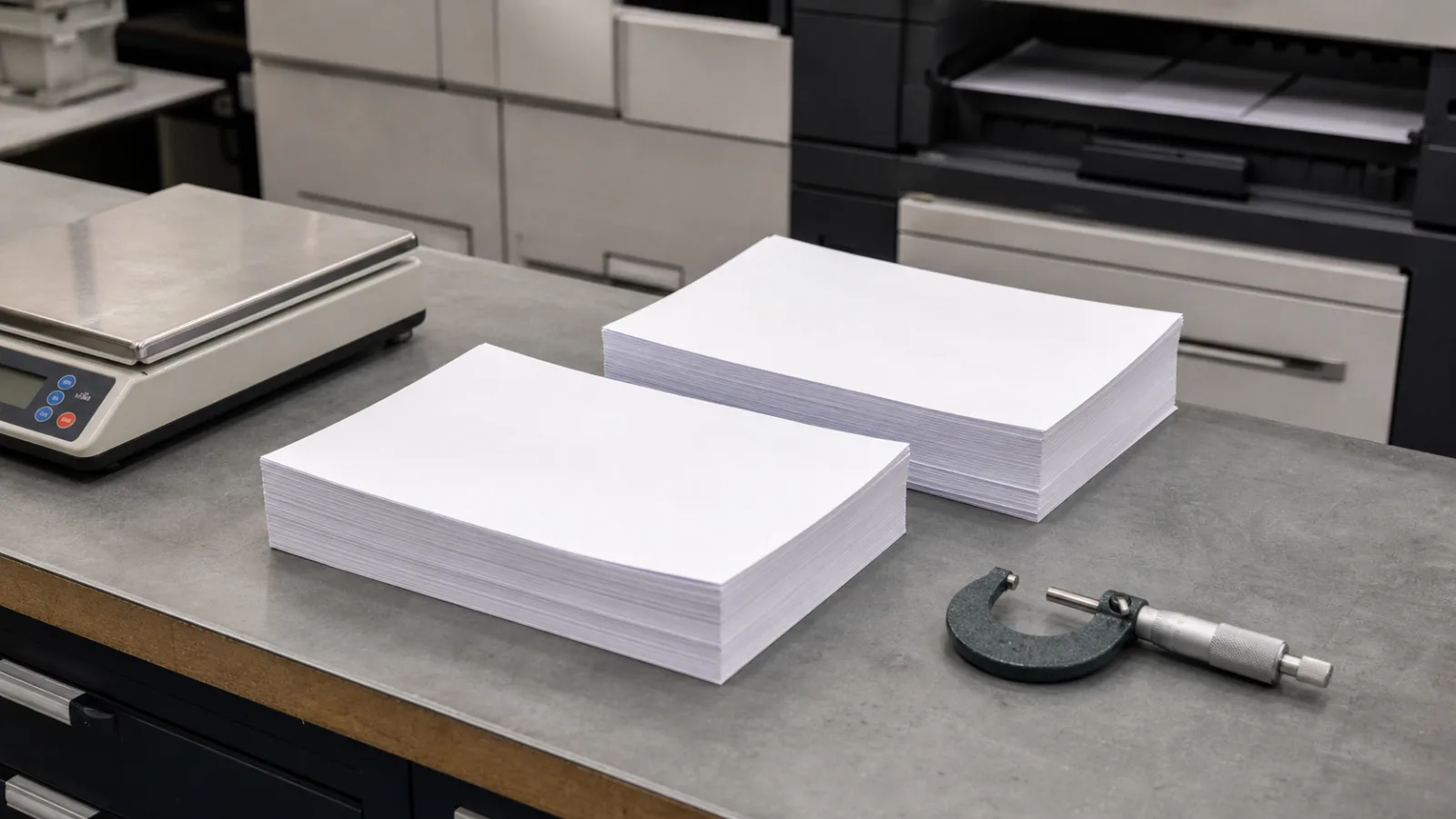
GSM means grams per square metre and describes a sheet’s basis weight. A square metre of 70 GSM paper weighs 70 grams; the same area of 80 GSM paper weighs 80 grams. It does not directly state thickness, because fibre composition, refining and calendering also affect caliper.
Handling and show-through
An 80 GSM office sheet generally feels firmer and is often more opaque than a comparable 70 GSM sheet. That extra substance can improve two-sided readability and feeding on equipment that prefers a stiffer sheet. A well-made 70 GSM grade can still run cleanly and may reduce the weight of large mailings.
Ten grams sounds minor, but a ream or a high-page-count document multiplies the difference. Procurement teams should compare total packed weight, printer settings and transport requirements rather than treating GSM as a quality score.
Which weight to specify
Choose 70 GSM for high-volume internal documents, manuals and transactional work where efficient material use matters. Choose 80 GSM when handling, opacity and a more substantial feel are priorities. Test the exact grade, because two papers at the same GSM can behave differently due to moisture, stiffness and surface treatment.
GSM is not the same as thickness
Grammage is mass per unit area. It provides a common metric across countries and sheet sizes, unlike North American basis-weight labels, which depend on the paper category and its traditional basic sheet size. A “20 lb” office sheet cannot be compared directly with a “20 lb” cover sheet, while 70 g/m² and 80 g/m² remain unambiguous measurements of mass.
Caliper describes thickness. Bulk describes the relationship between thickness and grammage. A bulky 70 GSM sheet can be as thick as, or thicker than, a dense and heavily calendered 80 GSM sheet. Fibre furnish, refining, fillers and surface treatment all contribute. Purchasing documents should list caliper or bulk when book thickness, an envelope insert or a machine setting matters.
What ten grams changes in a real order
An A4 sheet has an area of roughly one-sixteenth of a square metre. The theoretical mass difference is therefore about 0.625 grams per A4 sheet. Across a 500-sheet ream, that becomes about 312.5 grams. Across many cartons or a high-page-count mailing, the difference becomes operationally meaningful.
Do not use that calculation as a postage quote. Envelopes, ink, inserts, finishing and carrier weight bands all affect the shipment. Make a fully assembled proof, weigh it and confirm the current tariff.
| Requirement | 70 GSM is often suitable | 80 GSM is often suitable |
|---|---|---|
| High-volume internal printing | Uses less fibre and reduces stored bulk | More substantial than many drafts require |
| Duplex reports | Can work with an opaque, well-formed grade | Usually adds a margin against show-through |
| Long manuals | Reduces spine width and handling weight | Feels firmer but makes the book block heavier |
| Customer letters | Efficient for routine transactional mail | Frequently feels more deliberate |
| Mailing campaigns | May help meet a postal weight band | Useful where feel and opacity outweigh mass |
Opacity and show-through
Opacity is resistance to light passing through the sheet. Higher grammage often improves it because there is more material in the light path, but the relationship is not exact. Fillers, fibre distribution, shade and formation can let a well-engineered 70 GSM sheet outperform a poor 80 GSM sheet.
Show-through also depends on print. Dense black areas and saturated inkjet images are more demanding than light office text. “Strike-through” is different: it refers to colourant penetrating or becoming visible from the reverse. Evaluate a duplex test with actual coverage under normal reading light. A blank sheet held toward a window is not a production approval.
Feeding, curl and printer settings
Lighter paper has less bending stiffness, so worn feed rollers, static, curl or poor separation can show up sooner. Heavier paper is not automatically safer: it may exceed a tray, duplex-path or finishing limit. Check the equipment manual for the supported grammage range and select the correct media setting so speed, fusing or ink laydown can be adjusted.
Paper should be conditioned in its wrapper near the pressroom environment. Abrupt changes in temperature and humidity can produce wavy or tight edges. Grain direction also affects stiffness and curl. If reliable high-volume feeding is essential, test several reams under normal operating conditions rather than assuming weight alone determines runnability. The digital paper selection guide covers production-press qualification in more detail.
Feel and perceived quality
An 80 GSM sheet generally feels firmer when two grades share a similar furnish and finish. That can help correspondence, proposals and handouts feel less disposable. It is still a weak proxy for quality. Formation, whiteness, smoothness, edge quality and dimensional stability affect the experience as much as the ten-gram difference.
For image-led brochures, neither weight may be sufficient. Opacity, stiffness and colour reproduction could point toward a heavier coated or uncoated grade. Review coated paper and its print behaviour before turning a routine office-paper comparison into a graphic-paper specification.
Questions for a supplier or printer
- Is the quoted figure nominal grammage, and what tolerance applies?
- What are the opacity, caliper, bulk and moisture specifications?
- Is the grade qualified for the intended printer and duplex path?
- Which grain direction will be supplied at the required size?
- Does the job need permanence or certified-fibre documentation?
- Can the printer provide a representative duplex production proof?
Choose 70 GSM when efficient material use, compact documents and distribution weight lead. Choose 80 GSM when the job benefits from added stiffness, opacity and hand feel. For critical work, approve the named grade—not only the GSM number.
Frequently asked questions
Is 80 GSM always better quality than 70 GSM?
No. Grammage measures mass, not formation, fibre quality, opacity or runnability. Compare named grades and duplex print results.
Can both weights run in the same printer?
Often, but the supported range and media setting belong to the printer. A grade’s curl, moisture and stiffness can matter more than the ten-gram difference.
Which is better for double-sided printing?
An 80 GSM sheet often gives more opacity, but the exact 70 GSM grade may still perform well. Print the real coverage on both sides and view it under normal light.