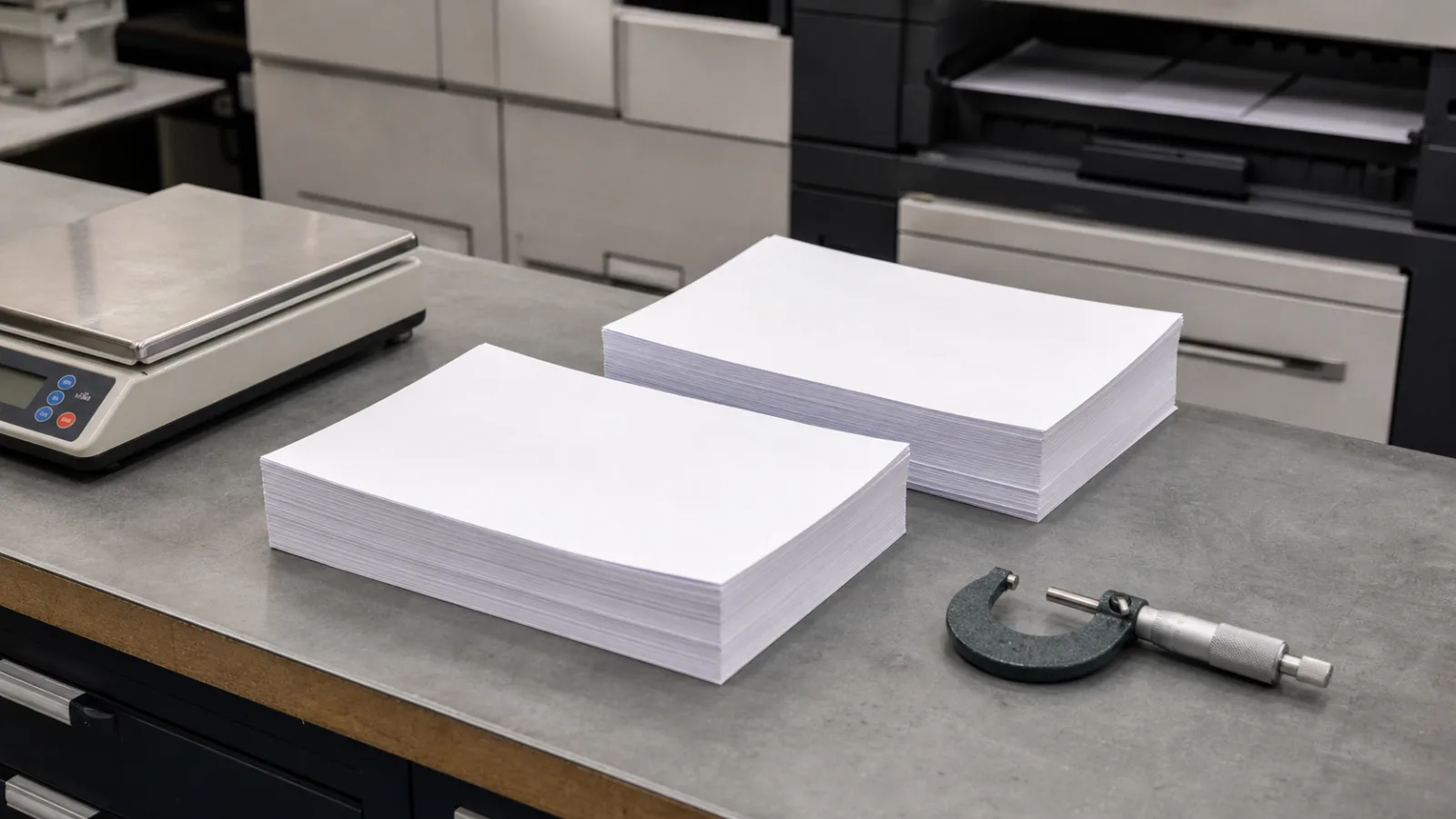

Recycled-content paper should be specified as a documented paper grade that must perform in a defined printed product. A recycled-fibre percentage is important when it meets a buyer policy, customer brief or procurement requirement, but it does not by itself establish print appearance, press performance, finishing suitability or the environmental outcome of the finished item.
Start by defining what the product has to do: carry text or high-coverage images, fold without visible cracking, survive mailing, accept a coating, run through digital equipment, or present a consistent shade across a campaign. Then set a recycled-fibre requirement that can be evidenced for the supplied grade. This approach prevents a common failure: approving a claim at the purchasing stage and discovering too late that the paper has not been qualified for the intended press or finish.
Start with the printed product, not a recycled-content percentage
Paper is an engineered sheet, not simply a fibre claim. Its furnish, formation, basis weight, bulk, surface treatment, moisture condition and converting history interact with the printing process. A sheet suitable for uncoated text pages may not be appropriate for a high-coverage direct-mail piece, a rigid folded carton, a laser-printed form or a publication requiring low show-through.
The product brief should therefore identify the functional job before the fibre requirement is written. Ask the printer, converter or merchant which grades are normally considered for the relevant process and format. A grade intended for reel-fed web offset cannot be assumed to behave the same way in sheetfed offset, electrophotographic printing or inkjet production.
The U.S. Government Publishing Office’s paper specifications illustrate this grade-specific approach. Its specification for JCP A70, for example, identifies a particular uncoated recycled text grade, describes intended uses and sets a recovered-fibre requirement within that grade definition. It is useful as an example of how fibre content and paper construction can sit together in a specification, rather than treating recycled content as the whole requirement. The GPO paper specifications should not be adopted automatically for commercial work outside its stated scope.
At minimum, define:
- the product type and expected service conditions;
- printing process, press format and ink, toner or inkjet system where known;
- paper category, such as uncoated text, coated text, cover, label face stock or publication grade;
- basis weight and sheet or reel dimensions;
- finish, shade and visual targets;
- finishing sequence, including folding, binding, varnishing, coating, die-cutting or embossing;
- the recycled-fibre claim and acceptable evidence; and
- the approval route for samples, proofs or production trials.
This leaves room to compare viable grades without weakening the recycled-content objective.
Define the recycled-fibre requirement and its evidence
Use the terms required by the applicable customer policy, procurement rule or ecolabel criterion. “Recycled content,” “total recovered fibre” and “post-consumer fibre” are not interchangeable unless the governing requirement says they are.
In practical terms, total recovered fibre can include material recovered from different points in the paper and product stream. Post-consumer fibre is generally used for material recovered after consumer or end-user use. The precise definition, calculation basis and permitted evidence must come from the requirement governing the purchase. Do not assume that a supplier’s marketing term uses the same definition as a customer’s procurement policy.
Write the requirement in a form that can be quoted and checked. For example:
The supplied paper grade shall contain not less than the agreed percentage of total recovered fibre, including not less than the agreed percentage of post-consumer fibre where stated. The supplier shall provide a current declaration identifying the exact grade, basis weight or range where relevant, and the claimed fibre-content basis.
The percentages in that wording must be filled in only when they come from a valid purchasing requirement or an agreement with the buyer and supplier. Avoid adding a universal threshold merely because it appears in an unrelated standard or public tender.
Request evidence that identifies the actual material being supplied. Depending on the programme and market, this may include:
- a mill declaration for the named grade;
- a current technical data sheet and product identification;
- a certificate or licence document where a specified certification programme applies;
- a merchant’s traceable supply documentation; and
- batch or lot information when the project requires stronger control.
A recycled-content declaration does not automatically prove chain of custody, responsible forest management, lower greenhouse-gas impact, recyclability in a local collection system, compostability, food-contact suitability or regulatory compliance. These are separate claims with different evidence needs.
For example, Green Seal GS-7 is a standard for printing and writing paper with a defined scope and requirements beyond recycled content. It may be relevant only where the product, edition, market and certification status have been confirmed. It should not be used as a generic proof for every recycled-content paper.
Specify the sheet properties that protect print appearance
Do not use “good print quality” as an acceptance criterion. Separate the properties that affect the visual and functional outcome, then agree how they will be evaluated.
Brightness and shade influence perceived whiteness, contrast and colour reproduction, but they are different properties. Brightness is a measured optical response under a stated method; shade describes the visual hue of the paper. A bright sheet may have a cool or warm cast, and two sheets with similar nominal brightness can look different beside one another. Approve a physical drawdown or printed sample when colour-critical work is involved.
Opacity matters where content on one side of the sheet can show through from the other. It is affected by the sheet’s construction, basis weight, fillers and other grade-specific variables. If show-through is unacceptable, state the end-use condition: duplex text, dense black type, colour imagery or variable-data content. A number without its test method, conditioning and acceptance range can create disputes rather than control them.
Other useful specification variables include:
| Property | Production consequence | Approval question |
|---|---|---|
| Basis weight | Influences feel, yield, stiffness, postage and some press settings | Is the nominal weight and permitted variation suitable for the job? |
| Bulk and caliper | Affect spine width, folding, stack height and apparent substance | Will the paper fit the binding, mailing or packaging geometry? |
| Formation | Can affect visual uniformity and consistency in solid areas | Is formation acceptable in the intended printed image? |
| Smoothness or surface profile | Influences ink transfer, image sharpness and gloss response | Is the surface compatible with the print process and coverage? |
| Surface strength | May affect picking, linting or coating performance under demanding conditions | Has the grade been approved for the chosen ink, blanket or coating system? |
| Moisture condition and curl tendency | Can influence feeding, register and flatness | Will storage and pressroom conditions be controlled before use? |
Recycled fibre does not determine any one of these outcomes on its own. A grade’s furnish, refining, additives, fillers, coating or sizing, basis weight and manufacturing controls all matter. Compare current data sheets for candidate grades, but treat nominal values as a starting point, not a substitute for a job-specific approval.
Confirm runnability, ink behaviour and finishing on the intended process
Paper, press, imaging system, ink or toner, dampening solution, coverage and finishing equipment form a production system. A stock that is satisfactory in one workflow may require different settings, drying time or finishing controls in another.
Ask the printer to review the planned job before paper is ordered, particularly when any of the following apply:
- large solid areas, heavy ink coverage or dense black;
- tight register tolerances or small reverse type;
- short turnaround with limited drying or curing time;
- high-speed folding, stitching, perfect binding or other automated finishing;
- aqueous coating, varnish, lamination, foil, embossing or die-cutting;
- cold storage, humid distribution conditions or mailing; or
- a new grade, a new supplier, or a change from a previously approved paper.
A pre-production trial should reflect the actual product as closely as reasonably possible. It should identify the grade, basis weight, sheet or reel format, press, imaging system, coverage, ink or toner, drying or curing conditions, finishing sequence and environmental conditions where these are material.
The assessment can cover feeding, static, curl, register, ink transfer, set-off, drying or curing, marking, dusting, scuff resistance, folding performance, cracking, trimming, binding and finished appearance. Not every check applies to every job. The important point is to agree the relevant checks before the trial and record any limitations. A low-coverage proof, for example, is not evidence that a high-coverage production piece will dry or scuff in the same way.
Supplier guidance can help select candidates, but it should be read within its stated scope. UPM Eco H product information, for example, concerns a named supercalendered, heatset web-offset grade and its recommended uses. That does not predict performance for another grade, basis weight or printing method.
Write a requirement that can be quoted, supplied and checked
A workable requirement gives suppliers enough detail to quote comparable options and gives the buyer an approval basis. It should also control substitutions, which are a common source of claim and appearance problems.
Use this structure as a starting point:
- Product and process: State the product, print method, coverage profile, press format and planned finishing operations.
- Approved grade: Name the preferred grade, or define approved equivalents with a requirement for written approval before substitution.
- Physical format: Specify basis weight, size, grain direction where relevant, reel width or diameter, and packaging requirements.
- Surface and appearance: State coated or uncoated construction, finish, shade and any agreed sample or colour target.
- Recycled-fibre claim: State total recovered fibre and post-consumer fibre requirements separately where applicable, including the required calculation basis.
- Evidence: Identify the documents required from the mill, merchant or converter and the date or production period they must cover.
- Performance targets: Include only those optical or physical values that have an agreed test method, unit, conditioning requirement and acceptance range.
- Approval process: State whether approval requires an unprinted sample, digital proof, press proof, finished dummy or production trial.
- Consistency and change control: Require notification and approval for a change in grade, mill, basis weight, finish, claimed fibre content or other material characteristic.
Avoid specifying a paper solely by a generic descriptor such as “100% recycled, premium quality.” It is difficult to quote consistently and does not establish whether the paper will meet the finished product’s needs.
Check environmental claims against the product and market
Environmental communications should remain as narrow as the available evidence. If the supplied grade has a verified recycled-content declaration, a claim may state that attribute in the precise terms supported by the documentation. Do not extend it into a total environmental verdict.
Before publishing a claim on packaging, printed collateral or a product page, confirm:
- the exact supplied grade and the period covered by the declaration;
- whether the claim refers to total recovered fibre, post-consumer fibre or another defined category;
- the destination market’s consumer-protection, labelling or customer requirements;
- whether a certification name or logo may be used and under what licence; and
- the product’s likely collection and recovery route after use.
Recycled content and recoverability are related but separate questions. A printed product may include coatings, adhesives, laminates, labels, inks or attachments that affect how it is handled in a particular recovery system. Confirm local collection and processing expectations separately rather than inferring them from the paper furnish.
Frequently asked questions
What is the difference between total recovered fibre and post-consumer fibre in a paper specification?
Total recovered fibre is a broader recovered-material measure, while post-consumer fibre refers to material recovered after consumer or end-user use. Use the definitions in the applicable policy, standard or customer requirement, and request documentation for the exact supplied grade.
Does a higher recycled-content percentage mean a paper will print worse?
No. Print performance depends on the specific grade construction, basis weight, surface, press, ink or toner system, coverage and finishing conditions. A higher percentage should trigger grade review and trial planning where the job is demanding; it is not a performance prediction.
Which paper properties should be approved before printing on recycled-content stock?
Approve the properties that matter to the product: basis weight, shade, brightness where relevant, opacity, surface, bulk or caliper, stiffness, print appearance and finished performance. For demanding work, include a press or production trial using representative coverage and finishing.
What evidence should a mill or merchant provide for a recycled-content claim?
Request a current declaration tied to the named grade, supported by the applicable technical documentation. Where a programme or customer rule requires certification or a particular claim format, confirm the current certificate scope, licence status and permitted wording separately.
Select recycled-content paper by matching a documented fibre claim to a named grade that has been approved for the actual printing and finishing workflow. If a requirement cannot be measured, evidenced or accepted by the printer and buyer, it is not yet a complete specification.