
Paper moisture conditioning is the controlled handling of paper as it moves from storage into printing and finishing environments. It matters because paper is hygroscopic: it absorbs or releases water vapour as surrounding conditions change. That exchange can alter sheet dimensions, flatness, stiffness and transport behaviour.
The practical problem is not simply whether paper is dry or damp. Trouble often begins when different parts of a sheet, stack or roll change at different rates. The result may be curl, wavy edges, tight edges, feeding failures, register drift or instability during folding, die-cutting, laminating and gluing.
There is no universal moisture percentage, pressroom relative humidity or acclimatisation period suitable for every job. The appropriate conditions depend on the grade, furnish, coating, basis weight or caliper, packaging, equipment, climate and production route. Supplier guidance and controlled trials must therefore take precedence over generic limits.
Why paper moves when the environment changes
Paper contains a network of fibres and pores that exchanges moisture with the surrounding air. Given enough time under stable conditions, it approaches an equilibrium moisture content: a moisture level associated with that material and environment.
Several measurements are relevant, but they are not interchangeable:
- Relative humidity describes the amount of water vapour in the air relative to what that air could hold at the same temperature.
- Temperature affects relative humidity and the rate and direction of heat transfer. It also influences whether moisture condenses on cold material.
- Paper moisture content expresses the water present in the paper relative to its mass under a defined measurement method.
- Equilibrium relative humidity, where used, characterises the humidity associated with a material in a closed measurement environment. It is not simply a room-humidity reading.
An ambient relative-humidity reading does not directly reveal the moisture content throughout a pallet or roll. Nor does a stable pressroom mean that the centre of a wrapped stack has already reached the same temperature or moisture equilibrium. Packaging slows exchange, while the mass and low exposed surface area of a pallet can create a substantial time lag.
General storage guidance consistently describes paper as moving toward equilibrium with its environment and recommends acclimatisation before use. The CFW Environmental discussion of paper storage provides this broad context, but grade-specific targets still need to come from the paper manufacturer.
The magnitude and direction of movement depend on the sheet itself. Furnish, fibre length, refining, fibre orientation, coating, multilayer construction and previous drying or conditioning all affect dimensional response. The PaperWorks explanation of curl and dimensional stability discusses how fibre composition and orientation influence moisture expansion. These variables are especially important in paperboard, where different layers may not respond identically.
How moisture imbalance becomes curl and dimensional change
Curl is curvature caused by unequal dimensional change through the sheet or board. If one face expands or contracts more than the other, the two sides cannot remain flat without internal stress. The sheet bends to accommodate the difference. This differential-change mechanism is also described in the PaperCurl technical resource.
The imbalance may come from the original construction, one-sided coating, uneven storage exposure, asymmetric printing, process heat or a combination of factors. Curl direction cannot reliably be predicted from a moisture percentage alone.
A different pattern develops when exposed edges exchange moisture faster than the centre of a stack:
- Wavy edges can occur when the edges absorb moisture and expand while the centre remains comparatively unchanged. The enlarged perimeter cannot lie flat.
- Tight edges can occur when exposed edges lose moisture and contract relative to the centre.
- Cockling is localised, irregular distortion rather than uniform curvature. Uneven wetting, drying, coverage or sheet formation may contribute.
Paper also moves differently along and across its predominant fibre orientation. This anisotropic behaviour means a moisture change can alter one sheet dimension more than the other. Grain direction therefore interacts with moisture conditioning, imposition and finishing geometry rather than replacing environmental control.
On press, distorted sheets can destabilise the pile, interfere with separation and feeding, lift away from transport surfaces or arrive inconsistently at grippers and registration systems. Dimensional change between colours, sides or passes can appear as image-to-image or front-to-back register drift. These symptoms are not proof of a moisture problem, however; mechanical feed, imaging, tension and press-setting faults can produce similar results.
Store and acclimatise paper before opening it
Acclimatisation should allow protected paper to approach the production-area temperature before its wrapper is removed. Keeping the package closed during this stage limits uncontrolled moisture exchange.
Cold paper is a particular risk when moved into warmer, humid air. Air next to the cold package or sheets cools, increasing local relative humidity and potentially causing condensation. Opening the wrapper immediately exposes sheet edges and surfaces just when the temperature difference is greatest. This mechanism is outlined in the Pressman Academy discussion of climate and the pressroom.
A practical receiving and staging workflow is:
- Record the delivery condition. Note the paper grade, lot, quantity, arrival time, wrapper integrity and visible pallet, carton or roll damage.
- Compare environments. Log temperature and relative humidity in receiving, storage, staging and production areas over time, not only at one convenient location.
- Keep the stock protected. Leave reams, cartons, rolls or pallets wrapped while their temperature approaches the intended operating environment.
- Follow the supplier’s conditioning guidance. Package size, stock mass, temperature difference and grade can all change the required time.
- Open only the quantity needed. Long exposure before printing can undo controlled storage, especially around the edges of a pile.
- Reprotect unused material. Use the original moisture-resistant wrapping where practical, or an agreed protective method suitable for the stock and storage period.
- Preserve identification. Keep lot, grain direction, face orientation and supplier labels traceable after partial packages are returned to storage.
A fixed instruction such as leaving every pallet for a set number of hours is not defensible without defined conditions. Acclimatisation time varies with the initial temperature difference, stack or roll mass, package construction, airflow, grade and supplier instructions.
What changes across offset, digital and finishing workflows
Environmental stability remains important across print processes, but the sources of imbalance differ.
Offset lithography
Sheetfed offset may expose paper to repeated press passes, pile handling and extended waiting periods between sides or colours. Conventional lithographic processes also introduce dampening solution at the printing unit, although the amount transferred to the sheet depends on the press, settings, ink-water balance and job.
Register-sensitive work can be affected if sheets gain or lose moisture between passes or if one side experiences a different process history from the other. Record pass sequence, elapsed time, pile protection, image coverage and sheet orientation before attributing movement solely to the delivered paper.
Digital printing
Electrophotographic systems generally expose media to rapid heating and transport through multiple nips and bends. Moisture loss, toner coverage, fusing conditions, duplexing and the construction of the media can interact to produce curl or transport difficulty. The relevant operating limits and approved substrates must be confirmed for the exact press model and configuration.
Production inkjet is too broad a category for a single moisture rule. Water-based or other ink chemistry, media treatment, laydown, drying technology, web tension and sheet or web construction all matter. A grade described generically as inkjet compatible may still require qualification for the specific machine, ink set, coverage and finishing route.
Post-press operations
A sheet that leaves the press within print tolerance may continue exchanging moisture before finishing. Process heat may also leave a temporary temperature or moisture gradient within a pile.
Changed flatness or dimensions can affect:
- feeder separation and transport through folders or binders;
- fold alignment and cracking risk;
- score position and score-to-fold relationship;
- die-cut, embossing or foil register;
- lamination flatness and curl after cooling;
- adhesive contact, open time and bond consistency;
- front-to-back alignment in cutting and binding.
These faults are not automatically environmental. Grain direction, score geometry, tooling condition, lamination tension, adhesive selection and machine setup remain separate diagnostic branches.
Pressroom checks that separate environment, stock and process
A useful investigation establishes where the defect first appears. Retain labelled samples from receipt, after conditioning, after each printed side or pass, and before and after finishing.
Environmental and stock checks
- Log temperature and relative humidity at storage, staging, press and finishing locations over a meaningful period.
- Position sensors where the paper is actually held, while avoiding readings distorted by doors, direct sunlight, heaters, humidifier outlets or local draughts.
- Check calibration status and response time for each instrument.
- Compare unopened stock with stock exposed to the room.
- Inspect wrappers for punctures, open seams, water marks or repairs.
- Identify wavy edges, tight edges, cross-direction or machine-direction curl, cockling and stack lean.
- Confirm grade, lot, basis weight or caliper, grain direction, face orientation and coating construction.
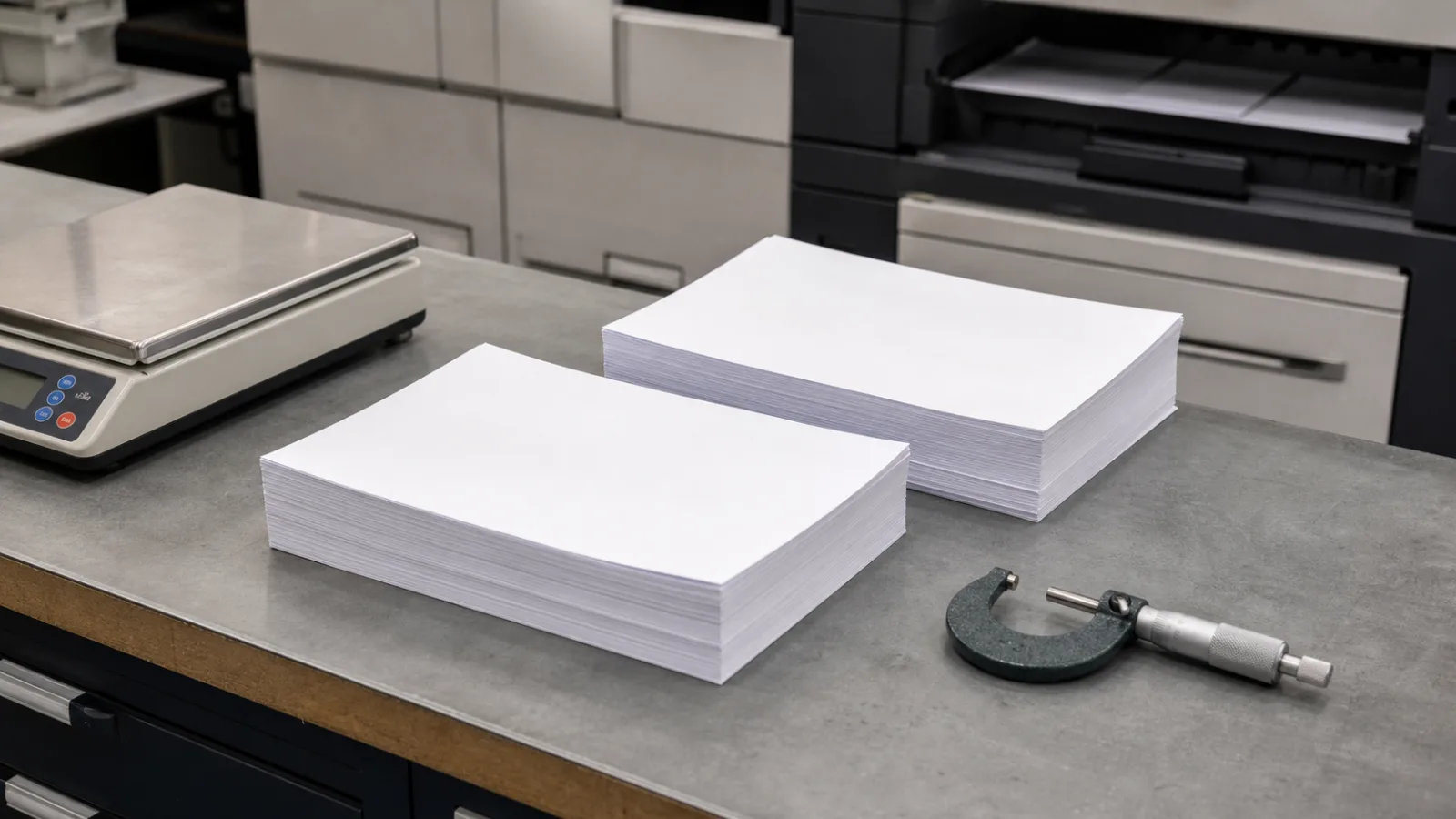
Handheld paper moisture meters can help compare samples when they are suitable for the grade and used consistently. Their readings depend on instrument design, calibration, substrate settings, measurement depth, contact and environmental conditions. A surface reading should not be treated as proof of the condition inside a pallet, roll or thick stack. Follow the instrument manufacturer’s procedure and use repeatable sampling locations.
Controlled production trial
When practical, run a limited trial that changes one variable at a time. For example, compare protected and exposed stock from the same lot while holding press settings, orientation, coverage and finishing delay constant. Record the opening time, process temperatures or relevant machine settings, side sequence and elapsed time at each stage.
Changing the paper grade, environmental setting, decurl adjustment and pass sequence simultaneously may remove the symptom, but it will not establish the cause.
Troubleshooting by symptom
| Symptom | Moisture-related checks | Other causes to exclude |
|---|---|---|
| Curl on arrival | Wrapper integrity, lot consistency, face and grain orientation, edge-to-centre condition | Pallet damage, inherent construction, winding or sheeting history |
| Curl after printing one side | Coverage, one-sided wetting or heating, pile exposure, sheet orientation | Press transport, coating or lamination tension, asymmetric construction |
| Register drift | Dimensions before and after each pass, conditioning history, pile waiting time | Gripper, feed, blanket, imaging, tension or register-control faults |
| Wavy or tight edges | Difference between wrapped and exposed sheets, local room conditions, exposure time | Poor stacking, edge damage, uneven cutting |
| Duplex feeding failure | Curl direction before and after the first side, heat history, approved-media status | Roller condition, static, separation settings, incorrect caliper setup |
| Folding or die-cut mismatch | Sheet dimensions and flatness at finishing, grain direction, time since printing | Tooling, score geometry, imposition, mechanical register |
| Lamination or gluing fault | Paper condition before application and after curing or cooling | Adhesive compatibility, coat weight, surface treatment, tension, pressure |
If a defect appears only after one process stage, investigate that stage before rejecting the incoming paper. If unopened packages from the same lot show the same distortion, preserve samples and records for review with the merchant or mill.
Frequently asked questions
How long should paper acclimatise before its wrapper is opened?
There is no universal period. Use the paper supplier’s guidance for the exact packaging format and grade. The required time depends on the temperature difference, package mass, wrapper construction, airflow and production environment. The objective is to reduce the temperature difference while the paper remains protected, not merely to leave it in the room for an arbitrary interval.
What is the difference between paper moisture content and pressroom relative humidity?
Paper moisture content measures water associated with the paper under a specified method. Relative humidity describes water vapour in the air at a particular temperature. The two interact, but one does not directly determine the other without considering material behaviour, temperature, exposure time and measurement method.
Can paper meet its supplied moisture specification and still curl on press?
Yes. A bulk or sampled moisture result may fall within a supplier specification while the sheet has a through-thickness gradient, edge-to-centre imbalance or asymmetric response to printing and heat. Construction, coating, coverage, orientation and handling history can also affect curl. Confirm how the moisture value was measured and where the defect first developed.
Should curled paper be reconditioned, turned over, decurled or rejected?
The remedy depends on the cause. Reconditioning may help some environmentally induced imbalances, but it can also delay production or create another gradient if uncontrolled. Turning a pile or changing face orientation may alter the symptom without resolving dimensional instability. A machine decurler must be used within equipment guidance and can compensate only for certain curl patterns. Reject stock when it fails agreed incoming requirements and controlled checks indicate the condition existed before production; otherwise, isolate the process stage responsible before deciding.
What to specify with each production partner
Ask the mill, merchant, printer and finisher to identify the exact grade, basis weight or caliper, coating and multilayer construction, grain direction, packaging format and intended print process. Where available, request the supplied moisture specification together with its test method, sampling conditions and tolerance rather than accepting descriptions such as dry, stable or digitally compatible.
For digital work, confirm qualified-media status for the exact press model and configuration. For finishing, define measurable acceptance requirements for register, flatness, fold or score position, die-cut alignment, binding, gluing and lamination performance.
The final approval should match the job and production route: intact wrappers, traceable lots, documented environmental history, a representative trial quantity and retained samples from critical stages. Conditioning is effective only when storage, press and finishing controls form one continuous system.