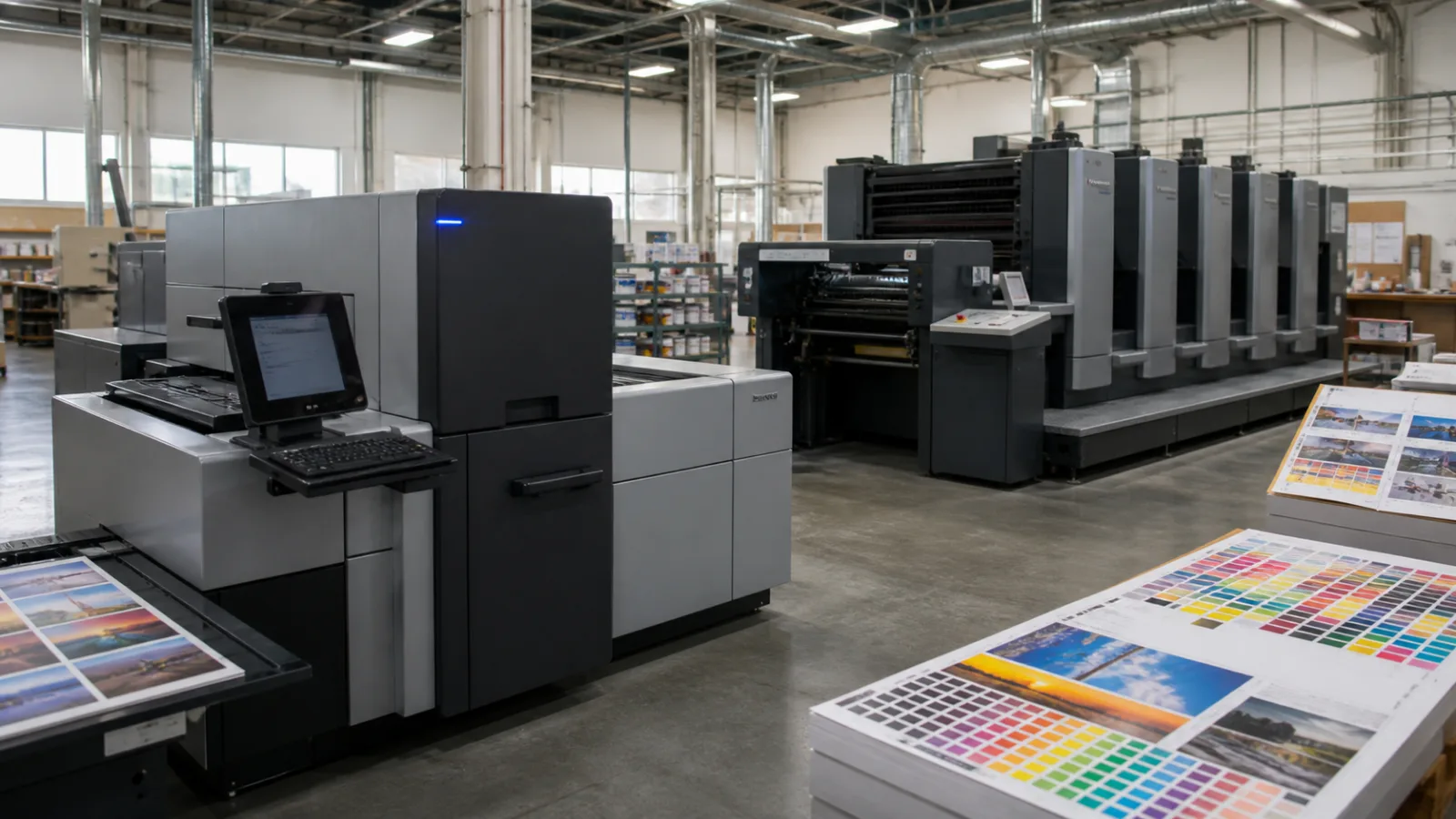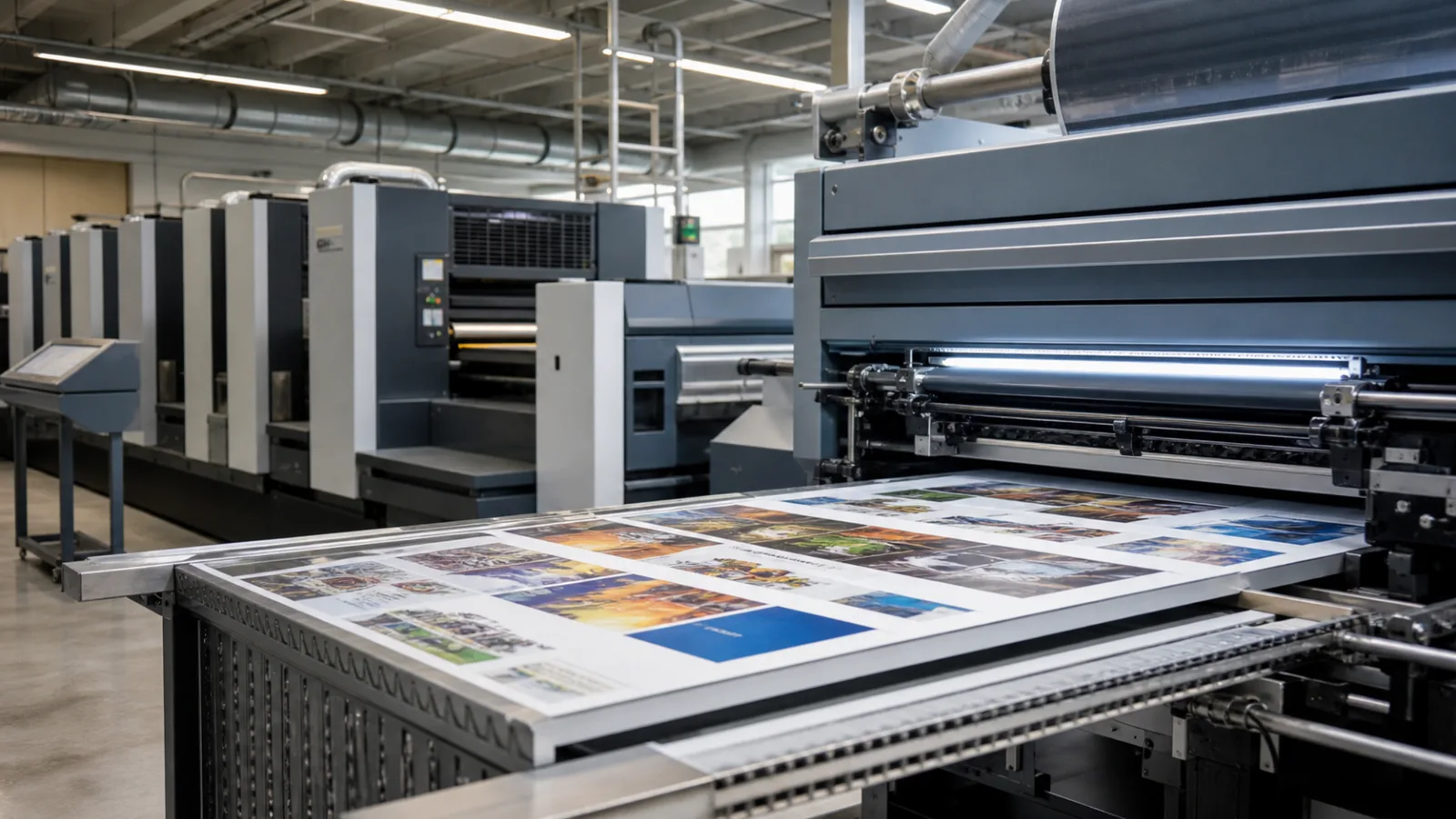


A colour approval chain is the recorded path from the intended printing condition to the file, proof, press sheet, and finished product. It establishes what has been approved, which reference was used, who had authority to approve it, and what should happen if production departs from that reference.
The chain matters because “approved for print” can mean several different things. A PDF may be approved for text and pagination without being a reliable colour prediction. A verified hard proof may predict a defined process-colour condition but not a metallic ink, laminate, or unprinted stock outside its simulation. A press sheet may be visually acceptable at makeready yet fail to represent variation through the full run.
No single profile, proof, measurement, or signature resolves all of these questions. A defensible approval process links them and records the limits of each decision.
Define what each approval is meant to prove
An approval should identify its purpose before anyone signs it or selects an approval button. The main purposes are distinct:
- Content approval accepts copy, image selection, page order, dimensions, and layout.
- Technical file approval accepts matters such as trim, bleed, image resolution, separations, overprints, and finishing layers.
- Soft colour approval accepts an on-screen prediction under documented display and software conditions.
- Contract proof approval accepts a physical colour prediction of a stated printing condition.
- Makeready approval accepts a clearly identified press sheet as the production reference at the start of the run.
- Finished-product approval considers the converted result, including coatings, laminates, folds, adhesives, or other changes that can affect appearance.
The FESPA guide to proofing and approval cycles distinguishes soft proofs, physical proofs, and colour contract proofs. That distinction should also appear in job records. Calling every output a “proof” leaves its authority unclear.
For each stage, record the approved object and revision, the reference condition, the decision-maker, the acceptance rules, and the permitted subsequent changes. A signature on an unidentified sheet is weak evidence if multiple file revisions or proof versions exist.
A simple chain might be:
- Approve content and geometry on a PDF.
- Freeze the colour-managed production file.
- Approve a verified contract proof made from that file.
- Use the proof and process targets during press makeready.
- Approve and retain an identified press sheet.
- Sample production and escalate material deviations.
- Reapprove if a controlled input changes.
The printer’s own quality plan should state the named decision-makers, sampling procedure, escalation route, and change-control process.
Anchor colour to a defined printing condition
An ICC output profile describes characterised colour behaviour associated with a particular output condition. It is not a complete press specification and cannot make different presses, papers, inks, or finishes behave identically.
The ISO/TC 130 guidelines for using print production standards explain a printing condition through primary process parameters that affect appearance. Depending on the process, these include substrate colour and gloss, process-ink colours, screening, and tonal-value behaviour.
Before files are separated or proofs ordered, the production provider should identify:
- printing process and intended characterised condition;
- exact ICC output profile and version;
- substrate grade or applicable substrate class;
- process ink configuration and any expanded-gamut or special inks;
- screening and relevant tone-reproduction controls;
- separation policy, including total ink limits and black generation where applicable;
- expected coatings, laminates, varnishes, or other appearance-changing finishes;
- documented departures from the characterised condition.
Three profile operations are often confused. Assigning a source profile tells colour-managed software how existing colour values should be interpreted. Converting changes the values to preserve appearance as far as possible in another colour space. Simulating uses an output profile to predict how a defined output condition may reproduce the content.
Assigning the wrong profile can change the interpretation of the file without changing its numbers. Converting repeatedly can alter separations and introduce avoidable rounding or gamut-mapping changes. Simulating an output condition does not convert a display into paper; it remains an emissive preview of reflective output.
The job specification should therefore state who may assign or convert profiles, which rendering policy applies, whether embedded profiles must be preserved, and whether the printer may reseparate supplied files. Profile names alone are insufficient because similar names may refer to different datasets, versions, or regional workflows.
Set the limits of monitor and PDF approval
A calibrated and profiled monitor can support colour correction and soft proofing, but only as part of a controlled system. Relevant variables include display gamut and uniformity, calibration targets, profile age, ambient illumination, monitor brightness, application settings, rendering intent, and correct treatment of embedded profiles.
An ordinary office monitor, browser window, email preview, or screen capture does not establish those conditions. It can still be useful for checking words and layout, but the approval record should say “content only” rather than imply colour acceptance.
| Approval object | Main purpose | Necessary controls | Approval consequence |
|---|---|---|---|
| Content PDF | Copy, layout, pagination, dimensions | Correct revision and reliable page rendering | Accepts content and geometry, not necessarily colour |
| Soft colour proof | On-screen prediction and image adjustment | Calibrated, profiled display; controlled light; correct profiles and application settings | Accepts a conditional display simulation |
| Contract hard proof | Physical prediction of a defined printing condition | Traceable proof setup, control wedge, verification method, controlled viewing | Establishes a physical colour reference within its stated scope |
| Press sheet | Makeready and production reference | Correct file, stock, inks, press controls, measurement settings, identification and retention | Accepts production output at a particular time and condition |
Soft proofing can reveal likely gamut compression, shadow loss, paper-colour effects, and separation problems before output. It remains subject to differences between emitted light and reflected print. Highly saturated colours, very dark tones, optical effects, metallics, fluorescents, surface gloss, and textured stocks may be particularly difficult to judge from a display alone.
Before treating a screen decision as colour-critical, record the display, calibration settings, measurement date, viewing environment, software configuration, output simulation profile, and profile-embedding policy. If those details are unavailable, narrow the approval to content and layout.
Make the contract proof traceable and verifiable
A contract proof is not simply a high-quality presentation print. It is intended to predict a stated printing condition and to function as an agreed physical reference. Its value depends on traceability and verification, not visual plausibility alone.
A colour-critical proof should travel with:
- customer, job, and component identification;
- source file name, revision, and production date;
- simulated printing condition and exact profile;
- proofing device, workflow, ink, and proof substrate identification where required by the quality plan;
- date and operator or responsible provider;
- control wedge or control strip;
- measurement instrument and measurement condition;
- measured result, applicable acceptance method, and pass/fail status;
- viewing instructions;
- approval signature or attributable digital record.
ISO 12647-7:2016 addresses requirements, aim values, and tolerances for digital proof printing intended to simulate a defined printing condition. The supplied sample of ISO 12647-7:2016 is useful for understanding that scope, but it is not the complete standard or proof that a particular system conforms. Current status, applicable edition, full requirements, and any conformity claim must be checked with the responsible standards body and the proof provider.
A verification label also needs interpretation. Confirm which control strip was measured, when it was measured, which instrument settings and backing were used, what printing condition was simulated, which acceptance rules applied, and whether the label corresponds to the supplied proof. A label by itself does not establish that the correct file or target condition was used.
If a proof lacks this information, it may still assist discussion, but it should not silently become the contractual colour master.
Translate the proof into press-side targets
The approved proof is one reference within press control. It is not an instruction to alter ink by eye until every element appears identical under uncontrolled conditions.
Press-side control should link the approved file and proof to measurable production targets. Depending on the process and job, these may cover substrate colour, process-colour solids, tonal values or curves, grey balance, register, spot-colour targets, and other process-specific parameters. The specification should identify the measurement instrument, geometry, illuminant and observer settings where relevant, backing, sampling frequency, target values, tolerances, and nonconformance procedure.
Universal colour-difference tolerances should not be inserted into a generic approval form. Suitable limits depend on the applicable process specification or customer agreement, patch type, colour set, measurement condition, production capability, product use, and contractual context.
At makeready, the production team should confirm:
- The press is using the approved file revision and imposition.
- The stock and ink configuration match the job specification.
- Instrument settings match those used to define the targets.
- Process controls are within the agreed operating range.
- Visual comparison takes place under the specified viewing condition.
- The approved press sheet is marked, dated, signed, and retained.
- Production samples are taken at the agreed frequency to detect drift.
If the press cannot reproduce the approved reference within the agreed rules, the response should be escalation, not undocumented correction. Possible causes include a mismatched profile, wrong substrate, proof limitation, press condition, ink issue, finishing effect, or an image colour outside the production gamut. The responsible parties then decide whether to correct the process, revise the file, accept a documented deviation, or produce a new proof.
Special inks, metallics, fluorescents, varnishes, laminates, and optical brightening agents need job-specific evaluation. A conventional process-colour proof may not predict their spectral or surface effects adequately.
Control the light used for visual decisions
Colour appearance depends on illumination as well as the object and observer. A proof and press sheet compared under different lights can produce different judgements even when measurement data remain unchanged.
Specify the visual assessment condition, including illuminant, light level where required, surround, glare control, backing, booth condition, and observer adaptation. D50-based conditions are commonly associated with graphic-arts proof viewing, but the exact current standard, edition, scope, and numerical requirements should be verified before claiming compliance.
A standardised booth creates a repeatable production comparison; it does not guarantee identical appearance in every office, shop, home, or outdoor setting. Materials and colourants with different spectral responses may match under one light and diverge under another, an effect associated with metamerism. Optical brightening agents can also affect comparisons between proofing and production substrates.
For packaging, retail displays, or other lighting-sensitive applications, compare critical colours under both the agreed production viewing condition and representative end-use lighting. Record booth lamp type, maintenance or inspection status, surround and backing arrangement, and any separate application-light review.
Measurement supplements visual assessment but does not eliminate it. Instruments provide repeatable data under defined settings; observers still need to evaluate image relationships, gradients, fine detail, gloss, texture, and the appearance of the converted product.
Use a recorded colour approval checklist
Buyer or brand owner
- State which elements are colour-critical and which are informational.
- Name the authorised approver and substitute.
- Define whether approval covers content, predicted colour, press output, or the finished product.
- Agree tolerances, viewing conditions, escalation, and permitted deviations with the printer.
- Identify relevant end-use lighting and finishing requirements.
Designer or prepress team
- Confirm the intended printing condition before separation.
- Preserve and document source profiles.
- Record conversions, rendering policy, and output profile version.
- Freeze the approved file revision and identify every proof from it.
- Mark non-colour-accurate PDFs clearly.
- Trigger reapproval after changes that can affect separations or appearance.
Printer or converter
- Confirm the production condition, substrate, ink set, press, and finishing route.
- Supply the proof verification record and viewing instructions.
- Document press targets, instrument settings, tolerances, and sampling frequency.
- Identify and retain the approved makeready sheet and production samples.
- Escalate mismatches rather than making unrecorded file or process changes.
Colour approval questions
Is a PDF proof enough to approve colour?
Only when it is produced and viewed as a controlled soft proof with documented colour-management and display conditions. A normal PDF viewed on an unspecified screen is better restricted to content, layout, and pagination approval.
What makes a hard proof a contract proof?
It must be intended to simulate a defined printing condition and carry enough identification and verification information to establish what was produced and assessed. An attractive print without a target condition, control data, or traceable file revision is a presentation proof, not automatically a colour contract.
Should the press sheet match the contract proof exactly?
The press sheet should satisfy the agreed visual and measurable acceptance rules for the target production condition. An exact visual identity cannot be assumed because proof and production systems may differ in substrate, ink, surface, gamut, screening, and illumination response.
When is colour reapproval required?
Reapproval should be triggered when a change could invalidate the accepted prediction or production target. Examples include a new file revision, profile or separation change, different paper, ink set, press condition, proof system, coating, laminate, or colour-significant finishing operation. The job’s change-control procedure should define which changes require a new proof, a new press approval, or both.
The bounded rule is straightforward: colour approval is defensible only when the approved reference and production target describe the same condition, and when any departure has a recorded disposition.