
Digital printing substrate qualification establishes whether a specific paper or board can be run acceptably on a particular press configuration for a defined job and finishing route. It is not a general declaration that the material is suitable for every digital press.
Approved-media status is a useful starting point, but it does not replace production checks. A qualification should connect the exact substrate, imaging system, media settings, artwork, environment and converting sequence. Changing one of those elements may change feed reliability, image quality, adhesion, registration or finishing performance.
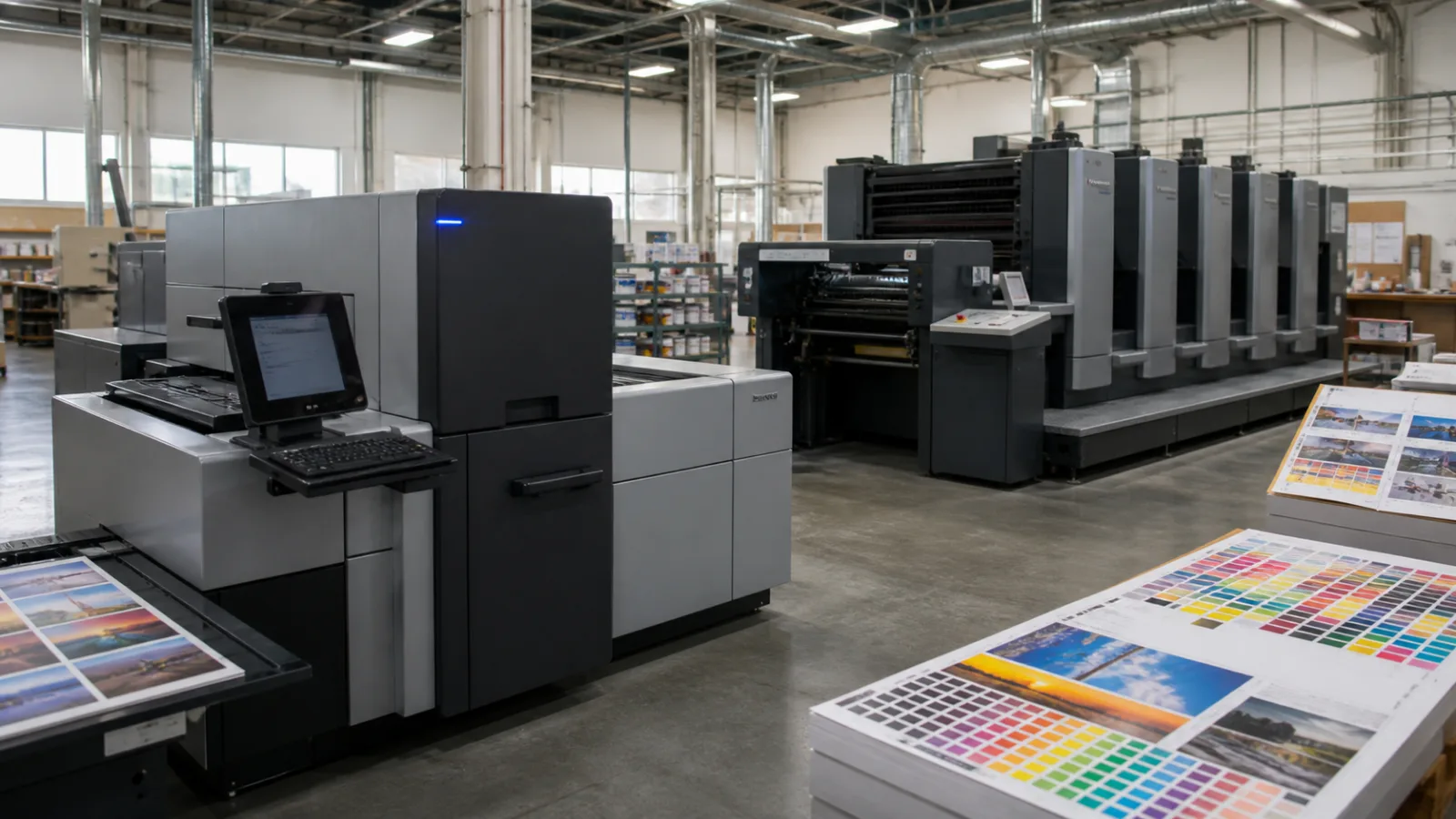
Toner, liquid electrophotographic and production inkjet systems do not impose identical requirements. Even presses within the same technology category can have different transport paths, transfer conditions, fusing or drying systems, media libraries and operating limits. Use the current documentation for the installed machine rather than a generic compatibility statement.
Define the qualification scope first
Record the production combination before selecting or testing a substrate. At minimum, identify:
- Press manufacturer, exact model and installed configuration
- Imaging process and the applicable toner, ink or treatment system
- Sheet-fed or web format and intended feed path
- Single-sided or duplex production
- Production speed or quality mode to be used
- Finished size, imposed sheet or web layout and grain requirement
- Representative ink or toner coverage, including heavy solids and reverses
- Required color condition and measurement method, where applicable
- Cutting, creasing, folding, laminating, coating, binding or gluing sequence
- End-use appearance, handling and durability requirements
This scope prevents an apparently successful but unrepresentative trial. A light-coverage simplex test, for example, does not establish that the same stock will remain flat, register correctly and finish cleanly during a heavy-coverage duplex job.
Certification also has a defined boundary. Idealliance describes systems evaluated against specified conditions, including programs involving particular ink-and-media combinations. Such systems certification can provide relevant context, but it does not by itself approve an individual job, substrate lot or finishing route.
Build an exact substrate record
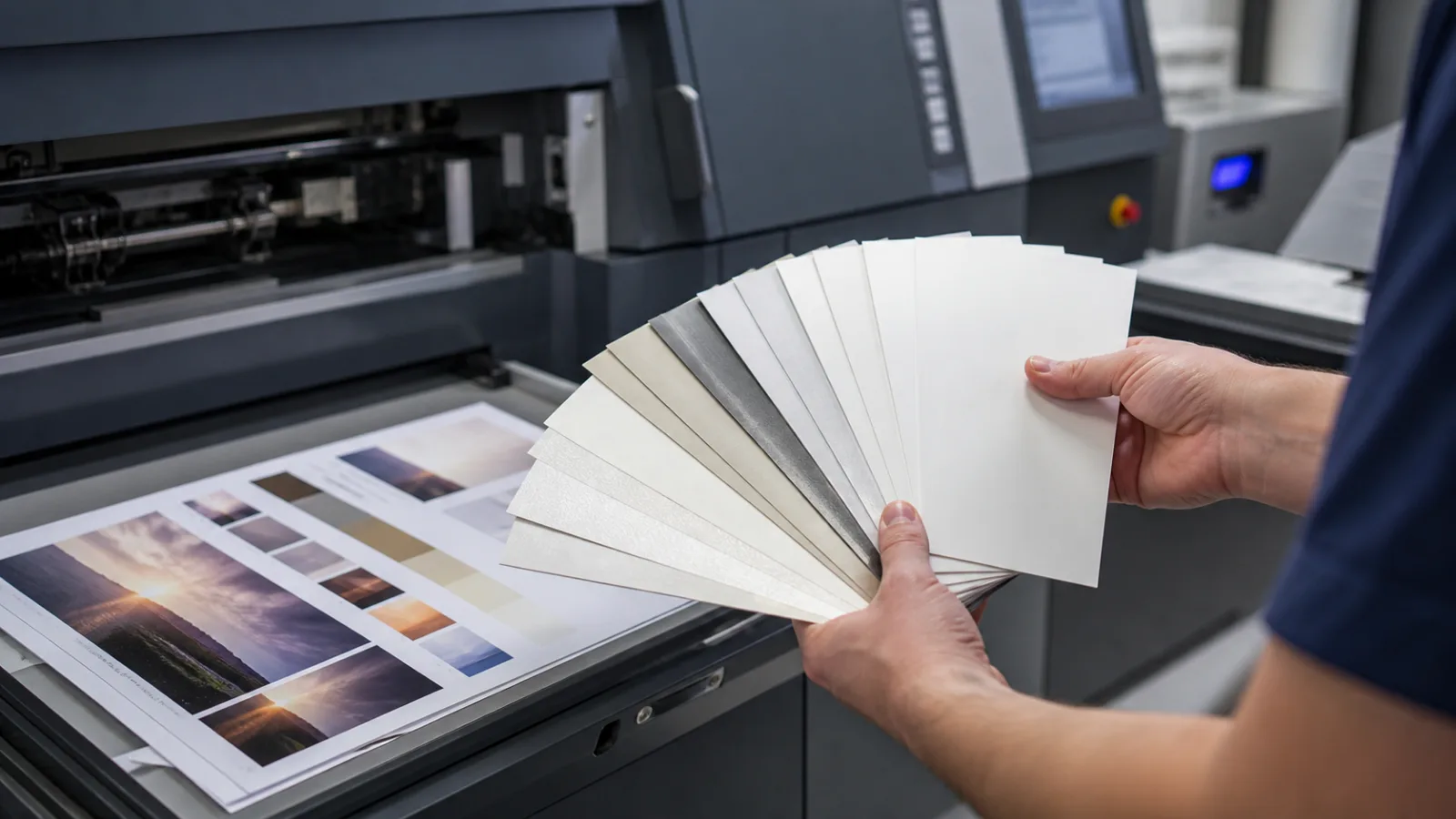
The material description should be precise enough to purchase the same construction and investigate differences between deliveries. Names such as “silk board” or “300 gsm coated stock” are insufficient because products with similar descriptions can differ in caliper, coating, stiffness, surface chemistry and moisture response.
| Specification field | Why it matters in production |
|---|---|
| Manufacturer and exact grade | Distinguishes the product from nominally similar alternatives |
| Finish and color | Affects appearance, image interaction and media identification |
| Merchant or mill reference | Supports ordering and traceability |
| Lot, batch, ream or roll identification | Helps isolate variation and retain evidence for a dispute |
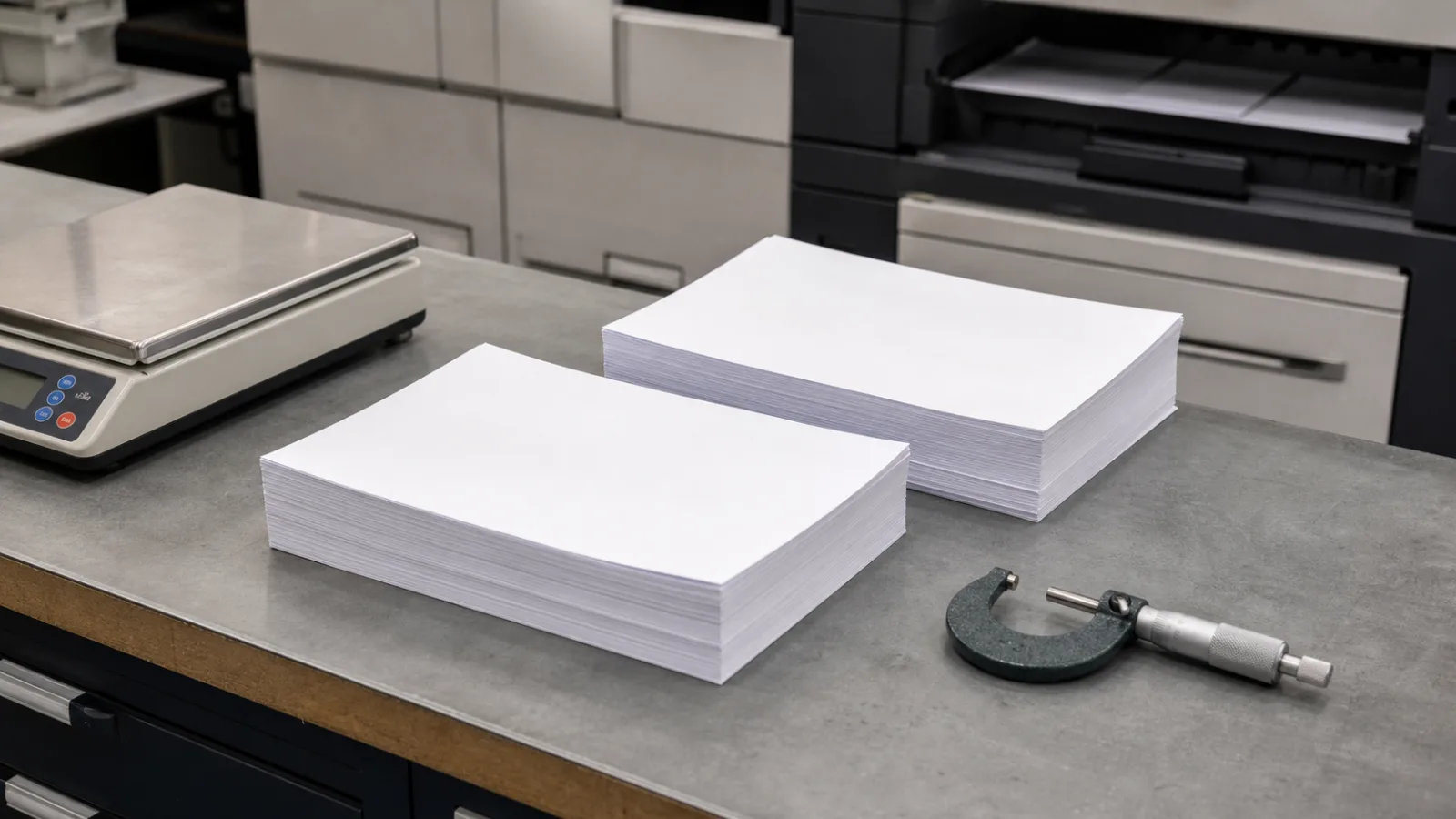
| Grammage or basis weight | Informs the machine’s weight category but does not define thickness |
| Caliper | Affects transport clearance, stack height, creasing and binding |
| Sheet or roll dimensions | Determines feed compatibility, imposition and finishing allowances |
| Grain direction | Influences folding, dimensional movement and sheet behavior |
| Coating, primer or treatment | May affect ink transfer, absorption, toner adhesion or drying |
| Moisture information, when supplied | Provides context for curl, static and dimensional behavior |
| Flatness, curl and surface condition | Directly affects feeding, transport, stacking and registration |
| Approved-media status | Indicates what has been evaluated and under which stated scope |
Do not convert grammage into caliper using a universal formula. Two sheets at the same grammage can have different thickness and stiffness because of fibre composition, coating, compression and bulk. Enter both values when the press media library or job engineering requires them.
Coating compatibility must also be tied to the imaging process. A coating intended for one ink or toner system should not be assumed to work with another. The discussion of ink transfer, adhesion and coating in this substrate-selection reference is useful, but its label-production scope should not be generalized to every paper and board application.
Collect the technical datasheet for the exact grade, weight and finish. Preserve purchase records, package labels and delivery documents. Where lot information is available, link it to the qualification record and retain a labelled sample.
Check media status and create the machine setup
Search the press manufacturer’s current media database using the exact press, substrate grade, weight and finish. Confirm that the listing applies to the installed configuration and software or media-library version where those distinctions are relevant.
Terms such as tested, certified, recommended and customer-approved are not necessarily interchangeable. Preserve the source’s terminology and read its stated scope. Konica Minolta’s Media Guide, for example, distinguishes the manufacturer’s own evaluations from customer-approved substrates for specified systems. A customer-approved entry should not silently be treated as a manufacturer certification.
An exact listing is more useful than one for a nearby grammage or related grade. Similar weight does not establish equivalent caliper, coating, electrical behavior, ink interaction or transport performance.
If the proposed stock is unlisted:
- Ask the substrate supplier for documentation specific to the named imaging technology or press. Treat an unsupported compatibility statement as a supplier claim, not proof of production suitability.
- Compare the material data with the press maker’s supported media categories and operating limits.
- Create a controlled custom media entry using the manufacturer’s instructions.
- Record the selected weight or thickness band, coating classification, feed source and other required settings.
- Run a production-intent qualification rather than releasing the job from the specification comparison alone.
Depending on the press, relevant controls may include transfer, fusing, drying, vacuum, air separation, web tension or transport speed. Adjust only controls covered by the equipment documentation and operator authority. Do not use trial-and-error changes that contradict machine or material supplier procedures.
Inspect and condition the production material
Qualification should use production-intent material rather than an unidentified sample sheet. Before loading it, inspect multiple packages or positions in the roll as appropriate.
Check for:
- Damaged or moisture-affected packaging
- Crushed, burred, wavy or poorly cut edges
- Dust, loose coating, debris or surface contamination
- Sheets sticking together or blocking
- Visible curl, cockling or waviness
- Dimensional errors and inconsistent squareness
- Correct grain direction and sheet orientation
- Differences in color, finish or surface appearance between packages
Follow the substrate supplier’s storage and conditioning instructions and the press manufacturer’s environmental guidance. There is no universal acclimatization time, room humidity or material moisture value suitable for every grade and press.
Where conditions are important, record room temperature and relative humidity using identified instruments. Record material moisture only when the method and instrument are suitable for the substrate and the result can be compared with a supplier or press requirement. An unqualified meter reading should not be treated as an acceptance standard.
Photograph visible defects and retain labelled samples when incoming condition may become part of a supplier discussion. If packages differ materially, do not blend them into one trial without preserving their identities.
Run a controlled press qualification
Agree on acceptance criteria before printing. The test quantity should be sufficient to observe the risks relevant to the job, but no universal number applies. A short static test may reveal image defects while failing to expose intermittent feeding, heat accumulation, stack curl or web-handling problems.
Use the intended substrate lot, sheet orientation, duplex mode, speed, calibration state and media profile. The test file should contain job-relevant elements such as:
- Solids, screens, gradients and representative images
- Fine positive and reverse type
- Heavy-coverage areas and abrupt coverage changes
- Front-to-back targets for duplex registration
- Elements near trims, folds, scores and binding edges
- Critical brand colors or neutrals where required
During the run, record rather than merely remember observations. Relevant checks can include:
Transport and delivery
Observe multifeeds, misfeeds, jams, skew, web tracking, marking, sheet-to-sheet movement and delivery-stack quality. Note whether curl changes during the run or differs between the two printed sides.
Image formation and durability
Inspect for missing image, mottle, banding, non-uniform solids, picking, surface damage, set-off or other process-relevant defects. Where adhesion, abrasion or rub resistance is critical, use a defined method with recorded conditioning, procedure and pass criteria. A casual scratch check may help identify an obvious problem, but it is not a substitute for an agreed durability test.
Registration and color
Evaluate front-to-back and sheet-to-sheet registration against job tolerances. Critical color should be assessed using the specified measurement instrument, reference condition and method; visual approval alone cannot establish numerical conformance.
Record the planned observation quantity, actual quantity run, waste events and any machine interventions. One uninterrupted trial is stronger evidence of runnability than a handful of selected sheets, but it remains evidence only for the recorded conditions.
Test the complete finishing route
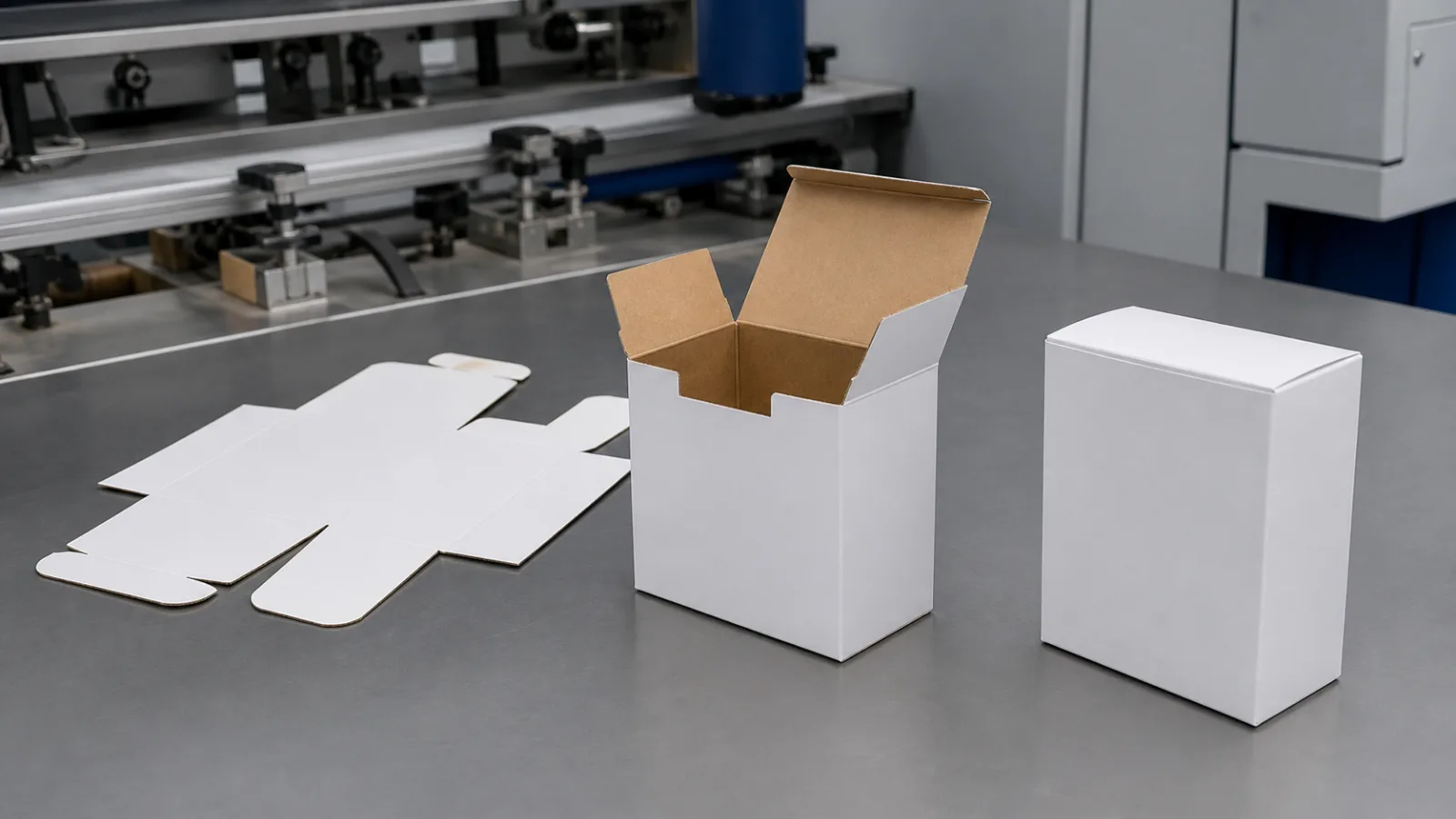
Successful imaging does not establish that the printed material can be converted successfully. Process representative trial sheets through the intended production equipment using the planned tooling, consumables and settings.
Depending on the job, examine:
- Cracking or whitening across folds
- Toner or ink damage at folds and creases
- Delamination or coating lift
- Score position and crease geometry
- Trim cleanliness, dust and edge damage
- Laminate appearance and bond
- Adhesive bond and fibre tear, where relevant
- Blocking, scuffing or set-off during stacking
- Binding quality and page opening
- Dimensional change affecting cutting or registration
Grain direction, caliper, coating and printed coverage can interact at a fold. Where heavy image coverage crosses a fold, include that exact construction in the test rather than approving an unprinted folding dummy.
The boundary between print and finishing approval is explicit in RIT’s certified-media listings: the cited certifications apply to printing on the specified HP Indigo presses and do not apply to finishing. This is a useful reminder to inspect the scope of any media listing rather than extending it to untested processes.
Digital-print suitability also does not establish food-contact, migration, archival, chemical, recyclability, compostability, safety or legal compliance. Obtain separate documentation for each requirement, with the applicable product construction, use, test method and market clearly identified.
Approve the combination and control changes
Release should produce a traceable record rather than an informal statement that the paper “ran well.” The approval file should include:
- Exact substrate, finish, weight, caliper and lot
- Press model, configuration and imaging consumables
- Media profile or library entry and relevant machine settings
- Trial date, operator and environmental observations
- Calibration or color setup used
- Test file and imposed orientation
- Quantity observed and recorded production events
- Measurements, test methods and acceptance criteria
- Finishing equipment, tooling, consumables and settings
- Approved printed and finished samples
- Deviations, restrictions and required production controls
- Named approval responsibility
Define change triggers at the same time. A new grade, weight, caliper, coating, supplier, lot, press, toner or ink set, profile, firmware version, finishing film, adhesive or tool may justify repeating selected checks or the complete qualification. The extent should follow the risk introduced by the change.
A new lot does not automatically mean that every test must be repeated, but incoming inspection and comparison with the approved sample can reveal whether further verification is needed. Conversely, a successful historical run should not override visible material changes or new supplier documentation.
Frequently asked questions
Does approved-media status remove the need for a production trial?
No. It provides evidence within the listing’s stated scope, which may cover a named press, configuration and printing assessment. It may not cover the job’s artwork, duplex demands, production duration, finishing route or end use. Confirm the listing and then perform checks proportionate to the job risk.
Can two papers with the same grammage use the same press settings?
Not necessarily. Equal grammage does not establish equal caliper, stiffness, coating, moisture response or surface interaction. Compare the exact datasheets and use the machine’s prescribed media setup. Qualify the second paper separately when the relevant properties or approval status differ.
How much material should a qualification trial include?
Set the quantity from the failure modes that need to be observed, the job length and the printer’s quality procedure. Agree it before the trial. The record should state how much material was run and inspected instead of describing the test only as “sufficient.”
When should paper or board be requalified?
Review qualification when the substrate construction or source changes, when a different press or imaging consumable is introduced, after relevant software or profile changes, or when finishing materials and tooling change. Recurring production defects, unexplained drift or a material lot that differs from the approved sample are also reasons to reopen the record.
The practical selection rule is bounded: approve the exact material only for the documented press, settings, job conditions and finishing route. If one of those variables changes, identify the resulting risk and repeat the checks needed to control it.