

Folding carton crease cracking is a defect at the intersection of board construction, printed surface layers, crease geometry, folding direction, and production conditions. It may appear as a white line on a dark printed panel, a fractured coating at the outside of a fold, exposed fibres, or a deeper split in the board. The corrective action depends on which of those failures is actually occurring.
A visible line is not automatically evidence that the board is unsuitable, the crease is too shallow, or the press finish is at fault. A crease can look poor while retaining carton strength, or look acceptable while damaging a barrier layer that requires separate functional testing. Start by classifying the defect, preserving process evidence, and changing one meaningful variable at a time.
Classify the defect before changing the process
During scoring and folding, carton board is concentrated around a narrow hinge line. The board must deform on the inside of the fold and extend on the outside. If that deformation is not controlled, the coating, ink film, fibre structure, or laminated layer may rupture.
Sappi’s technical guidance on folding and scoring describes this as splitting of the coating layer or fibre structure during finishing. The defect is generally more conspicuous where colour or images cross the fold, particularly on coated surfaces.
Separate the following observations in the defect report:
- Surface whitening or ink fracture: A pale line appears through a dark or solid-colour printed area. This may be a fractured ink or coating film, a disrupted coating surface, or exposed board beneath the print.
- Coating crack: The pigment coating opens along the fold, often before a substantial fibre split is evident. It is mainly an appearance issue unless the surface layer has a separate functional role.
- Fibre split or board rupture: Fibres visibly break or open at the fold. This can affect appearance, fold consistency, stiffness, and in severe cases carton integrity.
- Delamination: Layers within the board separate. This is different from a surface crack and should be recorded as such.
- Barrier or laminate discontinuity: A coating, extrusion layer, metallised film, or other functional layer may crack even when the board appearance is acceptable. Visual inspection alone cannot confirm barrier continuity, food-contact suitability, migration performance, or package protection.
The distinction matters because increasing creasing pressure may improve one failure mechanism while worsening another. A surface film may need a different print or varnish system; an uncontrolled fibre rupture may point to crease construction, board conditioning, or fold direction.
Start diagnosis at the affected fold
Do not begin with a broad statement such as “the cartons are cracking.” Map the defect to the exact score and panel. A carton often contains folds in more than one direction, with different artwork coverage and different stress levels during erection. One crease may therefore fail while another made from the same board performs acceptably.
For each affected sample, record:
- Carton and crease identification. Mark the panel, crease location, fold angle, and whether the defect occurs on the outside or inside of the finished fold.
- Fold orientation. Record the relationship between the score and board grain direction. Do not rely on an assumed grain direction from sheet layout; confirm it from the board specification or supplier documentation.
- Stage at which the defect first appears. Retain samples after printing, after die cutting and creasing, after initial folding, and after final carton erection where possible.
- Printed and unprinted comparison areas. Compare an affected printed crease with an equivalent unprinted crease. This helps distinguish surface-finish failure from a broader board or score problem.
- Artwork stack. Note solid ink coverage, number of colours, ink type, coating, varnish, lamination, foil, embossing, or other finish crossing the crease.
- Converting record. Capture board grade, caliper, lot, sheet size, grain direction, storage history, die specification, rule and matrix arrangement, make-ready condition, folding equipment, and production date.
Photograph the defect under an agreed viewing condition. Lighting, viewing angle, and fold opening angle can alter how severe whitening appears. A photograph is useful for comparison, but it should not replace an approved visual limit or functional test.
Board response depends on construction, orientation, and condition
Carton board does not bend as a uniform solid sheet. Its fibre layers, coatings, bulk, stiffness, caliper, and internal bonding influence how it opens at a score. Two boards of similar basis weight can therefore behave differently at the same crease geometry.
Grain direction is particularly important in diagnosis. The board usually folds more readily in one orientation than the other, but this does not justify a universal rule that a particular fold direction will eliminate cracking. The effect depends on the board construction and crease design.
The AIMS Group creasing and folding guidance advises, where possible, making creases parallel to the grain direction and folding into the crease bead. Its broader point is useful in troubleshooting: the crease should direct deformation into the body of the board rather than allow an uncontrolled rupture at the surface.
A study of a particular coated duplex board found different crack patterns when samples were folded in machine direction and cross direction. It also found that operating conditions influenced the result. Those findings are relevant as a diagnostic prompt, not as a performance guarantee for other carton boards, calipers, inks, or tools.
Check whether the defect:
- follows folds in one grain-related orientation;
- is confined to one board lot or caliper;
- worsens after storage in unusually dry or humid conditions;
- appears only after the board has been printed, coated, or laminated; or
- changes between die-cutting shifts, tools, or folding lines.
Moisture condition deserves attention because paperboard properties change with its environment. However, do not prescribe a target moisture value without the exact board supplier’s guidance and a suitable measurement method. Instead, confirm whether unopened stock, printed sheets, and work-in-progress were stored and conditioned according to the grade’s documented requirements. A poorly conditioned board can make a stable crease setup appear inconsistent.
Determine whether the print and finish stack is amplifying the crack
Heavy solid coverage does not necessarily cause the underlying fold failure, but it can make a minor disruption highly visible. Dark inks, dense coverage, high-gloss coatings, opaque white layers, and certain varnishes may reveal a white line that would be almost invisible on unprinted board.
Run a simple diagnostic comparison using representative production material:
| Sample condition | What it helps identify |
|---|---|
| Unprinted board, creased and folded | Baseline board and crease response |
| Printed board without final coating or varnish, where the process allows | Contribution of ink film and print build |
| Fully finished production sample | Combined effect of print, coating, curing, and folding |
| Printed sample with artwork moved away from the score, if practical | Whether visual severity is mainly artwork-dependent |
The comparison should use the same board, score direction, folding method, and fold angle. If only the fully finished sample cracks, investigate the surface stack and its curing or drying condition with the relevant ink, coating, varnish, laminate, or barrier supplier. A change in finish may improve fold appearance but alter gloss, colour, rub resistance, adhesion, scuff performance, or end-use suitability. Those trade-offs need approval on the finished carton, not just on a folded strip.
Coated papers and boards are generally more sensitive to visible fold cracking than uncoated surfaces because a disrupted coating layer contrasts with the surface around it. That does not mean an uncoated grade is an automatic solution; it may change print quality, stiffness, brand appearance, or pack function.
Use crease geometry to make a controlled hinge
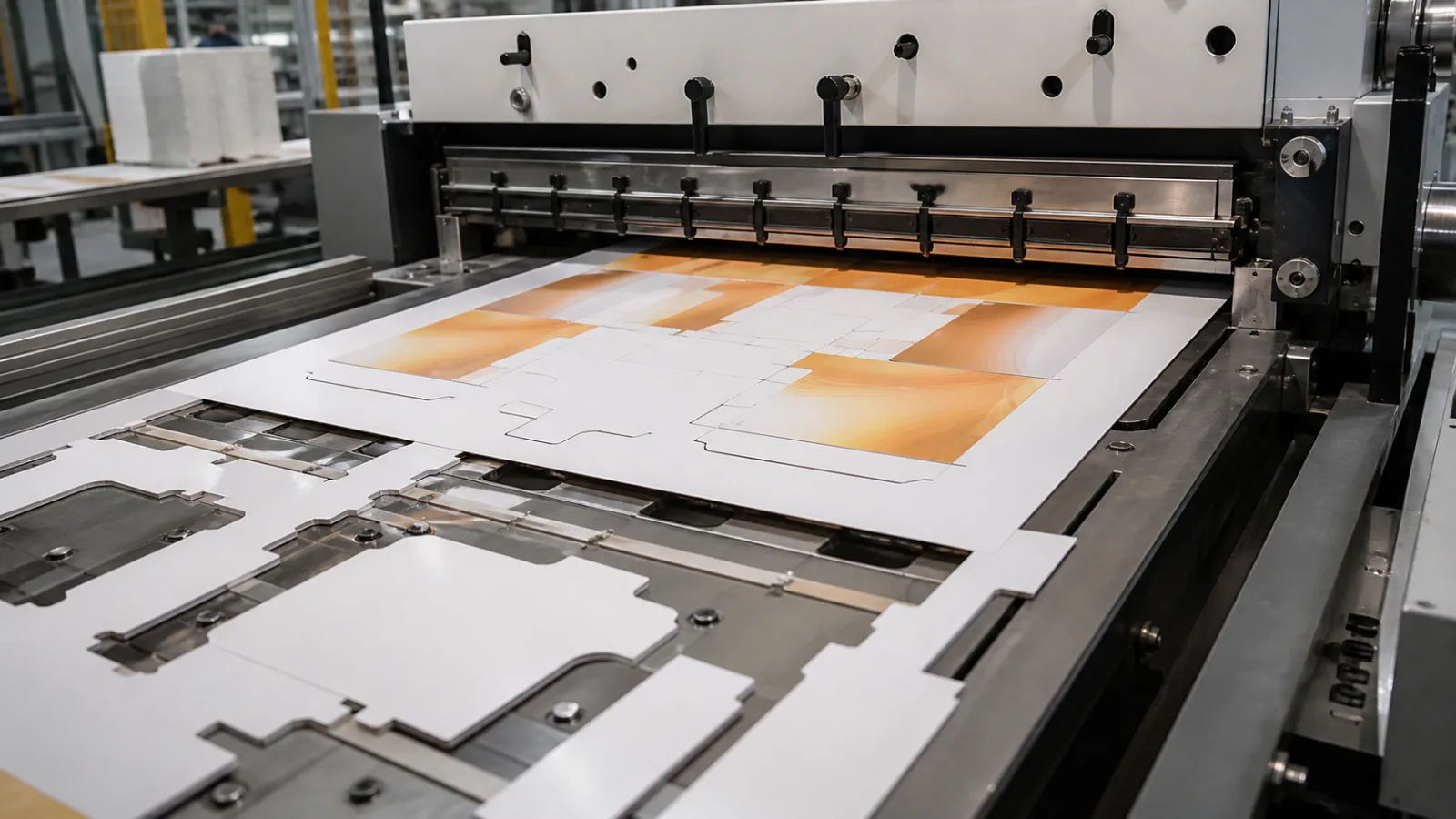
A crease is intended to localise bending. In typical platen or rotary die cutting, a creasing rule presses the board into a channel or matrix, creating an indentation and a bead or ridge on one side. Folding around that prepared structure is preferable to forcing the board to choose its own fracture line.
Research on carton-board package behaviour describes creasing as indentation against a matrix and recognises that creasing and folding methods can produce different crease properties. The published paper on carton-board package behaviour also discusses the long-recognised importance of bead formation and folding towards the ridge for crease performance.
In practical terms, inspect these variables together:
- board caliper and compressibility;
- creasing-rule width and profile;
- matrix or channel width, depth, and condition;
- make-ready thickness and alignment;
- score depth and continuity along the sheet;
- fold direction relative to the bead;
- die wear, debris, and local damage;
- folding speed, guides, belts, ploughs, and compression points.
Too little creasing can leave the board insufficiently prepared, so the fold opens unpredictably and may crack at the surface. Excessive pressure can damage fibre bonding or crush the board, making the fold weaker or more visibly fractured. The duplex-board study in the research record similarly reported poorer foldability at both insufficient and excessive creasing pressure under its tested conditions.
Therefore, “increase pressure” is not a complete corrective action. First inspect the formed score and its consistency. Then use documented die-maker, board-supplier, and equipment guidance for the exact caliper and tooling system. Setup changes should be made by trained operators following equipment procedures; a damaged rule, incorrect matrix, or unsuitable make-ready cannot be safely corrected by pressure alone.
Run a controlled corrective-action trial
A production trial should answer a defined question, not simply produce more samples. Keep the intended board, artwork, print process, and carton geometry as representative as possible. If the carton is folded by machine, include that folding method rather than assessing only hand-folded strips.
Use this sequence:
- Set an acceptance reference. Agree the approved carton sample, viewing condition, fold angle, areas to inspect, and any functional checks. Describe the defect limit in observable terms rather than using an undefined term such as “no cracking.”
- Establish the baseline. Retain samples from the existing approved or failed setup and document the process settings that can be recorded reliably.
- Choose one primary variable. Examples include a documented crease-rule/matrix change, board conditioning condition, fold direction in the layout, or a revised print and varnish stack.
- Hold other variables stable. If board, coating, pressure, matrix, and folding speed all change together, the cause of improvement or deterioration will remain uncertain.
- Inspect at more than one stage. Review after creasing, after first fold, after carton erection, and after any later compression or packing operation that stresses the score.
- Check function as well as appearance. Confirm score consistency, carton squareness, erection behaviour, glue-flap alignment, stacking, and the performance of any layer whose continuity matters.
- Document the released condition. Update the board specification, artwork restrictions near folds, die specification, crease setup, conditioning requirements, and approved sample reference where appropriate.
For barrier-coated structures, visual inspection may be an initial screen but is not a substitute for an appropriate barrier test. The research on barrier-coated packaging board after creasing and folding used before-and-after assessment of creased and folded substrates as part of investigating barrier failure. The required test method for a commercial carton must still be selected for the actual barrier, product, distribution environment, and regulatory context.
Questions to settle before release
Before approving a corrective action, ask the buyer, printer, converter, board supplier, and finisher to confirm the following:
- What is the exact board grade, caliper, lot, grain direction, and conditioning requirement?
- Which scores are appearance-critical, structurally critical, or crossed by barrier layers?
- Is the crack limited to ink, coating, varnish, fibres, internal layers, or more than one of these?
- What rule, matrix, make-ready, and fold direction were used on the approved sample?
- Does the artwork place dark solids, metallic effects, or high-contrast graphics across critical folds?
- Has the revised process been assessed after the actual folding and packing operations?
- What viewing condition and defect limit define acceptance for this specific carton?
- Are any food-contact, migration, barrier, or other functional requirements separately verified?
Frequently asked questions
Why does crease cracking show more clearly on dark or heavily printed folding cartons?
A fold can disrupt the surface very slightly while exposing a lighter coating or board beneath the ink film. On a dark solid panel, that contrast is highly visible. Heavy ink, varnish, or coating build may also introduce another layer that must elongate around the fold. Compare printed, unprinted, and fully finished samples before deciding whether the defect is mainly cosmetic or reflects board damage.
Should a converter increase creasing pressure when a folding carton cracks?
Not automatically. Insufficient creasing can cause an uncontrolled fold, but excessive pressure can crush or damage the board structure. Inspect score formation, rule and matrix compatibility, fold direction, board condition, and tool condition first. Change settings through a controlled trial and follow the documented procedures for the specific equipment and board.
Does folding with or across the grain eliminate crease cracking?
No orientation eliminates the risk in every carton. Grain direction can affect the crack pattern and the force required to fold, but board construction, caliper, coating, artwork, score geometry, and conditioning also matter. Use grain orientation as a recorded trial variable, especially where the defect is limited to a particular set of folds.
How should crease cracking be specified on an approved carton sample?
Define the carton panel, crease, viewing condition, fold angle, sample quantity, and acceptable appearance in terms that can be checked consistently. If a crease has functional significance, add the relevant functional test separately. Avoid relying only on a subjective description such as “acceptable fold quality” unless the parties also agree how it will be assessed.
The most reliable selection rule is to approve a crease solution only after the exact board, print-and-finish stack, tooling, fold direction, and conditioning state have been evaluated together on a representative carton. A visually improved fold is useful, but it is not a complete release criterion unless the carton still meets its required converting and end-use functions.