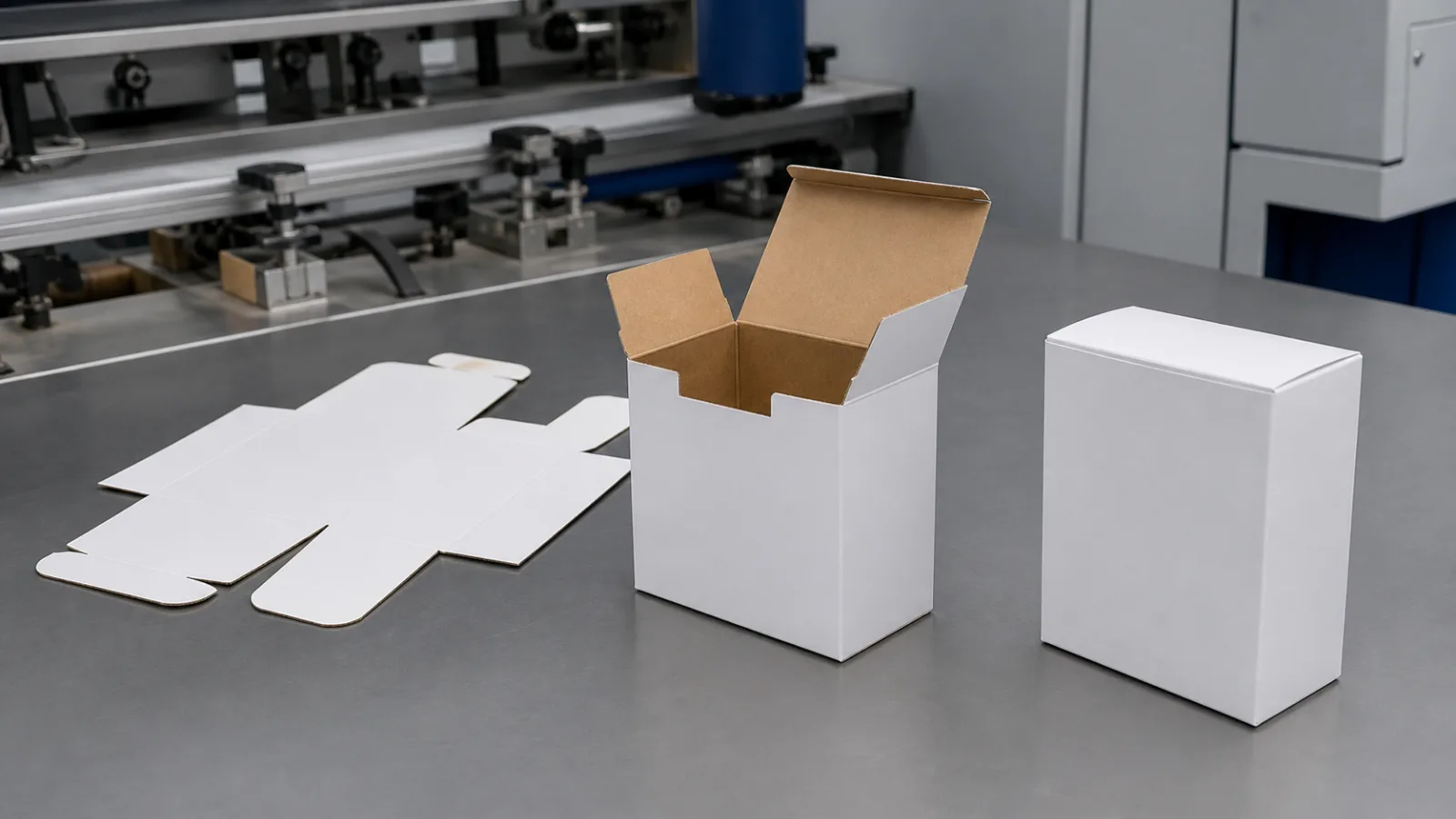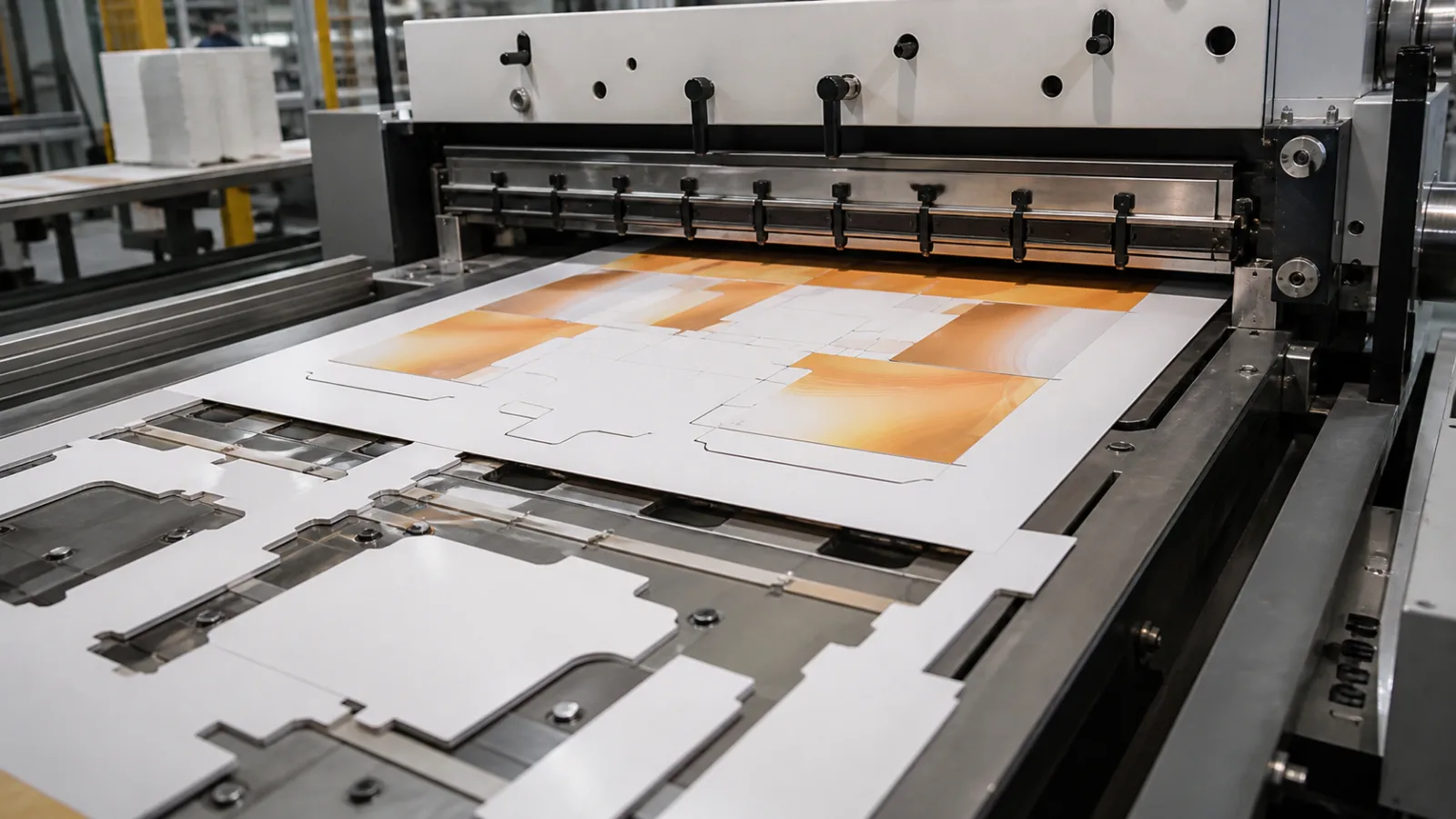


A useful folding carton board specification defines more than a grade name and grammage. It connects the packed product and carton structure to the board’s construction, thickness, directional stiffness, surface, moisture condition, grain direction, crease design, printing and finishing processes, and packing-line demands.
These variables interact. A board that produces an attractive press sheet may crack at a heavily printed fold. A rigid flat blank may resist erection. A nominally equivalent substitute may have different caliper, friction, stiffness direction, coating, or moisture response. Datasheet values are therefore starting controls, not proof that the converted carton will run correctly.
Final approval should be based on representative cartons made with the intended materials, artwork, tooling, finishing sequence, adhesive system, and packing equipment.
Start with the product, structure, and packing process
Define what the carton must do before selecting the board. The initial project brief should identify:
- product dimensions, mass, orientation, and sensitivity to movement or compression;
- carton style, panel dimensions, closure method, and opening sequence;
- inserts, windows, perforations, tear features, or internal fittings;
- filling sequence and whether erection is manual or automatic;
- glue, lock, tuck, or other closure requirements;
- secondary packaging, pallet pattern, storage, and transport conditions;
- expected exposure to changes in temperature or relative humidity;
- display, print, coding, tamper-evidence, and user-opening requirements.
Separate these into functional categories. Protective requirements concern containment, panel stability, stacking, and resistance to handling. Manufacturing requirements cover printing, die-cutting, stripping, folding, gluing, and delivery format. Packing-line requirements include blank feeding, erection, product insertion, closure, coding, and rejection controls. Appearance requirements concern shade, print detail, gloss, reverse-side presentation, and consistency.
Regulatory or customer documentation should form a separate category. A generic board description does not establish food-contact suitability, migration compliance, restricted-substance compliance, chain of custody, or acceptance in a local recovery system. Confirm each applicable claim for the exact material, intended use, market, and supply route.
The approved dieline must also be available at this stage. Panel proportions, fold positions, glue flaps, cut-outs, windows, and perforations can materially change the stiffness and converting demands placed on the board.
Choose the grade by construction, not abbreviation alone
Common commercial descriptions include solid bleached board, unbleached kraft board, recycled paperboard, coated recycled board, and multilayer folding boxboard. Abbreviations such as SBS, SUS, CRB, CNK, and FBB vary by region and supplier. They should not replace the exact manufacturer, grade, finish, and product code in a purchase specification.
Board constructions can differ in fibre furnish, number and arrangement of layers, density, coated sides, reverse-side appearance, shade, and surface treatment. Those differences may affect:
- stiffness at a given grammage or caliper;
- score formation and fold recovery;
- edge appearance after cutting;
- print holdout, ink demand, and drying or curing behaviour;
- visible variation in shade or formation;
- bonding to inks, coatings, foils, films, or adhesives;
- sensitivity to moisture and dimensional change.
Do not turn these tendencies into universal rankings. Performance depends on the exact grade and manufacturing tolerances, not just whether the furnish is described as virgin, recycled, bleached, unbleached, or multilayer.
Request the current technical datasheet for each candidate. Check the coated sides, available grammages and calipers, surface description, moisture specification where provided, dimensional tolerances, stated converting guidance, and reporting methods for physical properties. Examine physical samples of the actual grade, including the reverse side and cut edges, but do not treat a sample from an unidentified production lot as a controlled approval standard.
Availability is also part of the specification. Confirm sheet or reel format, grain orientation, trim options, minimum order constraints where relevant, and whether the converter can process the grade on the intended printing, die-cutting, folding, and gluing equipment.
Specify grammage, caliper, and stiffness separately
Grammage is mass per unit area, commonly reported in grams per square metre. Caliper is board thickness. Stiffness is resistance to bending under a stated test. The three properties are related, but they are not interchangeable.
Two boards with the same grammage can have different calipers because their density and layer construction differ. Two boards with the same caliper can have different mass and bending behaviour. Increasing grammage or thickness may improve panel rigidity, but it can also change crease requirements, fold resistance, bundle height, material use, die-cutting settings, and the board range accepted by packing equipment.
Paperboard is directionally dependent because fibre orientation develops during manufacture. Stiffness is therefore normally considered in the machine direction and cross direction. The useful value depends on how those directions align with the carton’s main panels, folds, and loads.
A controlled specification may include:
| Property | What to define |
|---|---|
| Grade | Manufacturer, exact grade name or code, finish, and coated sides |
| Grammage | Nominal value, tolerance, units, and measurement method |
| Caliper | Nominal value, tolerance, units, method, and conditioning state |
| Stiffness | Machine- and cross-direction values where critical, with method and units |
| Format | Sheet or reel dimensions, tolerances, grain direction, and delivery condition |
Stiffness figures should not be compared unless the direction, test method, units, specimen conditioning, and grade basis align. If supplier datasheets use different methods, request comparable measurements or have representative production material evaluated under an agreed procedure.
Relate the results to the structure. A stiffness value has limited meaning without the panel dimensions, grain orientation, cut-outs, crease pattern, closure style, and product load.
Match the surface to printing and finishing
The visible surface must suit the selected printing process, but visual quality is only one part of compatibility. Surface smoothness, absorbency, strength, coating integrity, shade, and friction can influence both appearance and runnability.
Confirm the printer’s accepted caliper and format range for the intended offset, flexographic, gravure, digital, or other process. Also identify the exact ink or toner system, drying or curing conditions, ink coverage, and whether both sides will be printed.
High ink coverage and fine detail can impose different demands from line work or light tints. Coatings and laminated layers may change fold behaviour, friction, glue adhesion, and moisture exchange. Foil stamping and embossing introduce pressure, heat, and local deformation. Variable-data coding must remain readable and attached to the intended surface after packing and handling.
Specify these elements where applicable:
- print process and production press class;
- artwork revision and critical solids, screens, reverses, and small type;
- colour reference and agreed viewing or measurement conditions;
- printed side or sides;
- varnish, aqueous coating, ultraviolet-cured coating, or other overprint layer;
- lamination, foil, embossing, debossing, or window application;
- areas that must remain free of ink or coating for gluing or coding;
- finishing sequence and any required surface-treatment checks.
Use production-representative press sheets for critical work. A drawdown or flat print sample may help assess colour and surface interaction, but it does not demonstrate die-cutting, folding, gluing, or packing-line performance.
Control moisture, grain direction, creasing, and folding
Board moisture condition affects dimensions, stiffness, curl, crease formation, and fold response. Changes between storage, print room, converting area, and packing site can cause curl or dimensional movement even when the delivered sheets initially meet specification.
Follow the board supplier’s storage and conditioning instructions for the exact grade. Keep protective wrapping intact until the appropriate conditioning stage, and record unusual environmental exposure. Acceptance measurements should use agreed conditions; otherwise, differences may reflect conditioning rather than a material change.
Grain direction should be marked relative to the approved dieline, not merely stated as long grain or short grain without context. The specification should show the board’s machine direction and identify which principal carton folds run parallel or perpendicular to it. This also connects the structure to the machine- and cross-direction stiffness values.
Creasing locally compresses and displaces the board so it can fold along a controlled line. Its performance depends on board construction and caliper as well as:
- crease-rule height and thickness;
- channel width and depth;
- matrix or counter material;
- press condition and make-ready;
- fold direction relative to grain;
- printed, varnished, or laminated layers across the fold;
- moisture condition during conversion;
- required folding angle and spring-back behaviour.
There is no universal crease formula for all cartonboard. Tooling should be selected by the die-maker and converter for the exact board, structure, and press condition, then confirmed through converted samples.
Inspect representative folds for outer-surface cracking, coating fracture, delamination, weak or poorly defined scores, excessive spring-back, bulging panels, and distortion. Evaluate both grain orientations where the design contains important folds in both directions. Heavily printed, coated, embossed, or laminated folds deserve particular attention because the complete layer system must withstand deformation.
Approve the carton on the packing line
A laboratory property or successful press run cannot by itself predict behaviour on a particular packing line. Approval should include production-equivalent cartons that have been printed, coated, die-cut, stripped, folded, glued, and bundled using the intended process sequence.
The trial should examine:
- Blank feeding: Check separation, friction, curl, dimensional consistency, and double feeds or misfeeds.
- Erection: Observe whether panels open fully, remain square, and follow guides without excessive resistance.
- Product insertion: Confirm clearance, orientation, internal fit, and any interaction with inserts or windows.
- Flap and closure control: Check tuck, lock, or glue-flap presentation and whether fold spring-back disrupts closure.
- Adhesive performance: Use the specified adhesive, glue pattern, application conditions, and compression time. Follow the adhesive and equipment suppliers’ operating and safety procedures.
- Coding and inspection: Verify code placement, readability, adhesion, and detection by installed inspection systems.
- Packed-carton function: Assess squareness, panel distortion, opening, containment, and handling performance under conditions relevant to the actual route.
Record the board manufacturer and grade, grammage, caliper, grain direction, lot reference where available, carton and artwork revisions, environmental conditions, line identity, operating settings, product or representative load, sample quantity, and observed failure modes. Machine speed and acceptable rejection criteria must be defined for the project rather than borrowed from a generic recommendation.
If a trial fails, preserve failed samples and separate the symptom from the suspected cause. For example, poor erection could result from crease resistance, blank curl, incorrect dimensions, friction, guide settings, or several of these at once. Changing to a heavier board without identifying the mechanism may introduce a different problem.
Build approval controls into the purchase specification
The final folding carton board specification should cross-check the board datasheet, converter quotation, dieline, artwork, finishing instructions, and packing-line trial report. At minimum, record:
- exact manufacturer and grade, or a written controlled-equivalent procedure;
- coated sides, shade or appearance reference, grammage, and caliper;
- directional stiffness where it is functionally critical;
- sheet or reel dimensions, tolerances, and grain orientation;
- storage, moisture, or conditioning requirements supplied for the grade;
- print process, colour reference, coatings, and finishing sequence;
- dieline and artwork revision numbers;
- crease, die, perforation, window, and glue-area controls;
- packing-line acceptance checks and defined test conditions;
- required compliance or certification documents for the exact material and market;
- sampling, nonconformance, traceability, and change-notification arrangements;
- identification and retention of approved production-equivalent cartons.
A proposed substitute should be reviewed as a new material combination, even when its grade family and grammage appear equivalent. Compare construction, caliper, directional stiffness, surface, moisture specification, grain orientation, converting response, and packing-line results before approval.
Frequently asked questions
Is grammage or caliper more important when specifying folding carton board?
Neither is sufficient alone. Grammage controls mass per unit area, while caliper describes thickness. Panel performance also depends on directional stiffness, board construction, carton dimensions, grain orientation, and environmental condition. Specify all properties that affect the actual structure rather than using one as a proxy for the others.
Can one board grade be substituted for another at the same grammage?
Not automatically. Equal grammage does not establish equal caliper, stiffness, surface behaviour, crease response, friction, moisture sensitivity, or packing-line performance. Review the exact datasheets and approve representative converted cartons before accepting the substitute.
How should grain direction be shown on a folding-carton specification?
Show the board’s machine direction directly on the approved dieline and relate it to the main panels and folds. Avoid relying only on terms such as long grain or short grain, which can become ambiguous when sheet orientation or dieline nesting changes.
What should a packing-line board trial record?
Record the material identity and lot, carton and artwork revisions, grain direction, trial environment, equipment, settings, operating speed, product or representative load, sample quantity, failures, adjustments, and agreed acceptance result. The record should make the approved setup distinguishable from later material or process changes.
Select cartonboard against the whole production chain: product, structure, press, tooling, environment, adhesive, packing equipment, and distribution route. Retain the approved converted carton and its documented settings as the reference; grade name and grammage alone are not an adequate folding carton board specification.
Sources
- Paper Weight and Thickness Guide: GSM, Caliper & Packaging Uses
- Folding Cartons: Dieline, Board Grades & Printing Guide | Print Codex
- Understanding Folding Carton Materials: A Guide to Board Stock Selection | BP Solutions Group
- Choosing the Right Paperboard for Folding Cartons
- Guide to Folding Cartons
- Mastering the Basics: A Guide to Buying Folding Cartons | Blog | Malnove