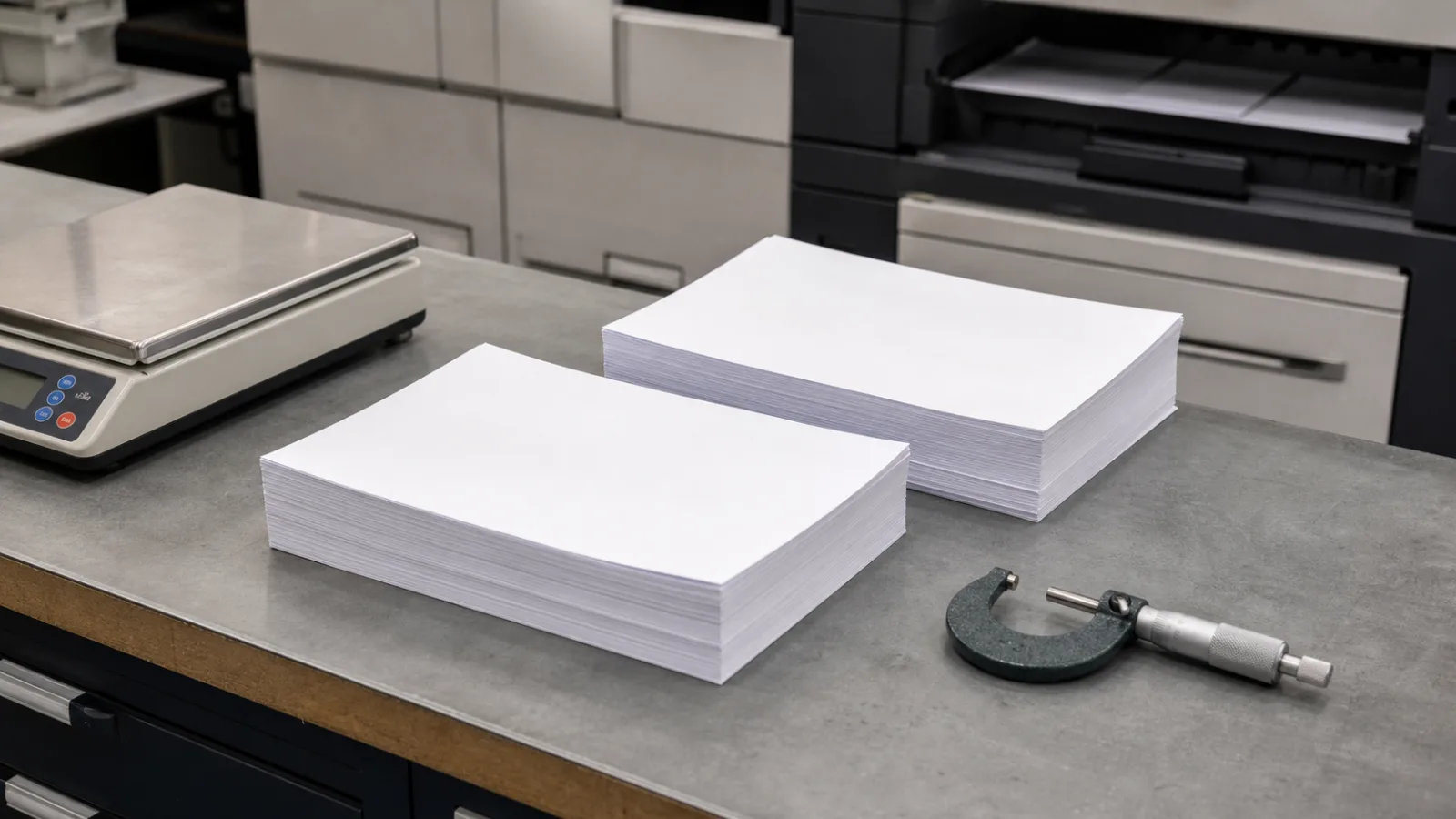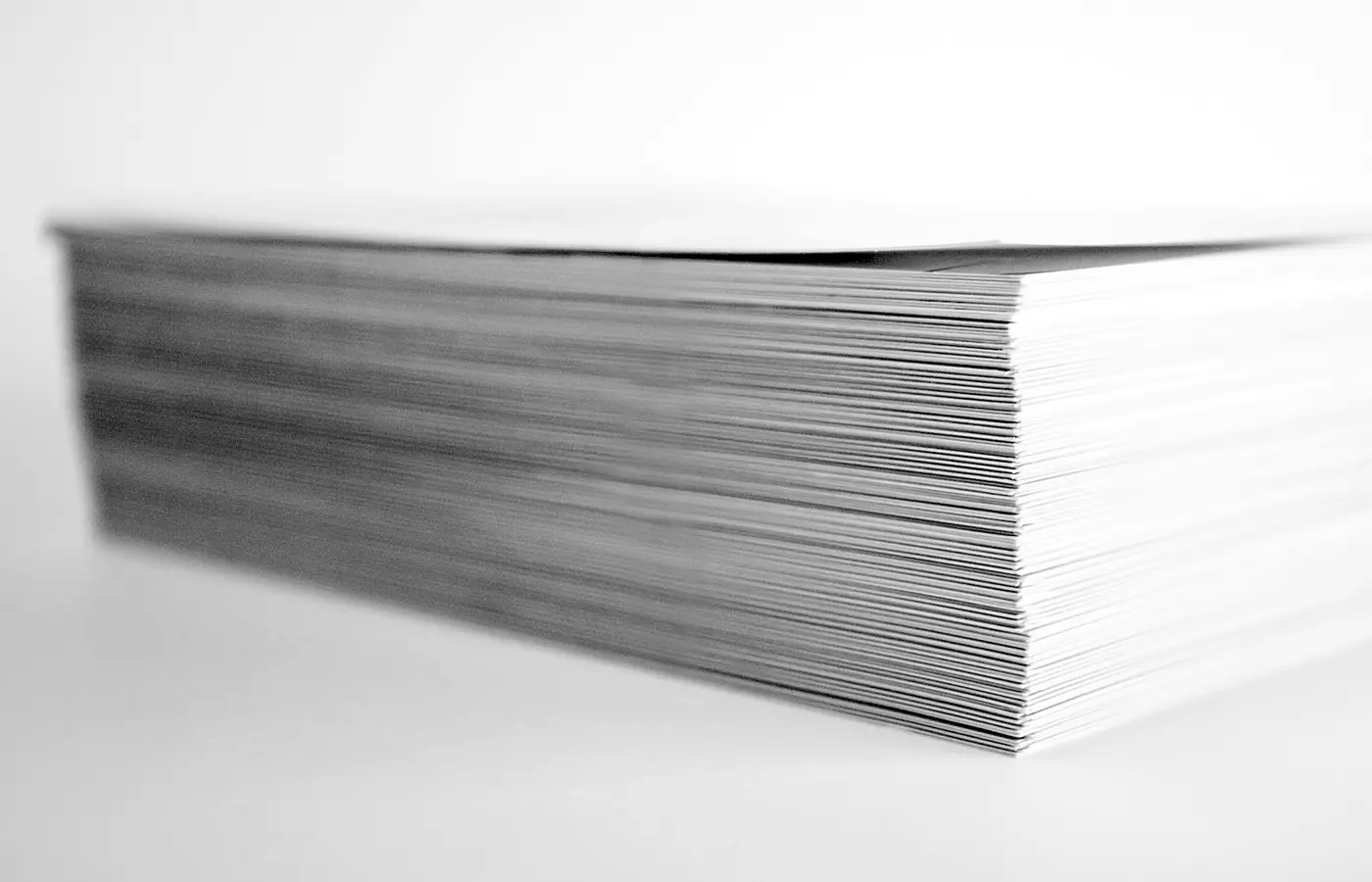

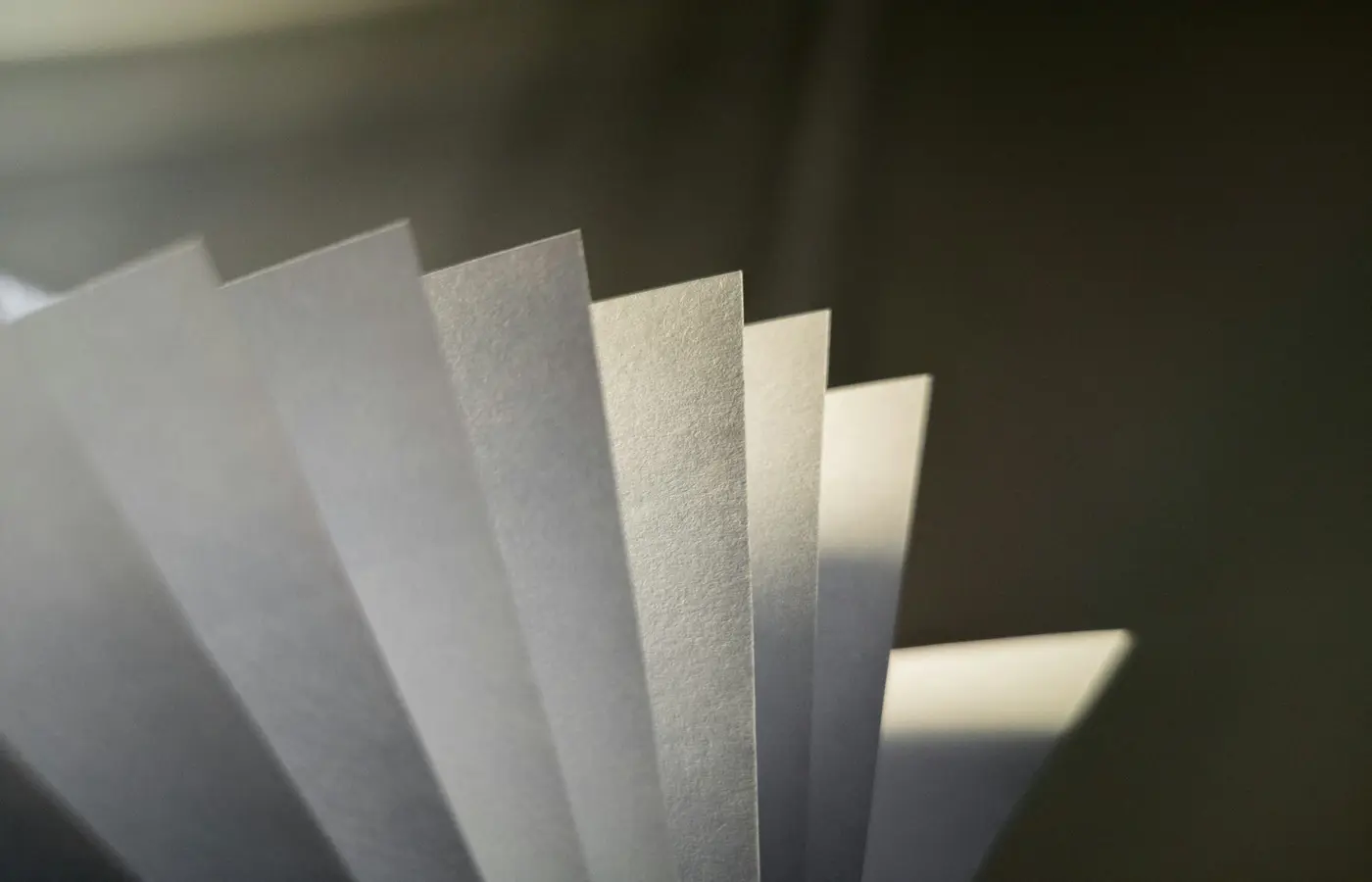
Paper grain direction is the predominant orientation of fibres created as a paper web travels through the paper machine. It is not a general measure of paper quality. It is a production variable that can influence how a sheet bends, folds, feeds, scores, binds, curls, and holds its finished shape.
For a folded leaflet, a book block, a cover, or a carton, the relevant question is not simply whether stock is long grain or short grain. The practical question is: where does the grain run relative to the finished fold, spine, crease, press path, and converting operation?
That relationship should be defined before imposition, paper ordering, and finishing approval. Grain direction may affect the result, but it does not explain every fold crack, feeding problem, warped cover, or weak-looking score. Basis weight, caliper, coating, moisture condition, score geometry, fold method, adhesive, machine settings, and storage conditions also matter.
What paper grain direction means in a production specification
During papermaking, fibres suspended in water tend to orient in the direction of web travel. This is commonly called the machine direction (MD). The direction across the web is the cross direction (CD).
A sheet cut from that web therefore has directional properties. It may bend, stretch, shrink, curl, and resist folding differently in MD and CD. The scale of the difference depends on the grade, fibre furnish, refining, formation, coating, moisture content, and other mill-controlled variables.
In sheeted paper, the terms long grain and short grain describe the grain relative to the supplied sheet dimensions:
| Sheet description | Grain runs parallel to | What it tells you |
|---|---|---|
| Long grain | The longer sheet dimension | Fibre orientation follows the long edge of that supplied sheet. |
| Short grain | The shorter sheet dimension | Fibre orientation follows the short edge of that supplied sheet. |
Neither description is automatically better. A long-grain sheet may be suitable for one imposed book signature and unsuitable for another. A short-grain board may be useful where a carton layout requires grain in a particular relationship to the main crease lines.
Do not infer grain from sheet dimensions alone. Mills, merchants, and converters can use different ordering conventions, and a standard sheet size does not prove the supplied grain. For critical work, confirm the supplier’s notation on the order acknowledgement, ream wrapper, skid label, or technical documentation.
Bookbinding guidance commonly describes grain as following the principal fibre direction and stresses the practical importance of identifying it before construction. The iBookBinding discussion of paper and board grain direction is useful as an accessible explanation, but a production job should still rely on documentation for the exact grade and supplied sheet size.
Why grain changes bending, folding, and creasing behaviour
Paper and board are anisotropic materials: their physical response is not identical in every direction. Fibre orientation contributes to this directional behaviour.
When a sheet is bent, fibres, bonds, coatings, and surface layers are stressed. The response may differ depending on whether the fold is parallel to the grain or crosses it. In practice, this can affect:
- bending resistance and how readily a sheet follows a fold path;
- the appearance and sharpness of a fold;
- fibre disruption at the fold line;
- tendency toward surface cracking in coated or heavily pigmented stocks;
- curl and shape change after printing, drying, laminating, or adhesive application;
- consistency through buckle folders, knife folders, scoring units, and other finishing equipment.
A fold made in the apparent grain direction often feels easier in a simple hand test. That observation can be useful, but it is not a substitute for production validation. A hand fold does not reproduce the compression, tension, folding speed, score depth, fold-roller pressure, or moisture history of a commercial finishing line.
It is also too simple to say that folding with the grain always gives the cleanest result. A light uncoated text paper, a heavily coated cover stock, and a multi-ply folding carton board can behave very differently. A properly designed score may improve a fold that would otherwise look poor, while an overly aggressive score can damage fibres or coatings regardless of orientation.
For a demanding fold, assess grain alongside these variables:
- Stock construction: grade, basis weight, caliper, coating, fibre composition, and whether the sheet is single- or multi-ply.
- Conditioning: temperature, relative humidity, package integrity, and the time stock has equilibrated in the production environment.
- Print and finishing sequence: ink coverage, toner or liquid-electrophotographic fusing, varnish, lamination, embossing, and adhesive application can change the fold response.
- Crease or score design: rule, channel, matrix, pressure, and fold position need to suit the actual board and caliper.
- Fold method: buckle folding, knife folding, plough folding, hand assembly, and carton erection do not impose stress in the same way.
Grain should therefore be treated as an input to process design, not as a cure for poor conditioning or unsuitable tooling.
Binding and book construction: match grain to the spine
Grain direction is particularly important in books because the spine and fold structure impose repeated directional stress during use. The usual production objective is to align grain with the spine or principal fold direction where the construction and supplied format allow it. This can support more natural opening and reduce the tendency for paper and board to resist the book’s movement.
For folded signatures, the imposition should be checked so that the grain relationship remains correct after folding, trimming, gathering, sewing, or binding. A sheet can appear correct before folding but become unsuitable if the imposed signature places the main fold across the grain.
Different constructions require different checks.
Folded and sewn signatures
In saddle-stitched and sewn work, the main signature fold is the important reference. Grain running parallel to that fold is often preferred because the sheet may fold with less resistance and follow the spine movement more readily. However, signature size, paper grade, fold count, print coverage, and folding equipment must still be considered.
Perfect-bound and adhesive-bound books
For adhesive-bound books, grain orientation can affect page curl, cover movement, and the way the finished block opens. It does not, by itself, determine adhesive performance. Adhesion depends on the adhesive system, spine preparation, paper surface, fibre exposure, glue temperature, application amount, dwell time, and binding equipment settings.
Specify the binding method and spine preparation separately from grain. Do not accept a claim that a grain change alone will correct page pull, poor glue penetration, or spine cracking.
Case-bound books and board covers
In case binding, text paper, endpapers, cover materials, and binders board may each have their own directional behaviour. Board grain can affect how a case wraps, how it responds to adhesive moisture, and whether it remains flat after drying. Warp can also result from uneven adhesive application, unbalanced covering materials, drying conditions, or storage environment.
For a high-value book, confirm the grain direction of both the text stock and board rather than assuming the same rule has been applied to each component.
Cartons, covers, labels, and other converted products
Grain direction matters beyond books wherever a paper-based substrate must crease, fold, wrap, feed, or remain flat.
For folding cartons, the relationship between grain and the principal score lines can influence crease appearance, panel movement, and carton erection. But carton performance also depends heavily on board construction, caliper, moisture condition, die-cutting pressure, crease rule and channel geometry, carton design, glue flap geometry, and packing-line settings.
A carton that cracks at a score may have a grain-related contribution, but it may also indicate dry board, a coating that cannot accommodate the fold, unsuitable crease dimensions, excessive rule pressure, or a fold radius that is too tight for the material. Grain should be checked as one part of the diagnosis.
For covers, sleeves, wraps, and presentation folders, grain can affect stiffness and the way the piece opens or lies flat. This is especially relevant where a cover has a wide spine score, heavy ink coverage, film lamination, or a large unprinted panel that makes distortion visible.
Paper facestocks for labels also need a broader system view. Grain orientation may affect dispensing or converting behaviour in some constructions, but release liner, adhesive, die-cut matrix removal, label shape, application speed, and environmental exposure can be equally important. A generic paper-grain rule should not be used to infer label performance on a specific applicator.
How to identify grain direction before production
The most reliable starting point is the supplier’s documentation for the exact grade, basis weight, sheet size, and supply format. Check the mill datasheet, merchant order confirmation, ream label, pallet or skid label, or carton marking.
If documentation is unavailable, incomplete, or inconsistent with the delivered material, physical comparison can provide an indication. Use more than one sheet from representative stock and compare both directions.
Practical indicators
- Bend comparison: Gently bend the sheet in each direction. One direction may feel more compliant while the other appears more resistant. This is an indicator, not a calibrated test.
- Fold comparison: Make comparable folds in each direction and inspect resistance, fold appearance, and surface disruption. Use this only as a screening check; it does not reproduce a scored or machine-folded production part.
- Tear comparison: A tear may travel differently depending on fibre orientation. Results can be affected by sheet formation, coatings, moisture, and how the tear is started.
- Dimensional observation: Where a sheet has been exposed to moisture or drying, the direction of curl or dimensional movement may offer clues. It should not be treated as proof of grain direction.
A supplier label is usually more useful than a hand test, provided its notation has been confirmed. If the job is critical, request confirmation in writing and retain a marked sample with the job record. This is particularly valuable when paper is reordered, substituted, split between suppliers, or supplied in more than one sheet size.
Fields to confirm on the job specification and approval
Grain direction is often lost between design, purchasing, prepress, press, and bindery because it is described only as “long grain” or “short grain.” That is not enough unless the supplied sheet dimensions and finished orientation are also clear.
Use a specification that connects stock orientation to the finished product.
Recommended confirmation checklist
- Exact paper or board grade, manufacturer, surface, colour, basis weight, and caliper where relevant.
- Supplied sheet size, roll width, or web orientation.
- Supplier-stated grain direction and the notation convention used.
- Finished size and trim orientation.
- Grain direction relative to the finished spine, main fold, score, or carton crease.
- Imposition and press-feed direction, where press or feeder behaviour is material to the job.
- Print process, ink or toner system, coverage level, and any varnish, lamination, foil, embossing, or coating.
- Folding, scoring, creasing, die-cutting, binding, or carton-erection method.
- Requirement for pre-scoring or a specified crease design.
- Requirement for a representative folded dummy, press proof, or production sample.
- Person or organisation responsible for confirming grain before final approval.
A useful approval note might read: “Grain to run parallel to the finished 210 mm spine; confirm against supplier label before imposition and retain approved folded sample.” This is clearer than requesting “long grain” without identifying which edge becomes the spine.
Does grain direction matter for digital printing as well as offset printing?
Yes, although the relevant failure modes may differ. Digital-printing systems can expose stock to heat, pressure, moisture change, and curved paper paths. Grain may interact with curl control, feeding, duplex registration, folding, and the appearance of toner at a fold.
That does not mean one orientation is correct for every digital press. Equipment path, stock qualification, fuser design, sheet size, coverage, duplexing, and finishing sequence all matter. Follow the press manufacturer’s approved-stock guidance and test the actual print-and-finish combination when the job includes heavy coverage, coated stocks, tight folds, or demanding binding.
Is long-grain paper always better for book binding?
No. Long grain only describes grain relative to the supplied sheet’s longest side. Whether it suits a book depends on how that sheet is imposed and which edge becomes the finished spine or signature fold. Specify the intended grain relationship to the spine rather than treating long grain as a universal requirement.
How can you tell grain direction if the ream label is unavailable?
Compare bending and folding in both directions to identify a likely orientation, then check against supplier documentation when possible. Physical tests are useful indicators for planning and troubleshooting, but they should not replace written confirmation for a critical or repeatable job.
Should paper grain run parallel to a fold or book spine?
For many folded and bound products, production teams aim to run grain parallel to the principal fold or spine. The final decision should still account for the actual paper grade, imposition, fold type, binding method, cover construction, and finishing process.
The selection rule is simple: specify grain in relation to the finished functional feature, not just the ordered sheet. Then confirm the supplied orientation before the job reaches press or bindery.
Sources
- Paper Grain Direction and Cardboard Grain Direction - iBookBinding
- Grain direction of the paper - PrintPlanet.com
- Grain direction of the paper - PrintPlanet.com
- What is Paper Grain and Why Does it Matter? - Yescom Paper
- Grain Direction in Paper: Why It Matters for Print - Print Codex
- Optimizing Folding Carton Grain Direction and Crease Matrix Tolerances for High-Speed Cartoning Lines - PM Packaging