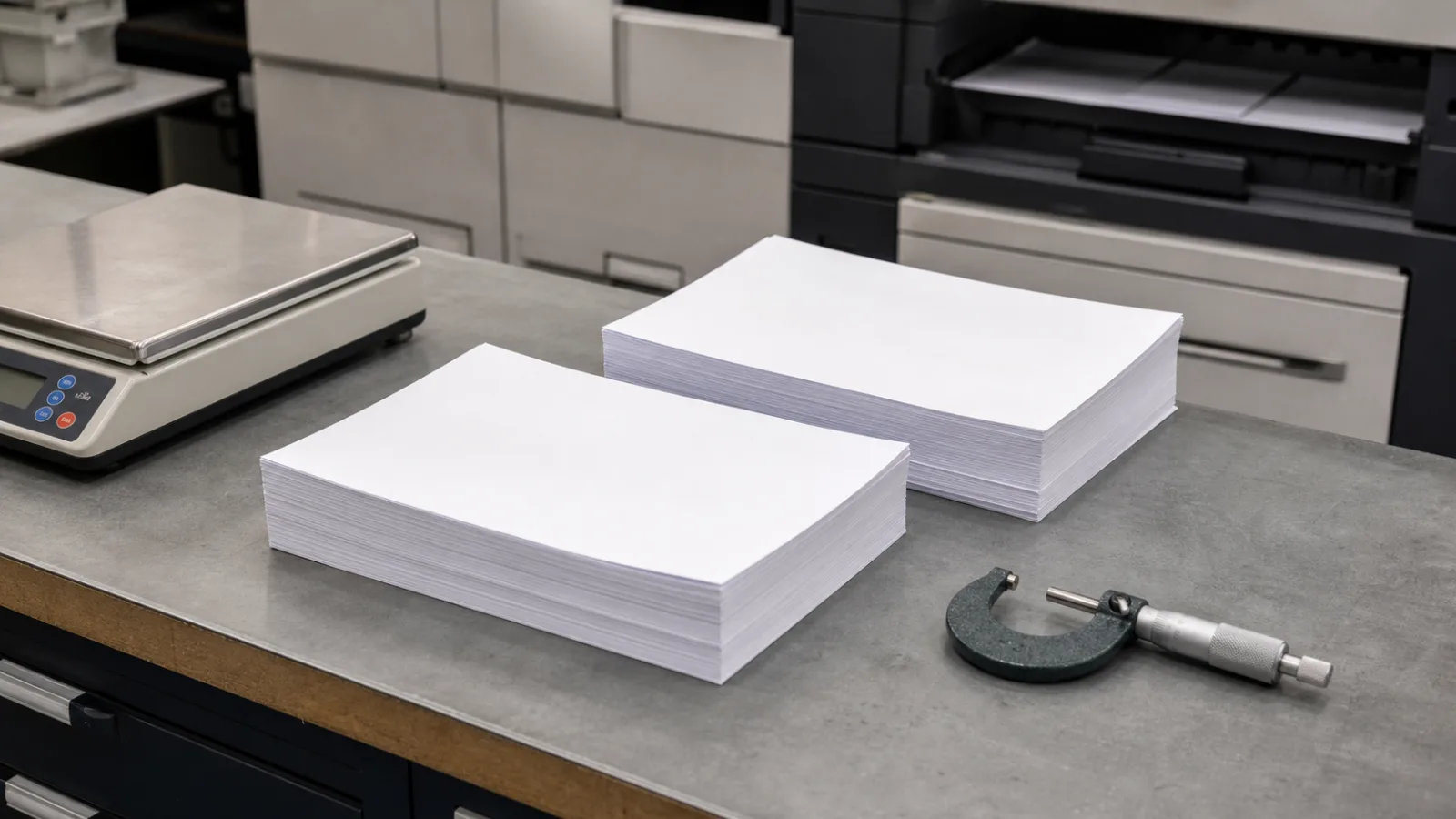


Paper moisture affects printing and converting because paper fibres exchange water vapour with the surrounding air. That exchange can change sheet dimensions, flatness and handling behaviour, particularly when paper moves from a cold warehouse, delivery vehicle or uncontrolled store into a different production environment.
The practical distinction is important: the moisture condition of delivered paper is not the same thing as the relative humidity (RH) and temperature in the pressroom. A paper maker may manufacture, wrap and ship a grade at a controlled condition, but the stock can begin adjusting once its protective wrapping is opened. Stable production therefore depends less on applying one universal humidity target than on keeping the paper, the production area and the process reasonably matched for the specific grade and job.
Why paper moisture changes production behaviour
Paper is hygroscopic: it absorbs or releases moisture as it moves towards equilibrium with its environment. This is a material property of the fibre network, although the degree and speed of response vary with furnish, coating, basis weight, calendering, packaging and exposure.
Sappi’s paper-conditioning guidance describes paper as continually changing in response to its environment and recommends acclimating stock to a controlled pressroom. Its guidance is useful context, but its stated climate ranges should not be treated as universal acceptance limits. The right operating condition may differ by paper grade, press technology, local climate, ink system and converting process.
In production, moisture-related instability often begins at the interface between logistics and the pressroom. Examples include:
- pallets brought indoors from a substantially colder area;
- wrapped reels stored beside a loading door or heat source;
- sheets opened before the stack reaches room temperature;
- partially used stock left exposed between shifts;
- a pressroom whose temperature or RH changes materially over the day.
A wrapped pallet slows moisture exchange. Once the wrapper is removed, the exposed edges and surfaces can respond differently to the surrounding air. The resulting condition may be non-uniform rather than a simple, evenly higher or lower moisture content.
Dimensional change, curl and registration loss
Cellulosic fibres change dimension as their moisture condition changes. In a sheet, that movement is constrained by fibre orientation, bonding, coating layers and the structure built during papermaking. As a result, paper does not necessarily move equally in every direction.
This matters when several colours, sides or converting operations must align. A relatively small dimensional change may become visible as front-to-back registration variation, colour-to-colour misregister, die-cut offset, poor score placement or folding inaccuracy. The effect is usually most consequential where the design has tight tolerances: fine rules, reverse type, security features, labels, cartons with close panel fit, or long repeat work.
The size and direction of movement cannot be inferred from moisture alone. Check at least:
- grain direction and machine direction;
- sheet size or web width and repeat length;
- basis weight and bulk;
- coated, uncoated or speciality construction;
- one-sided treatments, laminations or printed coverage;
- whether exposure is even across the sheet, pile or reel;
- the registration tolerance required by the finished product.
Sappi’s climate-and-paper document explains that paper is prepared under controlled manufacturing conditions and protected with wrapping, while later climate exposure is outside the paper maker’s control. A Verso technical bulletin on moisture and relative humidity also notes that paper types can respond differently and that uneven moisture exposure can alter flatness.
Curl is a particularly useful symptom, but not a complete diagnosis. If one face gains or loses moisture faster than the other, the two sides may develop different stresses and the sheet can curve. Tight edges, wavy edges and curl after unwrapping may point to an environmental mismatch. They may also involve coating construction, grain direction, one-sided ink coverage, drying, pile pressure or finishing conditions.
Do not classify a sheet as defective solely because it curls after being opened. First establish how it was transported, stored, conditioned and exposed.
Feeding, static and sheet or web handling
Moisture-related changes can become apparent before the first printed sheet reaches the delivery. A feeder may show inconsistent separation, double-sheeting, missed sheets or unstable pile behaviour. In reel-fed work, operators may see web tracking variation, edge deformation or tension instability. These symptoms have many possible causes, including mechanical setup, contamination, air movement, reel handling, static-control equipment and machine wear.
Low ambient humidity can also contribute to electrostatic effects. Humidification supplier Condair describes dry production conditions as a potential contributor to paper dimensional change, electrostatic problems, web breaks and downtime. This is supplier guidance for humidity control, not evidence that every feeding or web-break problem is caused by dry air.
Treat moisture as one variable in a wider handling system. Before adjusting press settings or requesting replacement stock, compare the following conditions across the affected and unaffected work:
| Check | Why it matters | What to record |
|---|---|---|
| Pressroom temperature and RH | Indicates whether the environment changed during storage or production | Location, time, instrument and reading |
| Paper temperature | Cold stock can be opened into a warmer environment before it has stabilised | Stack or reel surface temperature and room temperature |
| Wrapper and pallet condition | Damaged or prematurely opened packaging can expose paper unevenly | Lot label, wrap condition, open edges and delivery history |
| Symptom pattern | Localised curl or instability may identify an exposure pattern | Leading/trailing edge, top/bottom of pile, reel side and curl direction |
| Machine condition | Feed, registration and web faults can have mechanical causes | Feeder settings, tension, guides, static control and maintenance status |
Printing and finishing response are multi-variable
Paper condition can affect pile behaviour, register and flatness during printing. It can also influence what happens afterwards in creasing, folding, die-cutting, laminating and other converting operations. However, moisture should not become a catch-all explanation for every crack, curl, adhesion failure or misaligned die-cut.
For example, fold cracking may also depend on fibre orientation, basis weight, coating brittleness, ink coverage, score rule geometry, counter-pressure, fold radius and whether the printed job has been dried or cured aggressively. Die-cut variation can involve tool wear, sheet growth, make-ready, feed alignment, gripper control and repeat-setting errors. Lamination curl may reflect adhesive chemistry, coat weight, drying, film tension and the imbalance between the two sides of the structure.
A useful investigation separates material condition from process changes:
- Confirm the exact grade, basis weight, finish, lot and grain direction.
- Check whether the issue began after a change in storage location, delivery conditions or room climate.
- Compare wrapped reserve stock with exposed stock from the affected pile or reel.
- Review changes in ink, fountain solution, drying, coating, adhesive, film, score tooling or press settings.
- Run a controlled comparison only where production procedures permit it, keeping material identity and conditions traceable.
- Escalate with retained samples, labels and recorded conditions rather than a general description such as “paper is too dry.”
The paper supplier can advise on the named grade’s packaging, storage and conversion guidance. The press or finishing-equipment supplier should address approved adjustments to feeder, tension, drying, static-control or registration systems. Neither should be expected to diagnose the other system without adequate job information.
Condition incoming paper before opening the wrap
Temperature acclimation and moisture equilibration are related, but they are not identical. A pallet can be physically cold after transport even if its sealed contents have retained the intended moisture condition. Opening that pallet immediately in a warmer pressroom exposes the paper to a different environment while it is still changing temperature.
As a general handling principle, keep stock wrapped until it has reached the production area’s temperature, unless the grade supplier gives different instructions. Monadnock Paper Mills’ acclimation guidance similarly advises allowing paper to stand unopened until it reaches pressroom temperature and warns that humidity extremes can produce curl or edge-wave effects.
The required conditioning time is not a fixed number. It depends on the starting temperature, package size, pallet construction, wrapping, air circulation and destination conditions. Use the current supplier instructions for the exact product and package format rather than adopting a time from another mill, market or warehouse scenario.
After temperature stabilisation, assess whether the pressroom climate is reasonably compatible with the stock’s intended condition. PaperTyger’s storage guidance distinguishes between bringing paper to pressroom temperature and ensuring that pressroom relative humidity is in balance with its products. That distinction is broadly useful, while the product-specific figures in its document should remain specific to that supplier’s material.
For partially used paper, rewrap the remaining stock as promptly and completely as practical. Protecting the exposed edges is especially important where the next run will occur later or under different environmental conditions.
Checks to make before blaming the paper
A useful moisture-related complaint record should allow the supplier, printer and converter to investigate the same event. Record observations before corrective action removes the evidence.
Production diagnostic checklist
- Identify the paper manufacturer, grade, basis weight, finish, lot or reel number, sheet size and grain direction.
- Photograph packaging, pallet labels, reel ends and any visible damage before discarding the wrap.
- Record receipt date, storage location, when the stock entered production and when the wrapper was opened.
- Measure and log pressroom temperature and RH at the affected location and time. Note the instrument identity and calibration status where site procedures require it.
- Compare stock temperature with room temperature without damaging saleable material.
- Describe the symptom precisely: curl direction, tight or wavy edge, sheet separation issue, register direction, web location or finishing defect.
- Retain representative affected and unaffected samples, marked with orientation and production sequence.
- Check for recent changes in press settings, drying, inks, fountain solution, coating, adhesive, tooling, static control or machine maintenance.
- Verify whether the issue is limited to one lot, one pallet position, one press, one shift or one finishing operation.
If paper moisture is measured directly, document the instrument type, sampling location, test method and calibration condition. Ambient RH is not a direct measurement of paper moisture, and a single surface reading may not represent an entire pile or reel. Interpretation should follow the applicable supplier, site-quality or test-method procedure.
Frequently asked questions
Should paper be opened before it reaches pressroom temperature?
Normally, follow the paper supplier’s current conditioning instructions and keep sealed packages closed while they reach the pressroom temperature. Opening cold stock can expose it prematurely to a different atmosphere. The appropriate waiting period depends on the product, packaging, starting temperature and room conditions.
Can paper moisture cause registration problems in multicolour printing?
It can contribute if moisture-related dimensional change or non-uniform flatness alters the sheet or web between printing units, sides or passes. Registration problems also arise from press settings, gripper or web control, plate conditions, tension, drying and machine alignment. Confirm the direction and timing of the movement before assigning cause.
Why does paper curl after it is removed from its wrapper?
The paper may be responding to a different temperature or RH than the wrapped stock experienced during storage and transport. Uneven exposure between the two sides or across the sheet can create unequal stresses. Coating construction, grain direction, printed coverage and drying may also contribute.
What should a printer record when investigating a moisture-related paper problem?
Record the grade and lot, packaging condition, storage history, room temperature and RH, stock temperature, exact symptom, press and finishing settings, and retained samples with their orientation identified. This evidence is more useful to a supplier or equipment provider than a general report of curl, static or poor feeding.
Specify paper moisture management as a controlled interface between delivery, storage and production—not as a single number on a job ticket. For a critical job, confirm the grade supplier’s conditioning instructions, monitor the local environment and retain enough process information to distinguish a paper-condition change from a press or converting change.