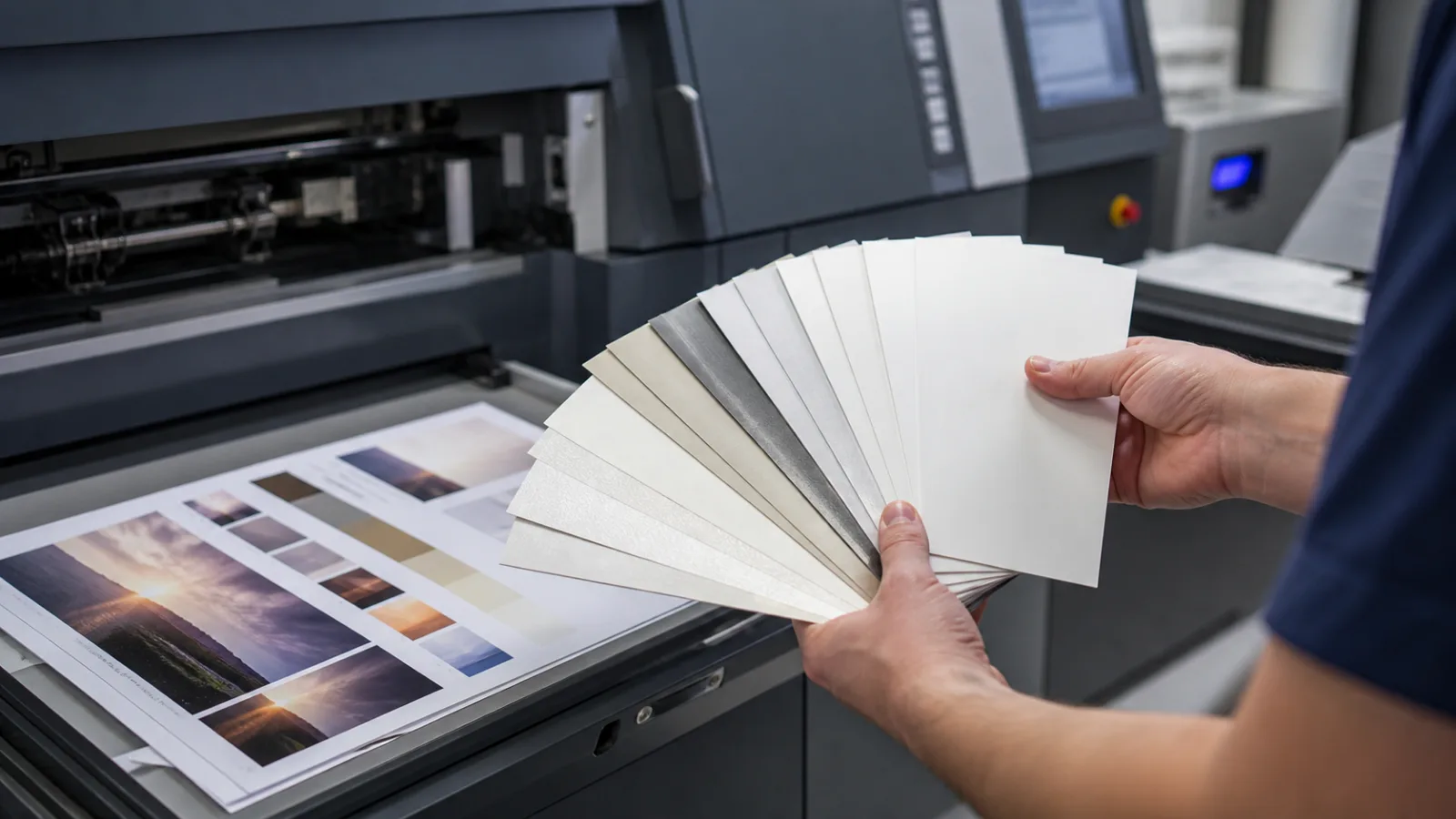

Grammage alone does not tell you how thick, rigid, or substantial a printed product will be. Two papers at the same gsm can produce different book spine widths, stack heights, fold behaviour, postal handling, and perceived substance because their fibre structure and density differ.
For products in which fit, thickness, or handling matters, specify grammage with caliper or bulk, then treat stiffness, grain direction, moisture condition, print coverage, and finishing as separate controls. A high-bulk sheet may deliver more thickness at a given grammage, but it is not automatically the stiffer, stronger, or more suitable option for a cover or structural printed component.
This distinction matters most when a nominal sheet property must become a reliable finished product: a perfect-bound book that must fit a cover, an insert that must feed cleanly, a folder that must stay closed, or a folded direct-mail piece that must run through automated handling. The relevant value is often the finished construction, not the unprinted sheet alone.
Why equal-grammage papers can produce different finished products
Grammage is mass per unit area, normally stated in grams per square metre (g/m² or gsm). It is a useful purchasing and material-selection variable, but it does not directly state sheet thickness.
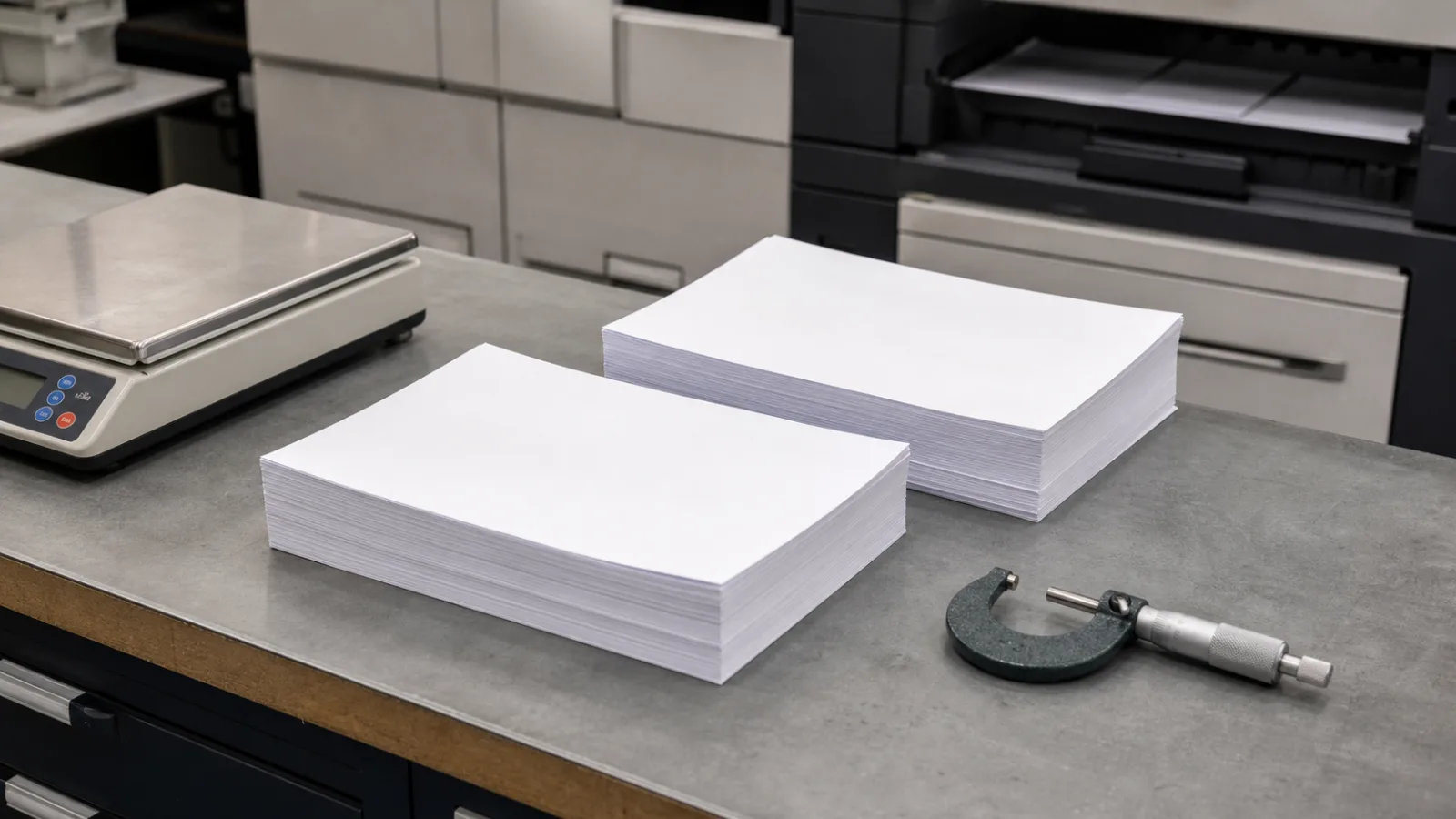
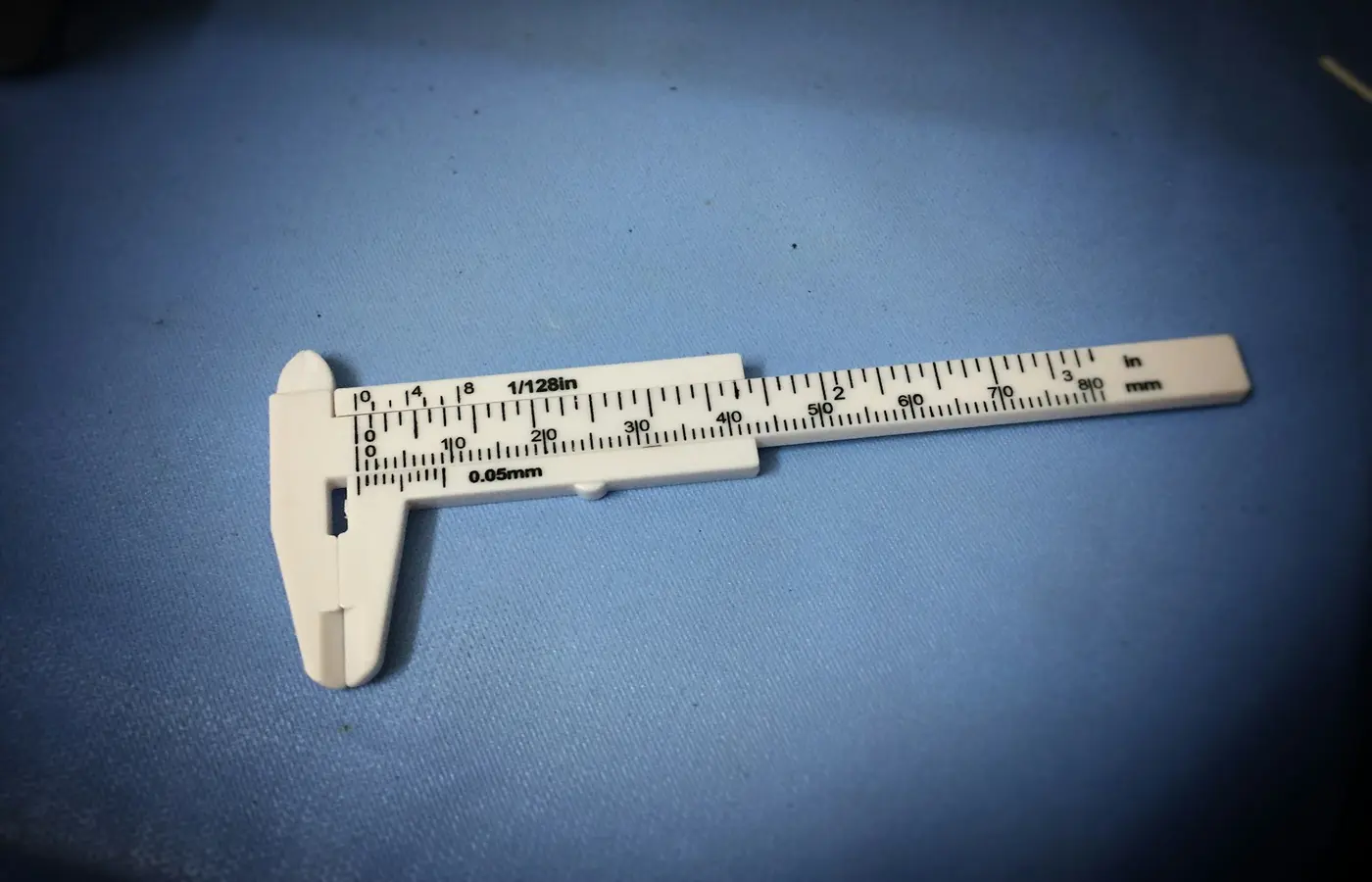
Caliper is the thickness of the sheet measured under a defined procedure. It is commonly reported in micrometres (µm) or millimetres (mm). For estimating the thickness of a text block, stack, or folded construction, caliper is usually the more directly useful starting value.
Bulk describes volume relative to mass. In paper specifications it is often expressed as cubic centimetres per gram (cm³/g), also called specific volume. As Holmen’s explanation of paper bulk notes, bulk is the inverse of apparent density: a higher-bulk sheet has more volume for its mass and is less compact.
That relationship explains why two 100 gsm papers can differ visibly in thickness. One sheet may be more densely consolidated; another may have a more open fibre structure with more internal volume. The latter can create a thicker book block without increasing grammage. It can also change opacity, compressibility, surface character, folding response, and the way the product feels in the hand.
Neither result is inherently superior. A compact sheet may be selected where a thin publication, close registration, a smooth print surface, or controlled folding is important. A bulkier sheet may be selected where spine width, tactile substance, or a lighter-weight but thicker construction is needed. The right choice depends on the finished function and converting route.
ISO 534:2011 covers methods for measuring paper and board thickness as single-sheet thickness or pack, or bulking, thickness. Its scope also covers calculations for apparent density and apparent specific volume. The standard notes that the two thickness methods generally give different results, so a caliper figure is not fully comparable unless the method is known. Before using ISO 534:2011 in a specification, confirm whether a newer edition or locally adopted equivalent applies to the relevant market.
Bulk, caliper, density, and grammage: define the variables before comparing grades
These four terms describe related but different aspects of the sheet:
| Property | What it describes | Practical use |
|---|---|---|
| Grammage | Mass per unit area | Material weight, yield, mailing calculations, and grade selection |
| Caliper | Measured sheet thickness | Stack height, spine estimates, clearance, and physical fit |
| Bulk | Volume per unit mass | Comparing how open or compact different sheet constructions are |
| Apparent density | Mass per unit volume | Comparing consolidation; inversely related to specific bulk |
When units are aligned, specific bulk can be derived from caliper and grammage. In a common paper-industry convention, caliper in micrometres divided by grammage in g/m² produces a value in cm³/g. For example, this is a useful comparison calculation only when the underlying thickness measurements were made under comparable conditions.
That qualification is important. Caliper can be reported as a single-sheet measurement or as a result from a pack of sheets. Measuring a pack can reduce the influence of local surface variation, while also reflecting compression under the specified test conditions. A quoted value can therefore differ according to the instrument, pressure, sample conditioning, method, and whether the result is single-sheet or bulking thickness.
Use caliper when the question is physical dimension: “Will this 160-page text block fit the planned cover?” Use bulk when the question is comparative construction: “Which of these 90 gsm grades provides greater volume for the same mass?” Use grammage when mass, yield, basis weight, or a grade family is the principal control. In most production specifications, all three may be relevant.
Do not compare a supplier’s bulk figure with another supplier’s caliper figure without obtaining the associated grammage, units, test method, tolerance, and conditioning details. A numerically similar-looking value may not represent the same property.
Stiffness is related to thickness but is not the same property
A thicker sheet often appears more resistant to bending than a thinner sheet of otherwise similar construction. That observation is useful, but it is not a stiffness specification.
Stiffness, often assessed as bending resistance, describes how a sheet resists deformation when bent under a defined test arrangement. It depends on more than grammage and caliper. Fibre orientation, fibre bonding, sheet formation, moisture condition, coatings, laminations, and the direction in which the sample is bent can all affect the result.
Paper has a grain direction because fibres become preferentially oriented as the web forms and travels through the paper machine. As the Toronto Metropolitan University graphic-arts instrumentation chapter explains, grain is expressed in relation to the long or short side of the finished sheet. Machine direction and cross direction can behave differently in bending, folding, dimensional change, and curl.
For that reason, a stiffness figure is incomplete unless it identifies the test direction and, where relevant, the test method and conditioning. A supplier may report machine-direction and cross-direction values separately. If a piece will be folded, fed edge-first, scored, or used as a cover, identify which direction matters in the actual layout.
A high-bulk sheet should not be assumed to be stiffer. More thickness can contribute to bending resistance, but a less dense construction may also be more compressible. Conversely, a dense coated sheet may feel thinner than a bulky uncoated sheet while performing differently in a particular bend or feed path. Select stiffness by a reported value or a representative production dummy when the product must stand, spring, feed, or retain a shape.
What can change after the sheet is specified
A paper datasheet describes the supplied sheet under stated conditions. The finished printed product can differ because conversion adds, removes, compresses, or redistributes material.
Moisture and conditioning
Paper is hygroscopic: it exchanges moisture with the surrounding environment. Its dimensions and physical response can change as moisture condition changes. Physical testing therefore normally depends on controlled sample conditioning and defined test conditions.
For a critical job, ask how the supplier’s value was conditioned and compare samples after they have equilibrated in the production environment. Avoid treating a caliper or stiffness result from an unknown warehouse condition as a final production guarantee.
Printing and surface finishing
Ink coverage, coatings, varnishes, lamination, and other applied layers can add build and alter surface friction, curl, fold response, and perceived rigidity. The magnitude is construction-dependent. A solid-coverage printed sheet with a film laminate should not be expected to match the handling of an unprinted sheet merely because the base paper is identical.
Surface finish can also affect caliper. The supplied Hand Papermaking discussion of physical properties notes that, with other factors held constant, smoother and rougher finishes can produce different thicknesses. That principle should not be expanded into a universal rule for all commercial grades, coated papers, or finishing systems; confirm the actual grade.
Folding, scoring, embossing, and binding
Scoring locally compresses and displaces fibres to control a fold. Folding creates a layered structure. Embossing alters the sheet profile. Binding applies pressure and may compact a text block; adhesive, sewing, lining materials, and cover construction add their own dimensions.
These effects make a simple multiplication of nominal caliper useful only as an initial estimate. It is not a universal book-spine formula. A spine calculation should identify whether the count refers to pages, leaves, or signatures; the paper caliper; the number of folded layers; print and coating build; binding compression; adhesive system; and bindery method.
Specify the property by product function
The most useful specification changes with the product’s failure mode.
Books and catalogues
Specify exact grade and grammage, nominal caliper with tolerance, grain direction, and the thickness measurement method. Use these values for an initial text-block estimate, then approve a printed and bound dummy if spine fit, opening behaviour, or cover wrap is critical.
Bulk is particularly useful when comparing alternative text papers at the same grammage. It helps answer whether a lower-mass paper can achieve a required spine width or perceived substance. It does not replace a measured finished dummy.
Inserts, leaflets, and direct-mail pieces
Caliper can affect stack height, feeder settings, and the number of pieces that fit in a pack. Stiffness and grain direction can be more important than caliper where the piece must feed reliably, resist dog-earing, or stay flat after folding.
Specify the fold direction, whether scoring is planned, print coverage, and any coating or laminate. If the item runs through automated insertion or mailing equipment, approve the converted piece on the relevant equipment or through the responsible operator’s normal qualification process.
Covers, folders, and presentation pieces
For a cover, grammage alone is rarely enough. Ask for caliper where fit and perceived substance matter, then request directional stiffness data if the cover must stand, resist curl, or maintain a particular opening feel.
A physical dummy is especially valuable where the cover includes a wide score, film lamination, embossing, foil, or an unusual fold geometry. These construction choices can dominate the final handling result.
Packaging-like printed components
A printed sleeve, header card, folded carton insert, or retail folder may need defined bending resistance, crease performance, and dimensional consistency. In such cases, caliper and bulk remain relevant, but the specification should also identify the converting sequence and any structural performance requirement. Do not infer packaging suitability from a paper’s thickness or weight alone.
A practical specification and approval check
Use a staged process rather than relying on a generic description such as “heavy,” “premium,” or “high bulk.”
- Name the exact material. Record supplier, grade, finish, shade, grammage, sheet or reel format, and any relevant coating or treatment.
- Request thickness information correctly. Ask for nominal caliper, tolerance, units, test method, test pressure where stated, sample conditioning, and whether the figure is single-sheet or pack thickness.
- Record bulk and density as comparison values. Where available, obtain specific bulk or apparent density for the same grade and grammage. Do not substitute a value from a related grade.
- Confirm grain direction. State whether the long or short edge is grain direction and map it to fold lines, spine direction, feed direction, and expected bending direction.
- Identify a separate stiffness requirement. If the item must feed, stand, resist bending, or retain shape, request directional bending-resistance data or define an agreed physical dummy assessment.
- Build an initial dimensional estimate. Calculate stack or text-block thickness using the applicable caliper and the actual number of layers. Treat this as a planning estimate, not final approval.
- Include the conversion route. Record ink coverage, coating, varnish, lamination, scoring, embossing, folding, and binding or packing pressure that could change the final construction.
- Approve a representative finished sample. Where fit or handling is consequential, approve a printed, finished, and bound or converted dummy produced as close as practical to the intended process.
Frequently asked questions
Is paper bulk the same as paper thickness?
No. Caliper is a measured thickness. Bulk is volume relative to mass, usually expressed as cm³/g. Bulk helps compare how compact different papers are, while caliper is the more direct input for a physical thickness estimate.
Why can two papers with the same gsm have different caliper?
They can have different apparent densities and fibre structures. A less compact, higher-bulk sheet contains more volume for the same mass and can therefore be thicker than a denser sheet at the same grammage.
Should a book cover be specified by grammage, caliper, or stiffness?
Usually by more than one property. Grammage identifies the material class and mass per area; caliper helps with spine fit and physical substance; directional stiffness helps where opening feel, curl control, or shape retention matters. Grain direction and finishing must also match the bindery design.
How should caliper be checked before approving a printed job?
First compare the supplier’s stated caliper, tolerance, test method, and conditioning details for the exact grade. Then measure or obtain measured data from the supplied production lot using an agreed method. Where the product depends on final thickness or handling, check the printed and finished construction rather than approving from unprinted-sheet values alone.
Specify caliper whenever physical dimension matters, use bulk to compare paper construction at a given grammage, and request stiffness data or a production dummy whenever bending performance is critical. The final question is not whether a sheet is simply thicker or heavier, but whether the specified material and conversion route produce the required finished product.