
Paper bulk and caliper are related, but they do not describe the same property. Caliper is the measured thickness of a sheet. Bulk expresses thickness in relation to mass per unit area. Grammage expresses mass per unit area. Stiffness describes resistance to bending under a defined test arrangement.
A specification that asks only for “thicker paper” or “a stiffer stock” leaves too much open to interpretation. Two sheets with the same grammage can have noticeably different caliper, surface, fold response, stack height, and bending behaviour. Equally, a thicker sheet is not automatically the stiffer sheet once fibre orientation, construction, moisture, coating, scoring, and finished-product geometry are considered.
For a usable purchasing or production specification, identify the grade and finish first. Then state the properties that matter to the job, the units and test conditions required, acceptable variation, and the product-level checks that must pass before approval.
Bulk, caliper, grammage, and stiffness measure different things
Grammage is the mass of paper or board per unit area, normally stated in grams per square metre, or g/m². It is often shortened to GSM. Grammage is useful when material mass, postal weight, yield, fibre consumption, or an established grade class matters. It is not a direct thickness value.
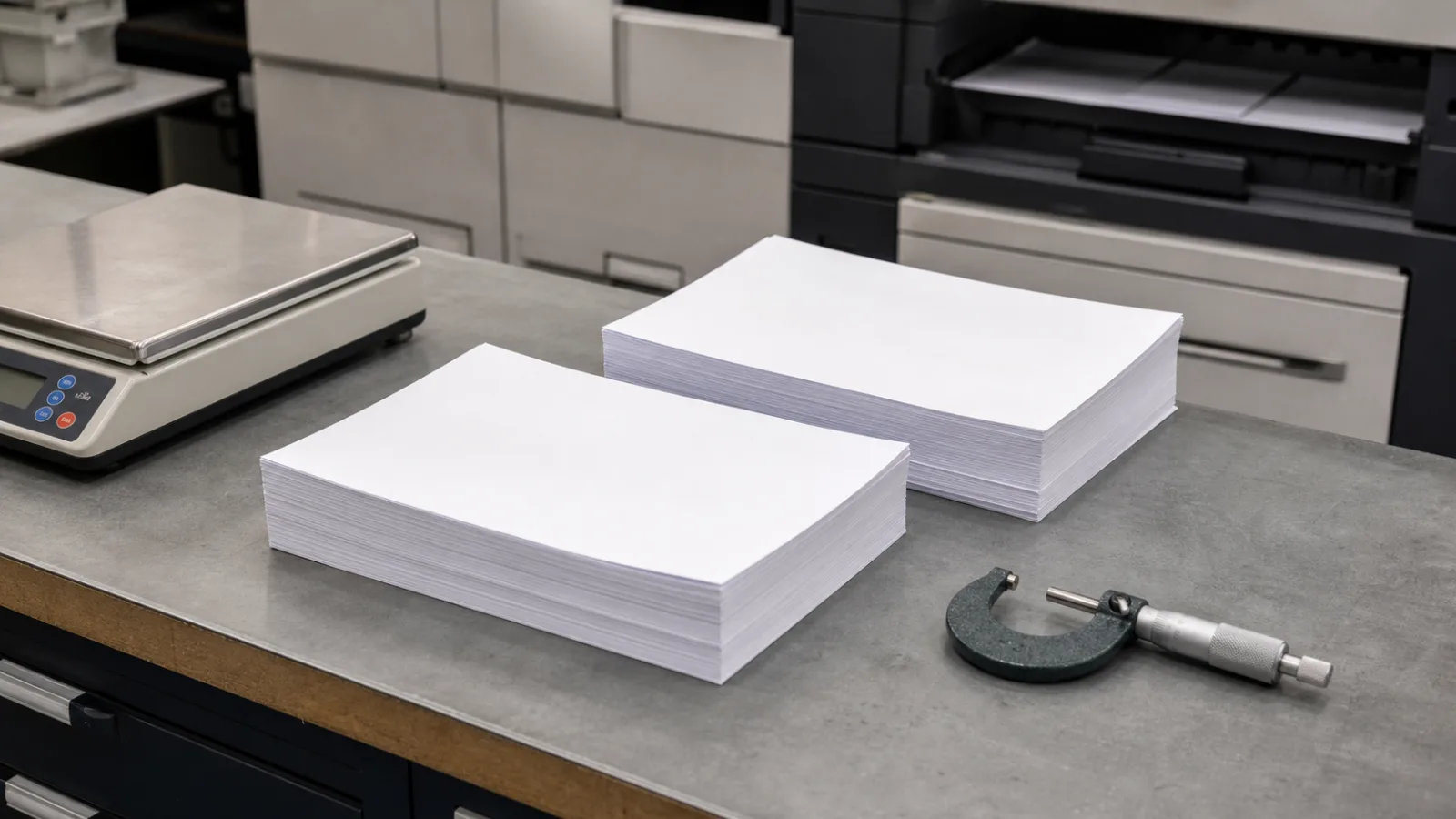
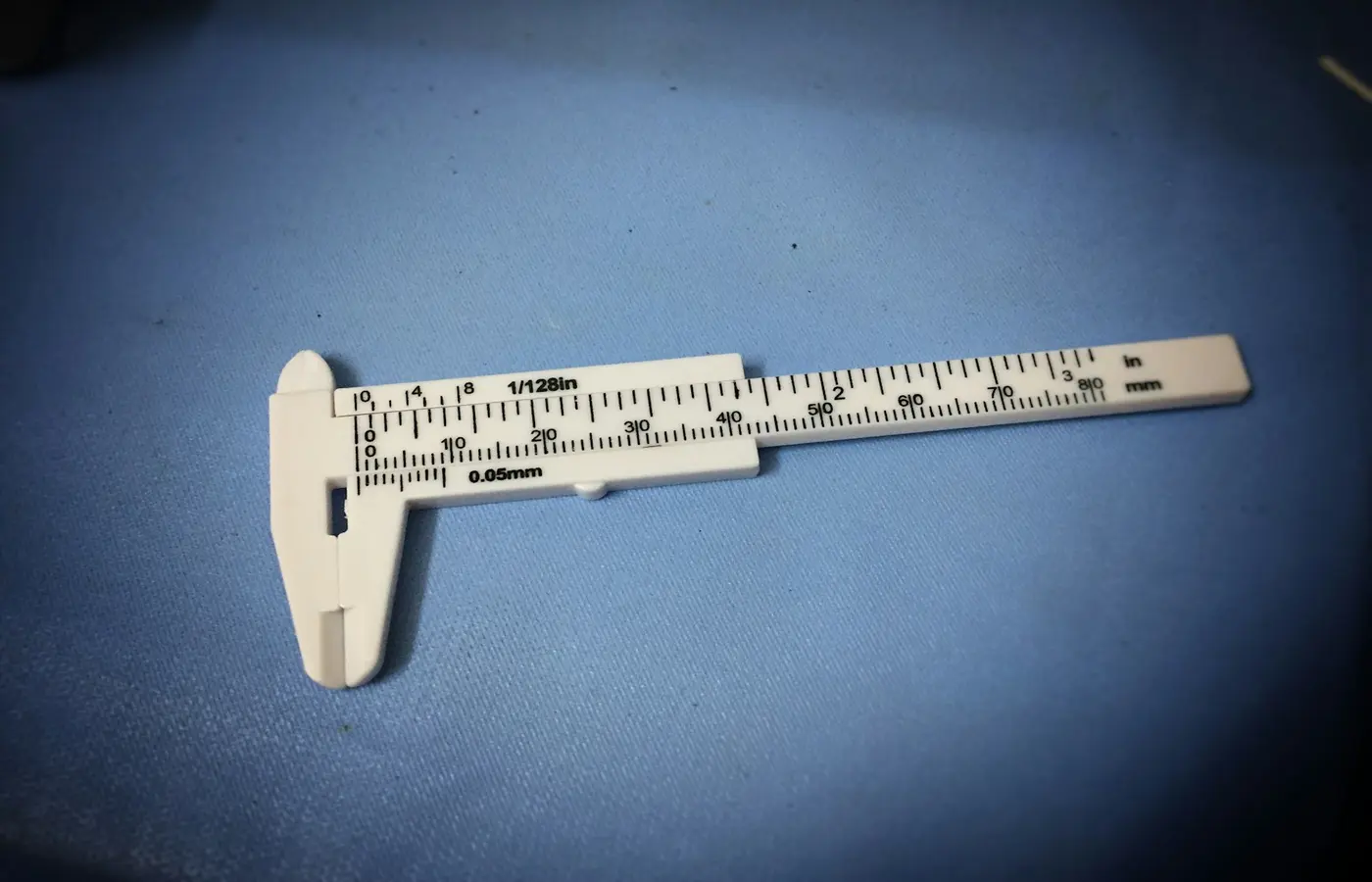
Caliper is sheet thickness, usually reported in micrometres (µm), millimetres (mm), mils, or points depending on the market and product class. It is measured with a defined instrument, contact pressure, sample preparation, and test procedure. If a carton must fit a tight pack-out, if a book block must reach a target spine width, or if a reel must deliver a specified running length at a given diameter, caliper is usually the more immediately relevant property.
Bulk compares thickness or volume with mass. In paper technology, it is commonly treated as the reciprocal of apparent density. One convention expresses bulk in cubic centimetres per gram (cm³/g):
bulk = caliper in mm × 1,000 ÷ grammage in g/m²
That convention is described in this paper properties reference. Other supplier documents may use a different bulk index, a different unit system, or a basis-weight convention. Do not transfer a bulk value between documents until you have checked the formula, units, and basis used by each supplier.
Stiffness, often described in testing as bending resistance or bending stiffness, is resistance to bending under stated conditions. The result depends on the test method, sample orientation, span or geometry, and environmental conditioning. It is a performance property, not a synonym for thickness, bulk, or grammage.
The distinction matters because each measure controls a different production risk:
| Property | What it primarily describes | Questions it helps answer | What it cannot establish alone |
|---|---|---|---|
| Grammage | Mass per unit area | Is the specified grade weight being supplied? What is the likely material yield? | Exact thickness, stack height, or bending rigidity |
| Caliper | Measured sheet thickness | Will the material fit a clearance, spine, roll, or packed-product geometry? | Stiffness, surface strength, or fold performance |
| Bulk | Thickness relative to mass | Which construction provides more thickness at a given grammage? | Whether the sheet will perform better in a press or conversion line |
| Stiffness | Resistance to bending in a defined test | Will a panel, cover, tag, or carton resist bending as required? | Full product performance after scoring, printing, laminating, or filling |
A useful rule is simple: specify the property tied to the failure mode. Do not use grammage as a proxy for caliper, or caliper as a proxy for stiffness, unless the relevant grade and application have already been validated.
Why equal grammage can produce different thickness and feel
Two 250 g/m² boards can have different calipers because they have different apparent densities. A lower-density construction occupies more volume for the same mass and will generally show higher bulk. A denser construction occupies less volume and may show lower bulk.
Several manufacturing and material variables can affect the relationship:
- Fibre furnish and fibre treatment. Fibre type, refining, filler content, recycled-fibre content, and bonding can alter how tightly the sheet structure packs.
- Layered construction. Multi-ply boards may use different fibre layers or furnish combinations to balance print surface, bulk, strength, and cost.
- Calendering. Passing paper through calendering nips can change surface smoothness and compress the sheet. The effect depends on grade, moisture, pressure, temperature, and target finish.
- Coating and surface treatment. Coatings add mass and can alter surface properties. Their effect on final caliper depends on the coating system and the base sheet construction.
- Moisture and conditioning. Paper dimensions and mechanical behaviour can shift with moisture content and relative humidity. A caliper figure without conditioning information may not match the material at the point of conversion.
- Measurement practice. Instrument settings, contact area, pressure, sampling plan, and whether the value is a nominal, average, or individual-sheet result all affect how a reported caliper should be interpreted.
In practical terms, higher bulk may help achieve a thicker-looking book, card, or carton without moving to a higher grammage. That can be valuable where postal mass or material yield is constrained. But it may also change stack height, folding settings, die-cut pressure response, carton geometry, feeder adjustment, or roll length.
Caliper is especially important in applications with a dimensional limit. A book printer may need a target spine width. A label converter may need a construction that runs through a dispensing system with limited clearance. A folding-carton producer may need a board that closes correctly after scoring and gluing. In each case, ask for the declared caliper of the exact grade, finish, and grammage rather than estimating it from GSM.
As a paper caliper guide for roll applications notes, caliper affects the amount of material that fits within a given roll outside diameter. This is a geometric consequence, not a statement that one construction is universally better. A bulkier sheet may reduce the linear metres available on the same reel diameter.
Thickness is not a stiffness specification
Caliper contributes to bending behaviour, but it is only one input. A thicker sheet can feel more rigid in the hand, yet finished-product stiffness also depends on fibre network structure, grain direction, moisture, coatings, laminations, creases, panel size, and how the item is supported.
Machine direction (MD) and cross direction (CD) are particularly important. Paper fibres tend to align preferentially in the machine direction during manufacture. As a result, mechanical behaviour can differ by direction. A carton blank, cover, sleeve, or insert may bend differently when its long panel runs with the grain rather than across it.
The finished design can dominate what a user experiences. Consider a folding carton side panel: its effective rigidity depends not just on board stiffness but also on panel dimensions, score quality, fold orientation, glued seams, cut-outs, contents, and whether the carton is supported by an outer pack. A laboratory stiffness result may be useful for comparing incoming material, but it does not replace a formed-pack trial.
This is why a requirement such as “high stiffness” should be expanded into a testable question:
- Is the concern panel sag, curl, crush during filling, poor shelf presentation, flap opening, or difficulty feeding?
- In which direction does the critical bend occur?
- Does the supplier report stiffness in both MD and CD?
- Which test method, span, sample conditioning, and units are required?
- Is the acceptance criterion a laboratory result, a converter run, a filled-pack test, or a combination?
If no defined stiffness method is available for the grade, retain caliper and grammage as material controls, then approve stiffness through a controlled application trial. Avoid converting a subjective hand-feel comparison into a universal stiffness claim.
What to request on a paper or board specification
A robust specification does not need to be long, but it must be specific enough for a supplier, printer, converter, and quality team to interpret consistently.
Request the following information for the exact material, not just a family name.
-
Grade identification
- Supplier, grade name, grade code if applicable, and construction.
- Coated, uncoated, treated, laminated, virgin-fibre, recycled-content, or other relevant description only where documented for that grade.
- Sheet or reel format, core size, reel width, grain direction, and finish.
-
Grammage requirement
- Nominal grammage in g/m².
- Supplier-declared tolerance or an agreed job tolerance.
- The measurement method and whether the stated figure is a target, range, or average.
-
Caliper requirement
- Nominal caliper and unit, preferably in µm for international clarity.
- Tolerance, stated separately from grammage tolerance.
- Test method, conditioning requirements, and sampling plan where caliper is critical to fit or function.
-
Bulk requirement, where thickness-to-weight is important
- State the bulk value, unit, and formula convention.
- Confirm whether it is a calculated value from grammage and caliper or a separately reported product value.
- Do not write “high bulk” without a reference grade, target range, or intended functional result.
-
Stiffness requirement, where rigidity is critical
- Test method, result units, machine direction and cross direction, and any required conditioning.
- A clear statement of whether the value is a release criterion or a comparative reference.
- A product-level confirmation, such as successful feeding, folding, erection, filling, or use.
-
Conversion and print requirements
- Print process, ink or toner system, drying or curing conditions, varnish, lamination, embossing, scoring, die-cutting, gluing, and any automated packing equipment.
- Critical defects to control: cracking at folds, scuffing, curl, registration movement, feeding issues, dimensional mismatch, or poor carton erection.
There is no universal caliper tolerance that suits every paper or board job. A permissible variation for a general print sheet may be unacceptable for a tightly toleranced label, multi-page book block, precision die-cut part, or automated packaging line. Set the tolerance from the product geometry, machine capability, supplier data, and trial evidence rather than copying a number from an unrelated grade.
Verify the grade in a job-relevant trial
A datasheet is necessary, but it does not prove that a material will perform in a particular design and process. Verification should move from document review to controlled production evidence.
1. Confirm the documented material
Check that the supplier sample, quotation, purchase order, and delivery documentation identify the same grade, grammage, finish, format, and grain direction. If the product uses a coated or laminated construction, confirm whether the reported caliper applies before or after that additional conversion step.
2. Agree the measurements before sampling
For properties that drive acceptance, agree the unit, method, sample quantity, conditioning, and reporting format before production. A caliper result is more useful when everyone knows whether it represents individual readings, an average, a reel profile, or another sampling approach.
3. Condition and inspect representative samples
Store and condition samples according to the material supplier’s handling guidance and the operating requirements of the production environment. Inspect for visible issues that could affect the trial, including curl, edge damage, moisture imbalance, surface contamination, and sheet-to-sheet variation.
4. Run the actual conversion sequence
Use the intended press, finishing route, tooling, and product geometry where feasible. A flat-sheet hand assessment cannot confirm how a carton will score and erect, how a cover will fold, or how a reel will feed through a production line.
Record the settings and observations that matter: feeder performance, register stability, print appearance, drying or curing response, score cracking, die-cut release, folding behaviour, glue performance, stack height, and pack fit. These observations apply only to the tested setup unless further evidence supports a broader conclusion.
5. Define sign-off criteria around the product
Sign-off should connect material measures with functional outcomes. For example, a carton project may require caliper within an agreed range, no unacceptable cracking at defined score lines, stable erection on the intended line, and fit within the specified outer pack. A book project may require caliper control, acceptable folding, and a finished spine within the design tolerance.
Keep retained samples, supplier documentation, and trial records together. They provide a more useful baseline for repeat orders than a general instruction to purchase “the same thick stock.”
Frequently asked questions
Can two papers with the same GSM have different caliper?
Yes. Sheets with the same grammage can have different thickness because their apparent density and construction differ. Fibre furnish, calendering, coatings, moisture condition, and layered structure can all affect caliper. Compare the supplier’s declared caliper for the exact grade rather than inferring it from GSM.
Does higher bulk always mean a stiffer sheet?
No. Higher bulk means more thickness relative to mass under the stated bulk convention. It does not establish bending stiffness or finished-product rigidity. If rigidity is critical, request a defined stiffness value in the relevant direction and verify the converted product.
What caliper tolerance should a paper specification include?
Use a tolerance derived from the actual application. The acceptable range depends on grade, product geometry, stack or reel constraints, conversion process, equipment capability, and the supplier’s declared manufacturing range. Ask the supplier what tolerance applies to the exact grade, then confirm that it supports the job through sampling and trial.
Should stiffness be specified in machine direction and cross direction?
Usually, yes, when directional bending behaviour affects conversion or use. Machine direction and cross direction may perform differently. State the required orientation relative to the finished product, along with the test method and conditioning, rather than requesting an unspecified single stiffness figure.
Select grammage when mass-related control is the main need, caliper when dimensional fit matters, and bulk when comparing thickness relative to mass. When the real requirement is rigidity, treat measured stiffness and a job-relevant trial as separate controls rather than assuming that a thicker or heavier sheet will solve the problem.