
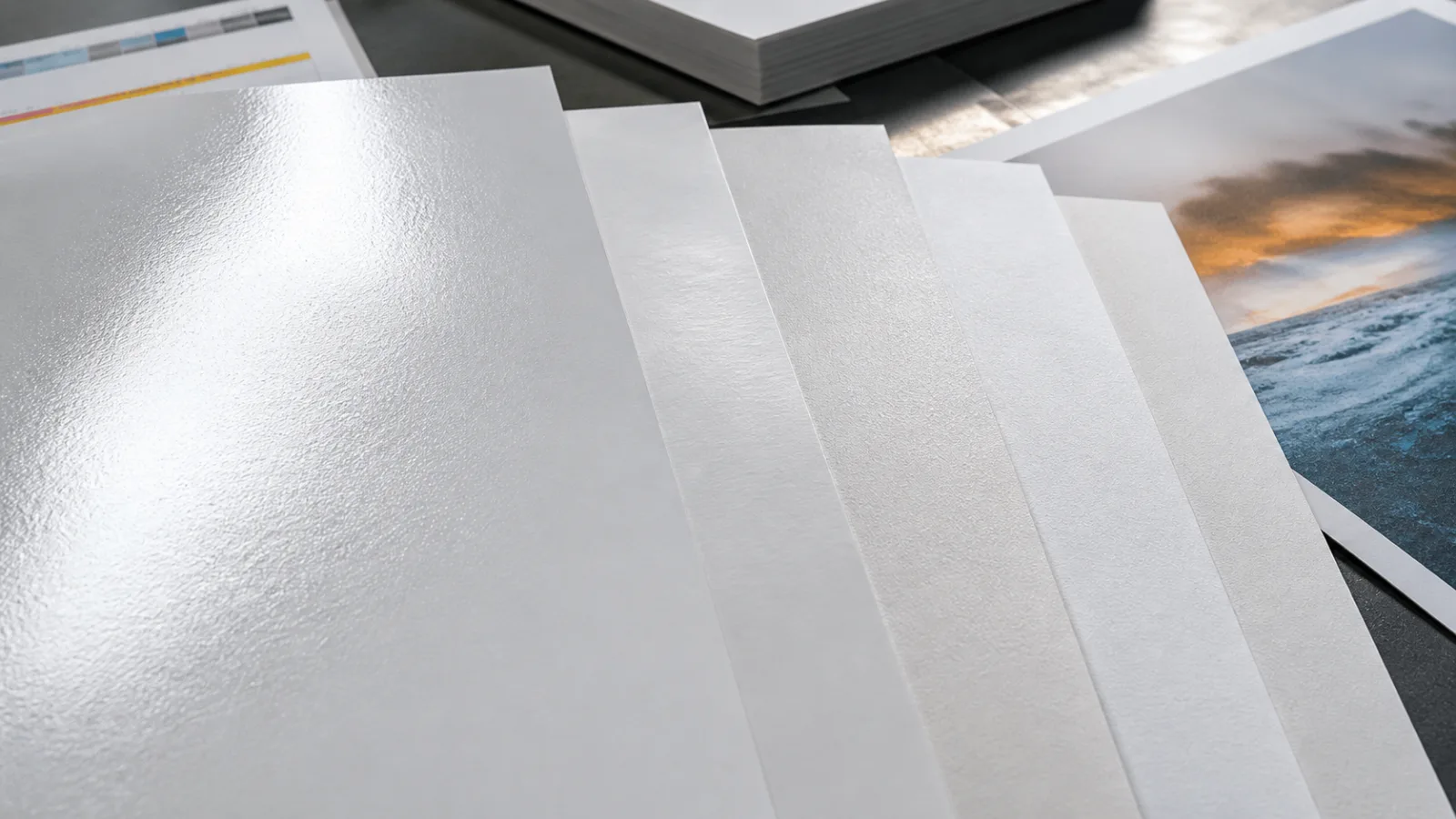
Coated paper is paper whose printing surface has been covered with a formulated layer of pigments and binders. That layer fills irregularities between fibres and gives the papermaker tighter control over smoothness, whiteness, gloss and ink absorption. It is why a photograph in a catalogue can appear crisper and more saturated on coated stock than on an otherwise comparable uncoated sheet.
The practical distinction is ink holdout. On uncoated paper, the liquid portion of an ink can penetrate the open fibre structure while pigment settles across a relatively uneven surface. A coating keeps more of that image-forming material near a smoother surface. Fine dots retain their shape more predictably, small type stays cleaner and solid colours usually look denser.
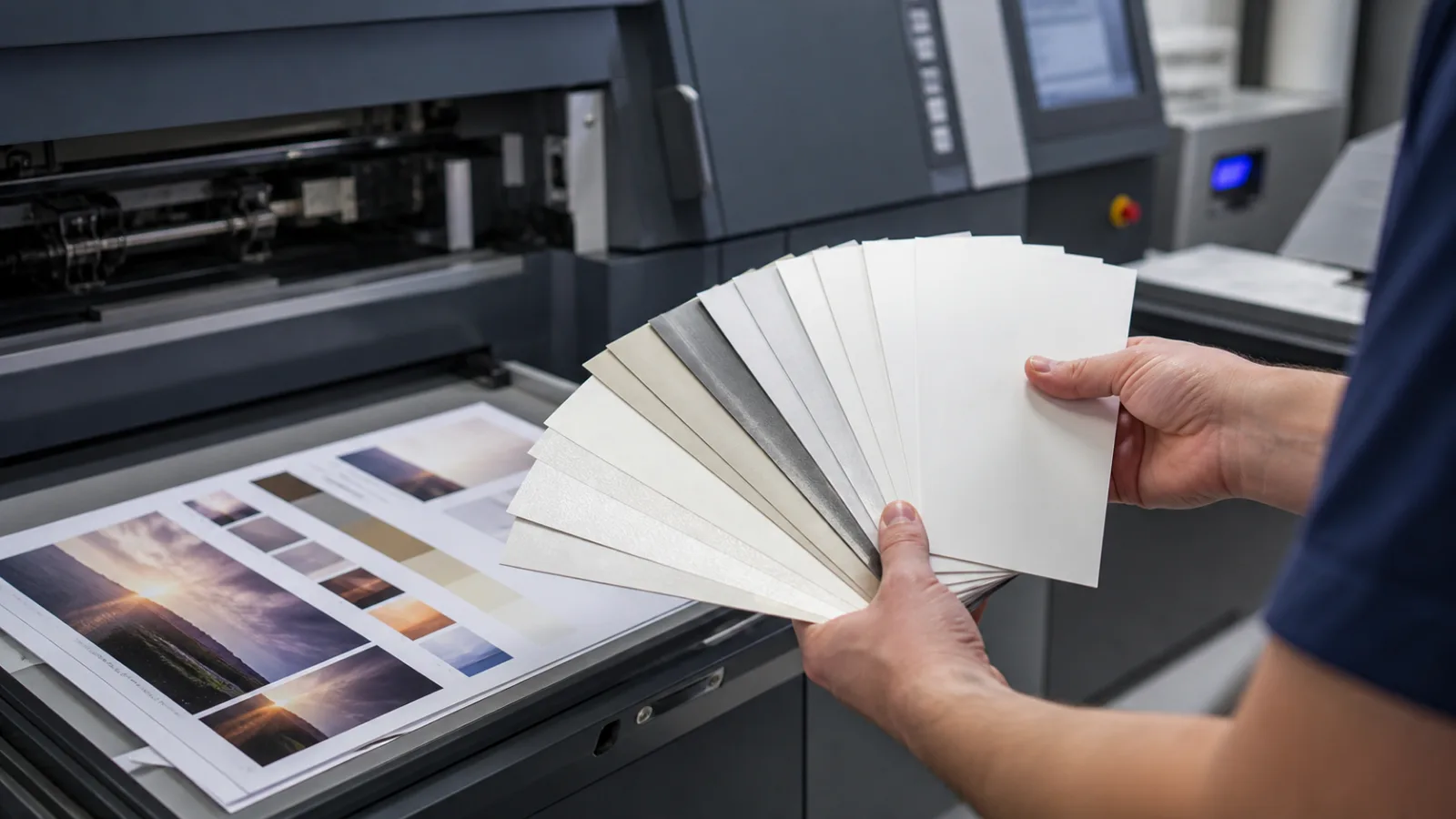
Coated does not automatically mean glossy, waterproof or premium. Matte, silk, satin and gloss papers can all be coated, and grades within one finish family differ considerably. A useful specification names the mill, grade, basis weight or grammage, finish, shade and grain direction rather than relying on “coated paper” alone.
What the coating changes
Many graphic papers use mineral pigments held to the base sheet by a binder. Formulations and coating methods vary, and manufacturers may engineer the surface for offset lithography, toner, inkjet or a particular converting requirement. Some papers are coated on both sides; others are coated on one side when only the exterior face needs high-quality reproduction.
The coating influences properties buyers can see or measure:
- Smoothness: a more uniform surface supports fine screening, sharp edges and even solids.
- Gloss: the direction of reflected light changes image contrast and text readability.
- Ink absorption: controlled holdout can improve colour strength, but the ink must still set or dry correctly.
- Surface strength: the coating has to resist picking, abrasion and damage during printing and finishing.
- Shade and brightness: these affect the apparent warmth of images and contrast of the printed sheet.
- Receptivity: ink, toner, varnish, laminate or adhesive must bond to the surface.
Coating is only the top layer of a system. Fibre furnish, formation, moisture, caliper and stiffness still govern feeding, opacity, fold behaviour and bulk.
Gloss, silk and matte are a spectrum
| Finish | What it tends to do well | Limitations to evaluate |
|---|---|---|
| Gloss | Strong apparent contrast, saturated photography, clean detail | Glare, fingerprints and scuffing can be conspicuous |
| Silk or satin | Balances image definition with restrained reflection | Names are not standardised; compare actual grades |
| Matte coated | Comfortable reading, muted reflection, refined tactile effect | Dark areas may burnish; some grades look less saturated |
These labels describe appearance, not a universal technical class. One supplier’s silk can be close to another supplier’s matte. Compare printed production proofs under the lighting in which the piece will be used. An exhibition handout viewed under spotlights has different glare demands from a mail-order catalogue read at home. Our glossy versus matte paper comparison looks at handling, writing and image reproduction in more depth.
Coated versus uncoated paper
Coated paper is usually favoured when a design depends on photography, tight colour control, small reversed type or smooth solids. Typical work includes catalogues, brochures, annual reports, book covers, art publications, promotional cards and premium cartons.
Uncoated paper exposes more of the fibre texture. It can feel warmer, accepts many writing instruments readily and often suits books, letterheads, forms and tactile brand pieces. Images normally reproduce with softer contrast because more ink enters the sheet and the surface is less uniform. That result may be exactly what the art direction requires.
Opacity, stiffness and thickness do not follow directly from finish. A lightweight coated grade can be thinner and less opaque than a bulky uncoated sheet. GSM is mass per area, not a quality score; see 70 GSM versus 80 GSM paper for why weight and caliper should not be treated as interchangeable.
Match the sheet to the print process
Offset lithography
Coated papers are a familiar offset choice, but ink and coating still need a compatible setting and drying route. Heavy coverage, tight delivery schedules and immediate finishing increase the risk of set-off, marking or poorly cured ink. The printer may adjust ink, spray powder, stack height and drying time to the grade and coverage.
Toner printing
The sheet must tolerate heat and pressure in the fusing stage, release cleanly through the paper path and allow toner to anchor. A stock sold for offset may run, but qualification on the actual device is safer—especially for heavy sheets, textured coatings or duplex work.
Production inkjet
Inkjet places liquid droplets directly on the surface. An appropriate treatment controls spread and keeps colourant near the image plane while carrier liquid is removed. A conventionally coated offset paper is not automatically a production-inkjet paper. Press manufacturers and mills publish qualified-media information because ink chemistry, drying capacity and transport design differ. The paper selection guide for digital printing explains how to plan that test.
Folding, binding and finishing risks
Coated surfaces can crack along a fold when the sheet is heavy, the fold runs against the grain, ink coverage is dense or the score is poorly matched to caliper. Put the grain parallel to the principal fold whenever the layout permits. Test scores on the real printed and conditioned stock; an unprinted dummy will not reveal whether a dark solid fractures.
Also confirm whether a laminate or adhesive bonds to the printed coating, whether varnish changes gloss or slip, whether foil and embossing retain detail, and whether finished pieces rub when stacked. For cartons, the coating must work with the board structure and converting sequence. The paperboard grades guide connects surface choice to stiffness, scoring and package performance.
A buyer’s approval checklist
- Confirm press qualification, available grain direction and supplier tolerances.
- Compare printed proofs using representative skin tones, neutrals, fine type and heavy solids.
- View them under intended lighting and handle them as a customer will.
- Fold, bind, laminate, foil or glue production-equivalent sheets.
- Check drying, rub resistance, cracking, show-through and finished bulk.
- Record the grade, grammage, finish and approved press condition in the purchase specification.
Coated paper earns its place when controlled image reproduction matters, but finish names are only a starting point. The dependable decision comes from matching a documented grade to the press, artwork, finishing and actual use of the printed product.