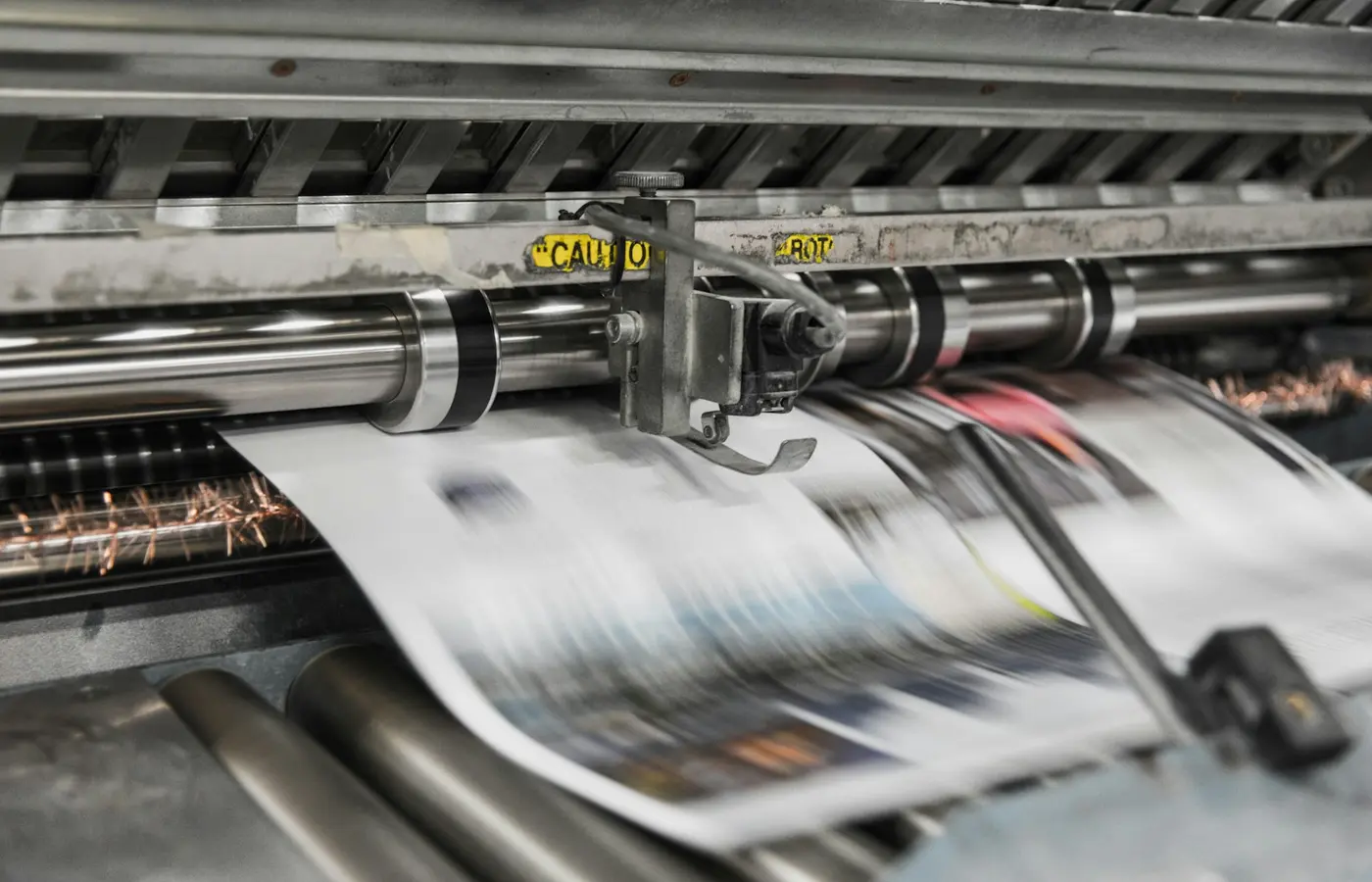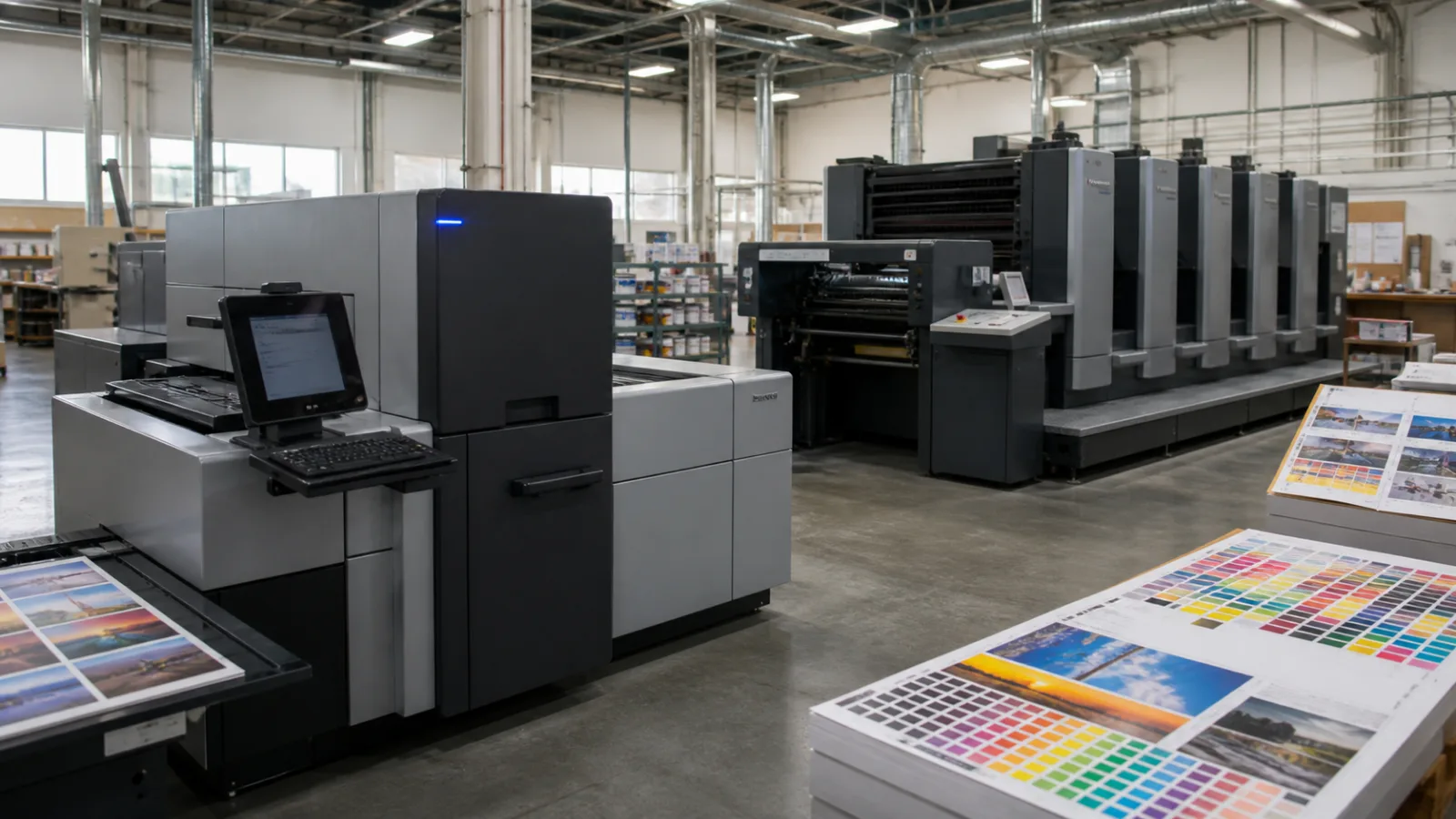

Offset vs production inkjet is not a choice that can be made from run length alone. The suitable route depends on the complete job: quantity, number of versions, substrate, colour expectation, finishing path, delivery date, inventory exposure and the cost assumptions used in the estimate.
Offset lithography uses printing plates and a press make-ready process to transfer ink through a plate, blanket and impression system. Production inkjet images directly from digital files, usually without plates, but still needs controlled file preparation, calibration, stock qualification, maintenance and finishing planning. Both routes can be effective commercial-print systems. Their cost and production structures are simply different.
A useful decision starts with a defined job brief and ends with approved samples and route-specific estimates. It should not begin with a universal claim that one process becomes cheaper at a particular quantity.
Start with the job definition, not the press type
Write the job specification before asking a printer to recommend a route. A vague request for “a short run” or “high-quality colour” leaves too much unstated for a meaningful comparison.
At minimum, define:
- final quantity and expected reorder quantity;
- number of versions, languages, territories or customer-specific editions;
- page count, finished size, imposition constraints and binding method;
- static versus variable pages, images or messages;
- substrate grade, basis weight, coating, grain direction and required appearance;
- ink coverage, solids, photographic images, fine type and reversed-out elements;
- brand-colour requirements and the approval method;
- coating, lamination, die-cutting, mailing or other downstream operations;
- delivery date, split deliveries and fulfilment requirements;
- likely obsolescence, amendment or reprint risk.
This turns a technology comparison into a production question. For example, a 20,000-copy brochure with one static version may have a very different route decision from a 20,000-piece campaign divided across 40 regional versions. The total quantity is identical, but the number of make-readies, files, approvals and inventory risks is not.
Separate the quantities that will genuinely print together from quantities that merely share a purchase order. If versions cannot be combined in one production run, each version has its own setup, waste, scheduling and finishing consequences.
Compare setup, changeover and run structure
Offset’s production structure includes plate output, mounting, ink and dampening setup, registration, colour adjustment and make-ready sheets. A change in version, paper, ink sequence or job format can require further preparation. The scale of that work depends on the press configuration, automation, job design and operating practice.
Those fixed activities can be distributed across more saleable sheets when one stable version has a larger quantity. Offset may therefore be operationally attractive where the job has a repeatable format, qualified stock, predictable finishing and sufficient volume to absorb setup and make-ready costs.
Production inkjet removes the plate-making step and permits image changes through the digital workflow. That can simplify a job with many versions, late editorial changes or variable data such as individual addresses, offers or codes. A production inkjet system still requires work before acceptable output begins, however. Files need preflight and raster image processing; the press may need calibration, cleaning or conditioning; and the selected stock needs to be suitable for the press, ink set and speed.
Ordant’s overview of production inkjet describes the technology as a complement to offset for variable-data and fast-turnaround work. That is useful framing, but it is not proof that every inkjet press will be faster or less costly for a particular job. Press availability, file complexity, roll or sheet handling, required drying time and finishing capacity can reverse an apparent advantage.
A practical comparison should ask these questions:
- How many independent versions require their own setup or file release?
- Is variable information integral to the job, or could it be applied later by another process?
- How often is the content likely to change after approval?
- Can all versions use the same stock, finishing route and delivery schedule?
- Is press capacity available when the job needs to run?
A static, repeatable job is usually easier to plan through either route. A job with continual version changes has a different exposure: not only press cost, but also the risk of using outdated artwork, holding obsolete inventory or producing a reprint.
Model total job cost instead of using a fixed crossover quantity
There is no defensible universal crossover quantity between offset and production inkjet. A threshold quoted for one plant may embed a particular press, level of automation, paper price, labour model, utilisation rate, finishing line and margin assumption. It may not apply to another supplier or even to another job on the same press.
Compare route-specific estimates using the same scope. The model should include more than the quoted print charge.
| Cost area | Questions to include in the comparison |
|---|---|
| Prepress | Are plates, imposition, data processing, proofing and file corrections included? |
| Make-ready | How are setup time, start-up sheets, wash-up, calibration and spoilage allowed for? |
| Materials | Is the quoted stock identical in grade, weight, coating and availability? What consumables are route-specific? |
| Press time | What production time, queue time and contingency are assumed? |
| Finishing | Are folding, binding, trimming, coating, mailing and packing compatible with the planned output? |
| Labour and handling | Are job changes, inspection, pallet movements and manual finishing steps included? |
| Inventory | What is the cost of storage, picking, write-off and redundant versions? |
| Reprint exposure | If content changes, what quantity must be discarded and reprinted? |
| Fulfilment | Does the estimate include split packs, mail sorting, distribution or delivery windows? |
For offset, the fixed portion often includes plates, setup and make-ready. For inkjet, fixed preparation may be lower for version changes, while click or ink cost, pretreatment, qualified media, drying and digital workflow requirements may be significant. Neither observation establishes a price outcome without a job-specific estimate.
Request estimates in a form that makes assumptions visible. Ask the printer to identify the stock, production route, finishing line, proof or sample method, spoilage allowance, delivery basis and validity period. If one estimate assumes a standard uncoated sheet and another assumes a treated inkjet grade, they are not directly comparable even if the finished job description appears similar.
A useful hypothetical example is a catalogue with a common cover and body but multiple local price pages. It may be economical to print stable sections in one route and variable sections in another, then combine them in binding or fulfilment. That hybrid approach adds handling and workflow complexity, so it should be priced and trialled rather than assumed to be efficient.
Check substrate, image and colour requirements early
Paper suitability is press-specific, not simply “offset” or “inkjet.” The relevant interaction includes the ink chemistry, coating, surface energy, porosity, absorbency, drying or curing method, total ink limit, web or sheet transport and the intended finishing process.
Water-based inkjet systems, for example, can interact differently with ordinary uncoated and glossy coated offset papers. The ink may absorb into an uncoated sheet in a way that changes perceived density or colour, while adhesion or drying can be a concern on some glossy coated sheets. As Ordant notes, this is a substrate consideration for water-based systems; it should not be generalised to UV, solvent, latex or every other inkjet configuration.
Ask for the technical data that applies to the actual combination:
- exact press and ink set;
- approved or recommended paper grades;
- permitted basis weights and calipers;
- coating and treatment requirements;
- grain, curl, moisture and storage conditions;
- maximum ink coverage or ink-limit guidance;
- drying, curing or conditioning requirements;
- approved finishing operations.
Colour also needs to be described more precisely than “match offset quality.” Process-colour consistency, photographic reproduction, solid-density appearance, fine positive type, small reverses and gloss uniformity are separate requirements. A job may be visually acceptable in general but fail a specific brand-colour tolerance or a reverse-type requirement.
Where colour is brand-critical, define the target colour values, measurement condition, substrate, viewing condition, allowable tolerance and approval method. A contract proof, calibrated hard proof and press sheet do not automatically represent the same condition. The approval should identify what is being judged: layout, content, process colour, spot-colour simulation, gloss, finishing appearance or all of these.
The strongest check is a representative production sample on the intended press, stock and finishing route. A sample from another machine, another ink set or an uncoated substitute stock may be useful for early direction but cannot fully qualify the final combination.
Treat finishing and delivery as part of the print route
Print is only one stage of the delivered product. A route that appears favourable at the press can become impractical if it creates delays or defects in folding, binding, coating, lamination, die-cutting, mailing or packing.
Confirm the finishing sequence early. Relevant questions include whether printed sheets can be folded without cracking, whether ink has sufficient rub resistance, whether stacks block under pressure, and whether a later coating, adhesive or laminate adheres properly. For bound products, check grain direction, fold behaviour, spine formation and trim accuracy. For mailed pieces, check addressing, barcode readability, drying, scuff resistance and inserter compatibility where applicable.
These are not inherent pass-or-fail characteristics of offset or inkjet. They depend on the substrate, ink coverage, drying or curing state, finishing equipment and production conditions. The printer, finisher, ink supplier and paper supplier may each have relevant limits, but their guidance must apply to the exact combination being proposed.
Request samples that have passed through the intended downstream operations. A flat press sheet does not reveal every problem that can emerge after folding, stacking, transport or lamination.
Use a route-selection workflow before committing the job
Use a repeatable workflow to make the decision auditable and to reduce late surprises.
- Freeze the working job brief. Record quantity, versions, page count, stock intent, colour targets, finishing, delivery and approval criteria.
- Split static and variable content. Identify pages, panels or records that genuinely need versioning or personalisation.
- Obtain like-for-like estimates. Ask each route to price the same finished specification and state its assumptions.
- Confirm stock availability and qualification. Check the exact paper grade, lead time, press suitability and any treatment requirement.
- Review representative samples. Approve colour, image detail, fine type, solids, reverses and gloss on the intended stock.
- Run finishing checks. Evaluate folded, bound, coated, laminated, die-cut or mailed samples as appropriate.
- Check schedule risk. Confirm current press capacity, finishing capacity, material lead times and delivery commitments with the supplier.
- Compare delivered cost and exposure. Include warehousing, obsolescence, split versions, fulfilment and probable reprints.
- Document a contingency. State what happens if stock is unavailable, approval fails, content changes or a delivery window moves.
For a live tender, ask the printer for a clear answer to these questions:
- Which press and finishing route is assumed?
- Which exact stock grade and weight are quoted?
- What setup, spoilage and proofing assumptions are included?
- Are brand colours being reproduced as process simulation, a dedicated colour, or another defined method?
- What finishing tests or prior qualifications support the proposed route?
- What part of the schedule is production time versus queue, drying, curing or delivery time?
- What would change if the number of versions, quantity or substrate changes?
Common route-selection errors
The most frequent error is comparing unit print prices while excluding the cost of unsold stock, late changes or finishing complexity. Another is specifying a familiar offset sheet for an inkjet job without confirming its behaviour on the chosen press. A third is approving colour from an unrepresentative proof and discovering differences only after finishing.
Avoid treating a printer’s preferred equipment as a decision rule. A supplier may be well placed to recommend its own production route, but you still need the assumptions, samples and scope that support the recommendation.
Frequently asked questions
At what run length is offset cheaper than production inkjet?
There is no fixed quantity that applies across jobs. The crossover changes with version count, coverage, paper, plates, make-ready, press speed, utilisation, labour, finishing, delivery and inventory assumptions. Request comparable estimates for the actual job rather than applying a published threshold.
Can production inkjet match offset colour for a brand-critical job?
It may meet a defined colour requirement, but this must be established for the exact press, ink set, substrate and workflow. Define the colour target and tolerance, then approve representative output. Do not treat a general process comparison as proof of brand-colour compliance.
Can the same paper be used for offset and production inkjet?
Sometimes, but it should not be assumed. A stock that runs well in offset may require treatment, altered ink limits or different drying conditions in a particular inkjet system. Confirm qualification with the press and paper suppliers, then evaluate finished samples.
What samples should a print buyer approve before choosing offset or production inkjet?
Approve samples that represent the final stock, image coverage, colour-critical elements and intended finishing. Include fine type, reverses, solids, photographs and any areas likely to be rubbed, folded, laminated, glued or mailed. Where possible, inspect the finished item rather than only a flat printed sheet.
Choose offset or production inkjet only after the proposed route has been priced, technically qualified and approved for the finished job. Quantity matters, but the better selection rule is to choose the route that meets the defined appearance, finishing, delivery and risk requirements at a transparent total delivered cost.