
An offset shop should add a digital production press when its own production records show a repeatable gap that a specific digital system can fill economically and reliably. Typical gaps include short runs that consume disproportionate make-ready time, frequent version changes, urgent reprints, variable-data work and jobs currently declined or outsourced.
The decision is rarely digital versus offset for the entire plant. It is usually a routing decision: which jobs should remain on offset, which should move to digital, and whether the combined workflow improves cost, turnaround and capacity without creating new bottlenecks.
A digital production press may mean a cut-sheet toner press, a cut-sheet inkjet press or a continuous-feed inkjet system. These are not interchangeable. They differ in format, media handling, image characteristics, duty profile, finishing requirements and cost structure. Any investment case must therefore be attached to an exact configuration and a defined set of applications.
Define the production gap before selecting equipment
A general desire to modernize is not a production requirement. Begin with evidence of work the shop cannot currently handle well.
Review declined, outsourced, late and unprofitable jobs. Record the product, quantity, number of versions, sheet or web format, substrate, colour requirement, finishing route, promised turnaround and reason the existing process was unsuitable. Then examine offset schedules for recurring disruption caused by short jobs, plate changes, wash-ups or emergency reprints.
Potential signals include:
- repeated short-run products with similar specifications;
- many regional, language, seasonal or customer-specific versions;
- reprints required faster than offset preparation permits;
- personalized text, images, numbering or barcodes;
- offset capacity occupied by low-impression jobs while longer runs wait;
- dependable volumes of outsourced digital work;
- customers ordering smaller batches to reduce obsolete inventory.
These signals do not by themselves justify ownership. Outsourcing may remain the lower-risk option when demand is irregular, applications vary widely or the required digital processes would need several different machines.
Commercial discussions of a hybrid print workflow commonly frame offset and digital as complementary processes. That is useful context, but it is not proof that a particular installation will be profitable. The shop’s job records, costs and trials must establish the case.
Audit the job mix at job level
Annual impression volume is an inadequate starting point. Two shops can have the same annual volume but very different production patterns. A steady flow of repeatable short jobs may support utilization; a few large, unpredictable projects may not.
Extract a representative period from estimating, management information system, prepress, production, waste and invoicing records. For each relevant job, capture:
- ordered and finished quantity;
- sheet count, page count and imposed format;
- number of versions and quantity per version;
- repeat frequency and seasonal variation;
- substrate manufacturer, grade, finish, colour, caliper and sheet size;
- simplex or duplex production;
- colour, spot-colour and matching requirements;
- finishing operations and setup time;
- planned and actual turnaround;
- make-ready sheets, production waste and rework;
- operator and equipment time;
- whether the job was produced, outsourced, declined or delivered late.
Include input from estimating, scheduling, prepress, press, bindery, sales and customer service. Their observations can identify hidden touches and demand patterns, but they remain internal planning evidence rather than industry-wide facts.
Treat sales forecasts separately from committed work. Record the forecast period, application, expected frequency, customer commitment and uncertainty. A proposed press should not depend entirely on unconfirmed volume from one customer or one new product category.
A useful output is a set of application families, such as short-run brochures, versioned manuals, personalized mail pieces or on-demand booklets. Each family can then be tested against one proposed press and workflow.
Calculate a shop-specific offset-to-digital crossover
There is no standard quantity at which digital becomes cheaper than offset. The crossover changes with press format, plate and make-ready cost, coverage, pagination, imposition, substrate, finishing, labour, utilization and service terms.
Compare total job cost, not only the offset running rate against a digital click or ink charge.
For offset, include as applicable:
- plates and plate processing;
- prepress and imposition work;
- make-ready labour and sheets;
- press time at the realistic running speed;
- wash-up and changeover time;
- ink, coating and other consumables;
- drying or curing constraints;
- spoilage allowance;
- finishing setup and waste.
For digital, include:
- chargeable impressions or estimated ink consumption;
- service and consumable charges;
- operator time and calibration;
- preflight, raster image processing and queue preparation;
- variable-data composition and validation;
- startup, quality-control and reprint waste;
- additional coating, conditioning or finishing steps;
- allocated equipment, software and financing costs;
- expected downtime and non-billable production.
Calculate the comparison for representative jobs rather than an average impression. A digitally imposed sheet may carry a different number of pages or products than the offset sheet, so impression counts alone can mislead.
Run at least expected, lower-volume and disruption scenarios. Change utilization, monthly volume, service cost, labour, waste and downtime. If the investment works only at the supplier’s rated speed and an optimistic volume forecast, the case is fragile.
Written proposals should identify the equipment configuration, included volume, chargeable impression definition, service scope, consumables, software, exclusions and contract term. Rated productivity must also be tied to the actual media weight, sheet format, print mode and duplex condition. Heavy stocks, enhanced image modes, maintenance cycles or paper treatment may reduce effective output.
Qualify format, colour and substrates
A press capable of feeding a nominal sheet size or grammage has not necessarily been qualified for the application. The relevant question is whether it can print and finish the shop’s actual work at an acceptable rate and appearance.
Check the maximum image area, non-image margins, duplex registration, sheet-size tolerances and supported feeding path. Compare these limits with existing impositions, trim requirements, colour bars, barcodes and finishing marks.
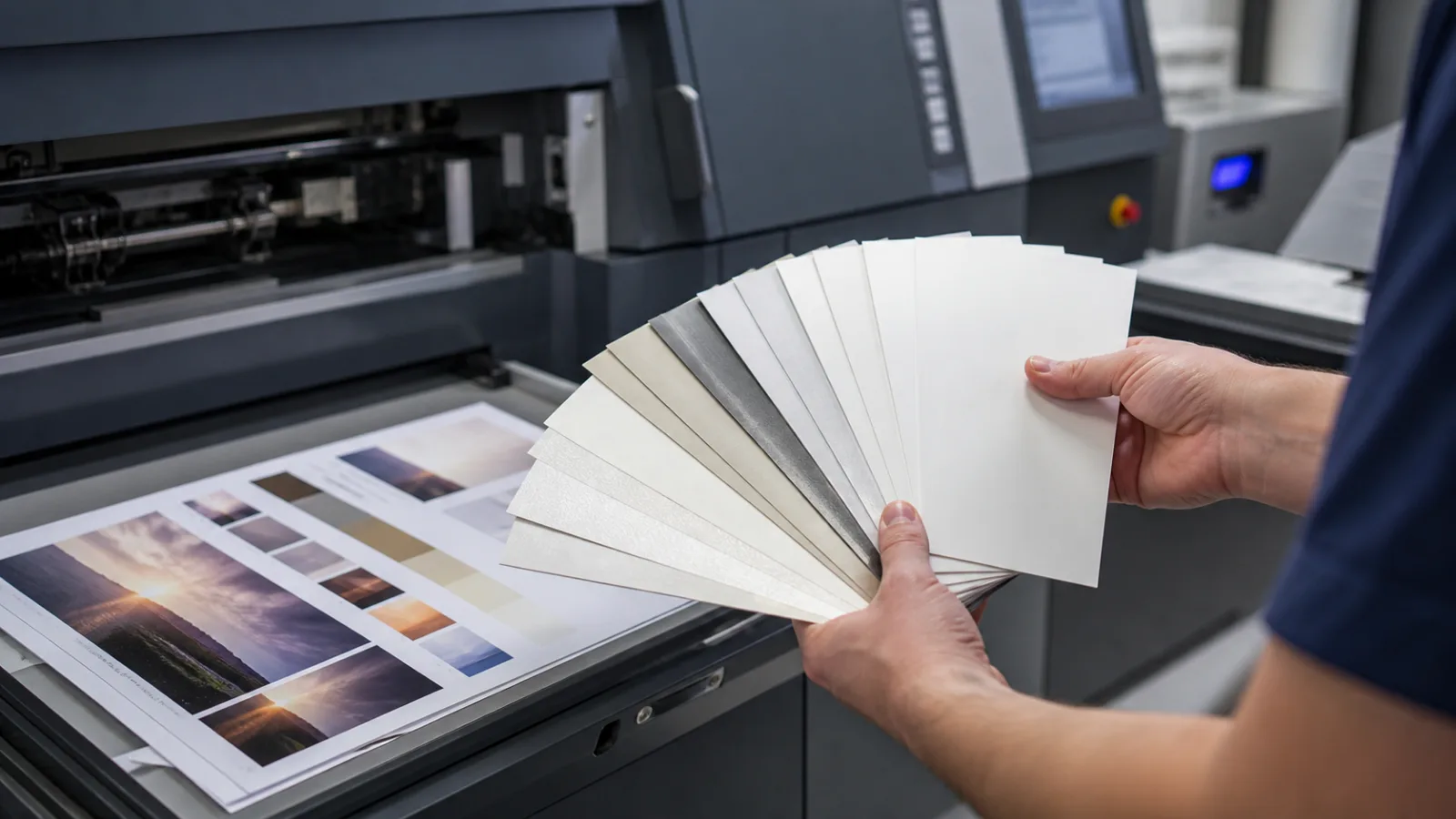
Build a trial set from both high-volume and difficult work. Include coated and uncoated papers, textured sheets, envelopes, synthetics or heat-sensitive materials only where those applications genuinely matter. For inkjet, confirm whether the paper requires a treated or inkjet-optimized surface. For toner, examine the effects of heat, pressure, static and fused toner on the sheet and later operations.
Evaluate representative customer files for:
- process-colour appearance and required colour tolerances;
- neutral greys, solids, gradients, fine type and reverses;
- spot-colour simulation or use of additional colour stations;
- duplex and image-to-cut registration;
- banding, mottling or screening artifacts;
- rub resistance, scuffing, cracking and blocking;
- curl, static, feeding and delivery condition;
- consistency through a realistic production quantity.
A qualified-media list is a starting point, not proof of acceptable print or finishing performance. Record the exact paper manufacturer, grade, finish, colour, caliper, grain direction and storage condition used in a trial.
Do not assume digital output will automatically match established offset work. Gamut, screening, gloss, solids, substrate appearance and metamerism can differ. Where both processes contribute to the same customer program, use agreed proofs or production samples and define what constitutes an acceptable match.
Map the workflow from file intake to dispatch
Eliminating plates does not eliminate production work. Digital printing can remove some physical setup while adding file handling, data preparation, software and quality-control tasks.
Document the current workflow from estimate to invoice. Mark every approval, queue, manual entry, file conversion, handoff and source of rework. Then map the proposed route through:
- estimating and order entry;
- customer file upload and preflight;
- imposition and colour management;
- variable-data composition and validation;
- raster image processing through the digital front end;
- job queuing and press operation;
- inspection, reconciliation and reprints;
- finishing, packing and dispatch;
- job costing and invoicing.
Confirm compatibility among the management information system, web-to-print platform, prepress software, digital front end, variable-data tools and finishing controls. A demonstration that begins with a prepared file at the press console does not test the full workflow.
Variable-data printing deserves particular scrutiny. The press may be able to change every impression, but the shop still needs a controlled process for receiving, validating, using, retaining and deleting customer data. Data protection, mailing and contractual requirements vary by jurisdiction and application; they cannot be inferred from the press’s variable-data capability.
Measure operator touch time and queue time during representative demonstrations or contract-production exercises where possible. Automation should be credited only when it removes a documented task rather than shifting that task to prepress, customer service or bindery.
Check finishing compatibility and end-to-end throughput
The print engine is only one stage of production. A fast digital press can leave the shop with a bindery bottleneck, especially when many short jobs require separate setups.
Compare output with existing guillotines, folders, stitchers, perfect binders, die cutters, laminators, coaters and mailing equipment. Check sheet format, lay orientation, grain direction, trim margins and the placement of control marks or barcodes.
Digital print surfaces can interact differently with folds, adhesives, laminates and coatings. Toner may crack at folds or affect adhesion under some conditions. Inkjet output may require sufficient drying or conditioning before finishing, depending on ink, coverage, paper and equipment. These are application-specific risks, not universal failures.
Conduct end-to-end trials that include printing, any required conditioning, cutting, folding, binding, coating, packing and realistic handling. Inspect for:
- cracked folds and disrupted image areas;
- scuffing, offsetting or blocking;
- curl and poor feeding into finishing equipment;
- laminate or adhesive failure;
- cutting, folding and binding registration;
- barcode readability after conversion;
- rework and spoilage at each stage.
Time the complete route, not just the press run. If finishing setup exceeds print time, grouping compatible jobs, using automated setup or selecting different finishing equipment may matter more than additional engine speed.
Use a gated approval process
Approve the investment only when each critical assumption has evidence behind it. A practical gate review should require:
- Named demand: documented applications, quantities, frequencies and turnaround requirements.
- An acceptable economic range: job-level crossover calculations under expected and lower-volume scenarios.
- Passed application trials: representative files, substrates, quantities and quality criteria.
- Verified integration: confirmed file, data, colour, queue and job-costing workflows.
- Finishing capacity: acceptable end-to-end throughput and converted-product performance.
- A staffing plan: named responsibility for operation, colour control, maintenance, scheduling, data preparation, inspection and escalation.
- Service terms: written coverage, response commitments, consumables, exclusions, software support and operator-maintenance duties.
- A suitable site: supplier-confirmed requirements for access, floor loading, electrical supply, networking, ventilation, temperature, humidity, paper storage and waste handling.
- A written acceptance test: agreed files, stocks, quantities, finishing routes, measurement methods and responsibility for correcting failures.
- An implementation schedule: installation, training, profiling, workflow testing, customer approvals and production transfer.
References from shops running comparable applications can help identify questions, but they do not guarantee equivalent results. Configuration, staff, environment, service support and job mix may differ.
Delay or reject the purchase when projected utilization depends on unsupported sales forecasts, critical substrates cannot pass trials, integration remains uncertain or finishing cannot absorb the proposed work. Continued outsourcing can provide additional demand evidence while preserving flexibility.
Frequently asked questions
Is there a standard run length at which digital becomes cheaper than offset?
No. Calculate the crossover for representative jobs using the shop’s plate, make-ready, waste, labour, running and finishing costs, then compare them with the proposed digital system’s impression or ink charges, service terms, labour and capital costs. Sheet size, imposition, coverage, substrate and utilization can materially change the result.
Should an offset shop choose toner or production inkjet?
Choose by application and workflow, not by technology label. Compare required format, monthly volume, media range, image characteristics, variable-data needs, finishing route, space, service support and total cost. Cut-sheet toner, cut-sheet inkjet and continuous-feed inkjet address different production profiles.
Can a digital production press match existing offset colour?
It may achieve an acceptable match for defined work, but this must be tested. Substrate, ink or toner set, colour management, screening, gloss and viewing conditions affect appearance. Establish agreed tolerances and approve representative samples, especially when offset and digital pieces will be viewed together.
What jobs should be used for a digital press acceptance test?
Use high-volume jobs and difficult jobs from the intended production mix. Include representative stocks, duplex work, solids, gradients, fine type, variable records and demanding finishing. Run realistic quantities through the complete workflow, then judge the finished product rather than an isolated press sheet.
The sound selection rule is bounded: add digital capacity only when a defined group of real jobs passes economic, print, workflow and finishing tests on the exact proposed system. Keep offset where its format, substrate range, appearance or run economics remain the better fit.
Sources
- Hybrid Print Workflow: Finding Your Offset-to-Digital Crossover Point
- Hybrid Offset & Digital Workflows: When to Mix Print Technologies
- Print Technology Decision Guide
- Analog vs. Digital Printing: Why Printers Choose Both
- How to Choose the Right Printing Solution - Pulsesoft | Your Tech Pipeline
- Investing in Digital Printing — Five Factors to Evaluate | Engineered Printing Solutions